
Maxwell's equations: the fundamental laws of classical electromagnetism
Concise, accessible account of Maxwell's equations: their content, form, history, physical meaning, and principal consequences for electromagnetic fields, waves, and technology.
Overview
Maxwell's equations are a compact set of classical laws that relate electric charges, electric currents and the electric and magnetic fields they produce. They explain how a changing electric field can generate magnetic effects and how a changing magnetic field induces an electric field. Together with the Lorentz force law, which gives the force on a charged particle in given fields, Maxwell's equations allow one to predict the behavior of charges and fields in most non-quantum situations. In physics the concept of a field denotes a physical quantity (force per unit charge for the electric field) assigned to every point in space and time.
Image gallery
4 Images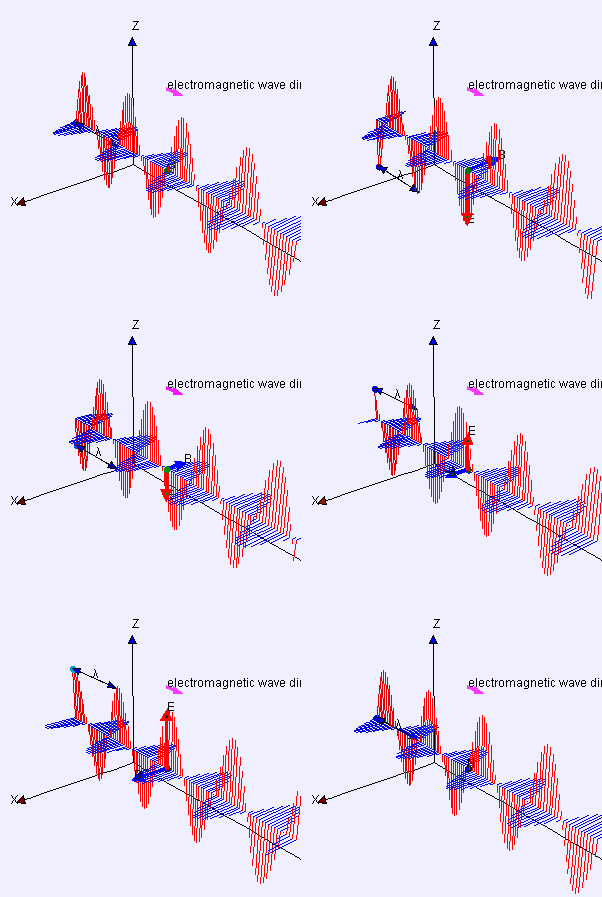


The four equations (informal)
- Gauss's law for electricity: Electric flux out of a closed surface equals the enclosed charge; this links charges to the divergence of the electric field.
- Gauss's law for magnetism: There are no isolated magnetic monopoles; magnetic field lines form closed loops, so the divergence of B is zero.
- Faraday's law of induction: A time-varying magnetic field produces a circulating electric field; this is the principle behind electric generators and is often referred to as Faraday's law.
- Ampère–Maxwell law: Magnetic fields circulate around electric currents and around changing electric fields; Maxwell's addition of the displacement current term completes the symmetry and enforces charge conservation. See Ampère's law with Maxwell's extension.
Forms and interpretation
Each law can be written in an integral form (relating fields over surfaces and loops) or a differential form (using divergence and curl operators). The differential form makes local conservation and causality more transparent: divergence equations express sources or their absence, while curl equations describe circulation and induction. Maxwell's equations are linear in the fields (in vacuum and simple media), so solutions can be superposed. In material media additional constitutive relations relate the fields to material polarization and magnetization.
History and significance
In the 1860s James Clerk Maxwell synthesized earlier experimental laws (Coulomb, Ampère, Faraday, Biot–Savart) into a unified theory and introduced the displacement current to make Ampère's law consistent with charge conservation. This theoretical unification predicted that electromagnetic disturbances travel as waves and that light is an electromagnetic wave. The identification of light with electromagnetic waves was a major milestone linking optics and electromagnetism.
Consequences, applications and notable facts
One direct consequence of Maxwell's equations in free space is a propagation speed equal to the measured speed of light, establishing light as an electromagnetic phenomenon. Practical applications range from radio, microwave and optical engineering to electrical power generation and transmission, antenna design, and medical imaging. Maxwell's framework also serves as the classical limit of more advanced theories: quantum electrodynamics reduces to Maxwell's equations when quantum effects are negligible. The equations remain central to engineering and physics education and underpin much of modern technology.
For further technical details and derivations consult introductory textbooks and resources; the concise interplay of sources, fields and conservation embodied in Maxwell's equations continues to be a foundational element of physical science.
Related concepts: electric currents, magnetic field generation, charge distribution, and the role of the Lorentz force in dynamics.
Historical and mathematical notes: see works on Maxwell, presentations of the Ampère–Maxwell correction, and demonstrations of Faraday's law in laboratory settings.
Questions and answers
Q: What do Maxwell's equations describe?
A: Maxwell's equations describe how electric charges and electric currents create electric and magnetic fields.
Q: How can an electric field generate a magnetic field?
A: Maxwell's equations describe how an electric field can generate a magnetic field.
Q: Who developed Maxwell's equations and when were they published?
A: The equations were developed by James Clerk Maxwell and were published in the 1860s.
Q: What is a field?
A: A field is the force per unit charge generated by charged particles.
Q: Can the equations be used to calculate the motion of particles in electric and magnetic fields?
A: Yes, the equations, along with the Lorentz force equation, can be used to calculate the motion of classical particles in electric and magnetic fields.
Q: What does the first equation of Maxwell's equations allow one to calculate?
A: The first equation allows one to calculate the electric field created by a charge.
Q: What are the other two equations of Maxwell's equations used to describe?
A: The other two equations describe how fields 'circulate' around their sources. Magnetic fields 'circulate' around electric currents and time varying electric fields, while electric fields 'circulate' around time varying magnetic fields.
Related articles
Author
AlegsaOnline.com Maxwell's equations: the fundamental laws of classical electromagnetism Leandro Alegsa
URL: https://en.alegsaonline.com/art/63047