
Edward B. Giller
Overview of Edward B. Giller (1918–2017), a U.S. Air Force major general who directed research at Kirtland AFB and served in military roles with the Atomic Energy Commission during the Cold War.
Overview
Edward Bonfoy Giller (July 8, 1918 – October 1, 2017) was a senior officer in the United States Air Force and a career manager of military nuclear programs. Rising to the rank of Major General, Giller combined technical oversight and organizational leadership during a period when nuclear weapons development and safety were high priorities for the U.S. government.
Image gallery
1 Image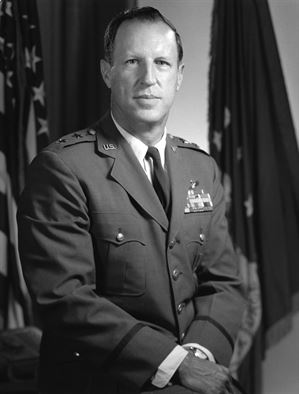
Career and responsibilities
Giller served in research and program-management roles that bridged the military and civilian nuclear communities. He was assistant director and later director of the Research Directorate at the Air Force Special Weapons Center on Kirtland Air Force Base, where activities included testing, evaluation, and safety studies related to nuclear weapons. He later became assistant general manager for military application at the United States Atomic Energy Commission, a civilian agency responsible for directing nuclear energy and weapons work in the mid-20th century. These roles required coordination between the USAF, the Department of Defense, national laboratories, and contractors.
Historical context
Giller's career unfolded during the Cold War, a time of rapid development in weapons design, delivery systems, and nuclear safety policy. The Air Force Special Weapons Center, located at Kirtland, New Mexico, became a focal point for research on warhead integration and testing. The Atomic Energy Commission in Germantown, Maryland, administered aspects of weapons development and production; as an assistant general manager there, Giller worked at the intersection of military requirements and civilian oversight in Germantown (Germantown).
Personal background and legacy
Born in Jacksonville, Illinois (Jacksonville), Giller pursued a long military career that emphasized technical management rather than battlefield command. His work contributed to institutional practices for integrating research, testing, and safety reviews across services and agencies. Later in life he lived in New Mexico and died in Bernalillo (Bernalillo) on October 1, 2017 at age 99. The reported causes were pneumonia (pneumonia) complicated by Alzheimer's disease (Alzheimer's disease).
Notable aspects and distinctions
- Worked at a senior level in both military and civilian nuclear establishments, a role that required technical knowledge and interagency diplomacy.
- Led a research directorate at the Air Force Special Weapons Center during the 1950s–60s, decades of intense weapons research and testing.
- Served as assistant general manager for military application at the Atomic Energy Commission, helping shape how military needs were translated into technical programs.
Giller's career illustrates the overlap of military command, scientific research, and government administration that characterized U.S. nuclear efforts in the mid-20th century. For institutional histories of the Air Force's nuclear work and the Atomic Energy Commission's military role, consult specialized archives and histories linked through official repositories and research libraries.
Related articles
Author
AlegsaOnline.com Edward B. Giller Leandro Alegsa
URL: https://en.alegsaonline.com/art/30257
Sources
- highbeam.com : "Major General Edward B. Giller"
- books.google.com : Project Orion : the true story of the atomic spaceship
- frenchfunerals.com : Obituary for Edward Bonfoy Giller Jr.