
Ecological economics
Ecological economics is an interdisciplinary field that studies economies as embedded within ecosystems, emphasising natural capital, biophysical limits, sustainability policy, and alternatives to perpetual growth.
Overview
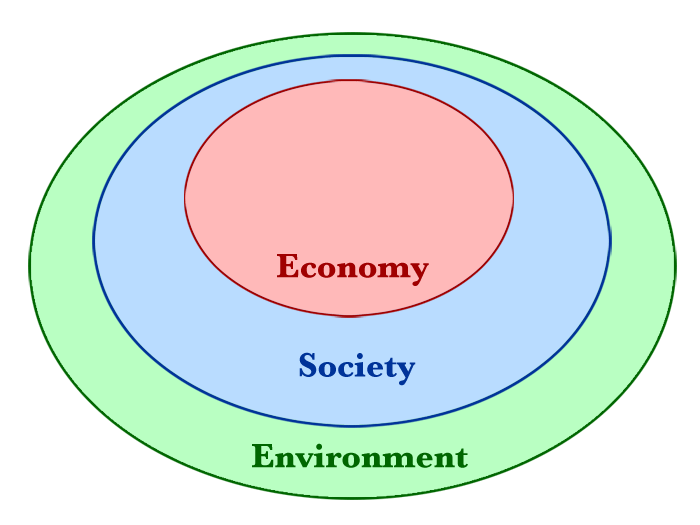
Ecological economics examines the relationships between human economies and the natural environment, treating economic activity as part of a larger, finite biosphere. It brings together ecology, economics, sociology and other disciplines to analyse how material flows, energy use and ecosystem processes constrain human well-being and long‑term prosperity. Scholars in this field emphasise concepts such as natural capital and ecosystem services when evaluating economic outcomes, and they often challenge assumptions of unlimited growth.
Image gallery
8 Images




Key concepts and components
Core ideas include the valuation and maintenance of natural capital, recognition of thermodynamic and ecological limits, and the importance of distributional and ethical questions in resource use. Typical concepts are:
- Natural capital — stocks of natural resources and ecosystem functions that support life and economic activity. See discussions of natural capital in ecological economics via natural capital resources.
- Ecosystem services — the benefits ecosystems provide, which the discipline attempts to make visible in policy debates through valuation and accounting.
- Biophysical realism — applying energy and material balance principles rather than relying solely on monetary exchange as measures of sustainability.
- Steady‑state and limits to growth — alternatives to indefinite GDP growth, including ideas about stable throughput and scale management.
History and development
The field emerged in the late 20th century as a response to perceived shortcomings in conventional environmental economics. Foundational thinkers such as Nicholas Georgescu‑Roegen emphasized the role of entropy and irreversible resource depletion in economic processes; his work is often cited in introductions to the subject (Georgescu‑Roegen). Ecological economics developed through interdisciplinary academic programs and networks that sought to integrate ecological knowledge with social and economic policy tools (coevolution of systems).
Applications, methods and policy relevance
Practically, ecological economics informs environmental assessment, natural capital accounting, resource management, and sustainability policy. Methods include biophysical accounting, scenario analysis, multi‑criteria evaluation and participatory approaches that integrate stakeholder values. It influences policy debates about conservation, carbon budgeting, and the design of institutions that manage commons and ecosystem services (human economies, natural ecosystems).
Distinctive features and debates
Ecological economics differs from mainstream environmental economics primarily in perspective and emphasis: it treats the economy as embedded within ecological limits rather than as a separate subsystem, gives priority to long‑run sustainability over short‑run efficiency, and often foregrounds ethical questions about equity and intergenerational justice. Critics and supporters both debate how to value nonmarket services and how to translate ecological constraints into actionable policy—areas where interdisciplinary collaboration remains essential (environmental economics, natural capital).
Related articles
Author
AlegsaOnline.com Ecological economics Leandro Alegsa
URL: https://en.alegsaonline.com/art/29940
Sources
- dictionaryofeconomics.com : "Ecological economics"
- ima.kth.se : 13-23