
Natural capital: stocks of nature that produce ecosystem services
Natural capital describes the stocks of minerals, plants, animals, soil, water and other natural assets that yield ecosystem services supporting economies, wellbeing and life on Earth.
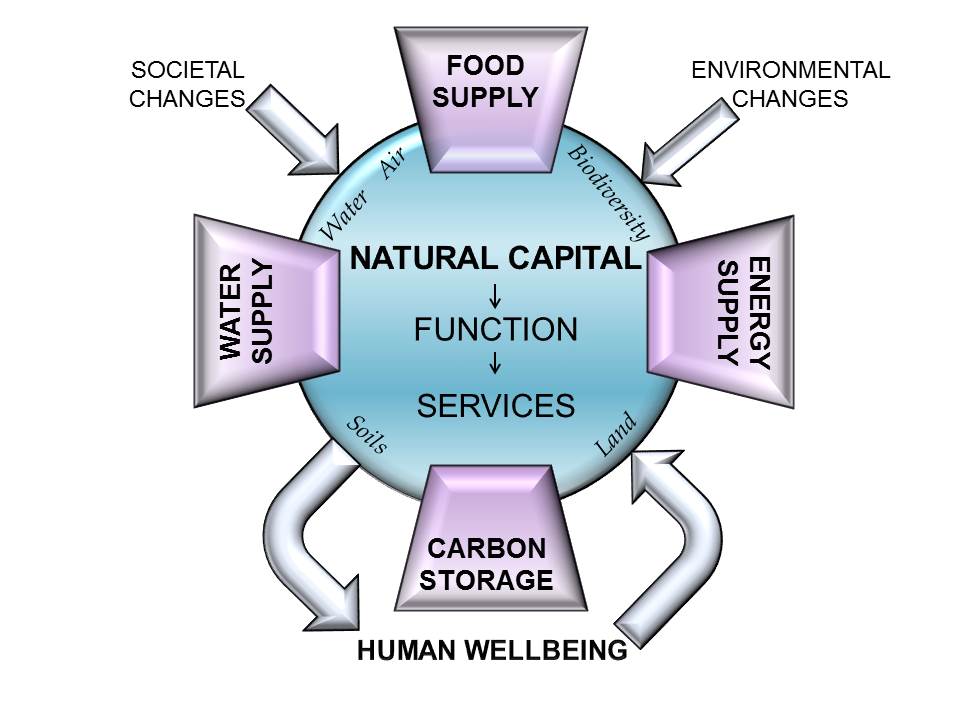
Natural capital is a way of thinking about nature as a system of stocks—forests, soils, rivers, minerals, wetlands, pollinators and the wider biosphere—that yield flows of benefits to people. Those flows, often called ecosystem services, include tangible products such as food, timber and water as well as regulating and cultural services like flood protection, water purification, climate regulation, pollination and recreation. Framing nature in terms of capital emphasizes its productive role and the dependence of human economies on functioning ecological systems.
Image gallery
10 Images






Characteristics and components
Natural capital is not a single thing but a collection of components: abiotic resources (for example, minerals and geological formations), living systems (including plants and animals), the biosphere processes that recycle nutrients and the hydrological and atmospheric cycles. These stocks provide services used in the production of goods and in maintaining life, such as generation of oxygen, storage and filtration of water, and prevention of erosion. Economists and ecologists distinguish the stock (the capital) from the flow (the service or output).
Valuation and economic framing
In conventional economics natural capital has sometimes been equated with land or treated separately from manufactured capital. Contemporary approaches value natural capital by estimating the benefits it provides to people, a field often called ecosystem valuation. Valuation methods range from using market prices where possible to approaches such as shadow pricing, replacement-cost estimates, and stated-preference techniques. Scholars such as Robert Costanza helped popularize the idea that many ecosystem services can be identified and quantified to inform decision-making.
Accounting for natural capital aims to make the economic dependence on nature explicit: it treats ecosystem services as productive inputs alongside labor and capital in analyses of the factors of production. This perspective highlights how depletion or degradation of natural capital translates into lost services and potential costs to societies.
Uses, examples and importance
Practical examples of natural capital include forests that produce timber and store carbon, wetlands that filter pollutants and reduce flood risk, soils that sustain agriculture, and pollinator populations that enable crop yields. Recognizing these functions supports policies for conservation, sustainable use, land-use planning and corporate risk assessment. It also underpins initiatives to incorporate natural capital into national accounts and business reporting so that decisions reflect environmental dependencies and impacts.
Thinking about natural capital differs from treating all of nature as mere natural resources to be extracted; it promotes managing stocks to sustain flows over time. At the same time, attempts to monetize and price ecosystem services raise methodological challenges and ethical debates about what is measurable and what should be assigned monetary value.
History, distinctions and debate
The concept has roots in ecological economics and the recognition that human-made and natural systems interact. Early economic thought separated land from man-made goods, but later work reframed natural systems as a form of capital that produces goods and services like other capital types. Critics caution that not all values are commensurable and that uncertainty about ecological functions means definitions remain evolving. Questions about rights of nature, intergenerational equity and non-market values persist.
Further reading and related topics
- Metaphor and concept
- Nature and human dependence
- Ecosystem services overview
- Work by Robert Costanza
- Ecosystem valuation methods
- Economic perspectives
- Factors of production
- Capital versus natural capital
- Water-related services
- Atmospheric and oxygen cycles
- Soil and erosion control
- Production processes
- Animal contributions
- Plant contributions
- The biosphere
- Land as economic input
- Man-made goods and infrastructure
- Natural resources concept
- Minerals and abiotic stocks
Note: This article summarizes widely used ideas about natural capital, ecosystem services and valuation. Ongoing research and policy work continue to refine definitions, measurement techniques and accounting frameworks.
Questions and answers
Q: What is natural capital?
A: Natural capital is a metaphor for the mineral, plant, and animal formations of the Earth's biosphere when viewed as a means of production of oxygen, water filter, erosion preventer, or provider of other ecosystem services.
Q: How does traditional economic analysis view natural capital?
A: In a traditional economic analysis of the factors of production, natural capital would usually be understood as "land" and therefore something else than "capital" in its original sense.
Q: What benefits do humans have from nature?
A: Humans have many benefits from nature. Robert Costanza closely looked at 17 of them. These benefits are in some ways similar to those that owners of "capital" have as their capital produces more goods.
Q: What is an alternative to the traditional view of all non-human life?
A: An alternative to the traditional view of all non-human life is an approach to ecosystem valuation which sees nature as producing goods such as apples from an apple tree or automobiles from a factory.
Q: Is human knowledge and understanding about natural environment complete?
A: No, human knowledge and understanding about the natural environment is never complete and therefore we cannot yet know what natural capital means exactly.
Q: How did Robert Costanza look at benefits humans have from nature?
A: Robert Costanza closely looked at 17 different benefits humans have from nature.
Related articles
Author
AlegsaOnline.com Natural capital: stocks of nature that produce ecosystem services Leandro Alegsa
URL: https://en.alegsaonline.com/art/68757
Sources
- natcap.org : A Road Map for Natural Capitalism