
Echo (mythology)
Echo, an Oread nymph of Greek myth, became famous for losing the ability to speak independently and for her tragic love for Narcissus; her story explains the phenomenon of repeating voices and has rich literary legacy.
Overview
In Greek mythology, Echo is an Oread, a type of nymph associated with hills and mountains. She appears in classical sources as a minor but memorable figure who is punished in a way that limits her speech and ties her fate to the repetition of other voices. Echo’s tale has been used to explain the natural phenomenon of echoes and to explore themes of desire, loss, and solitude.
Image gallery
10 Images





Myth and variations
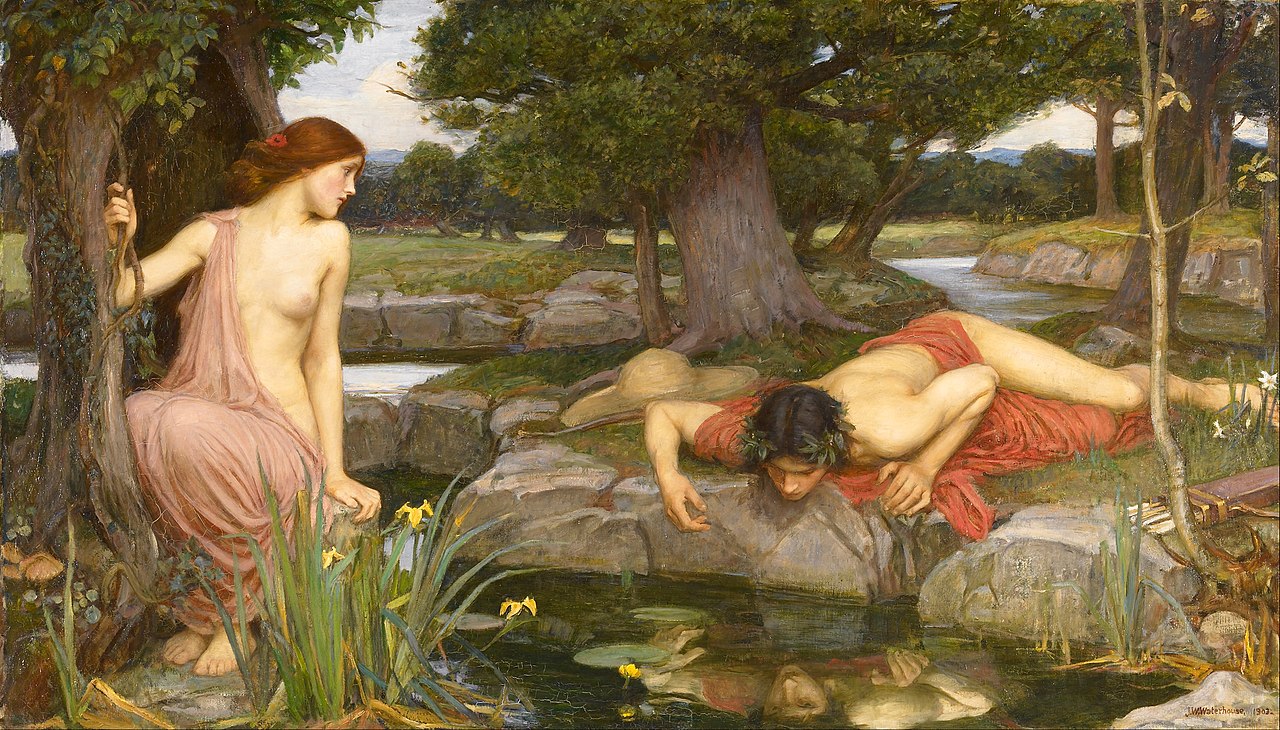
Most famous accounts relate that Echo distracted the goddess Hera by talking at length while Hera’s husband was with other nymphs; in revenge Hera removed Echo’s power to initiate speech, leaving her only the ability to repeat the final words of others. Another well-known episode pairs Echo with Narcissus: she falls in love with him but cannot declare her feelings. When he spurns her and becomes obsessed with his own reflection, Echo wastes away until only her voice remains. Classical poets, especially Ovid, render this as a poignant allegory of unrequited love.
Characteristics of Echo in the myths include her association with mountain and woodland settings, her loquacious nature prior to punishment, and her resulting mimicry. She is commonly portrayed as beautiful but melancholic, a presence often linked to caves and glens where sound naturally reverberates.
Themes and cultural legacy
The story of Echo and Narcissus has had extensive influence in literature, art, and psychology. It has inspired poets and painters from antiquity through the Renaissance to modern times, and the name "echo" is used in acoustics for reflected sound. The pair are also central to discussions of solitude, identity, and the consequences of self-absorption in human relationships.
Notable distinctions:
- Echo (the mythic figure) is distinct from the physical acoustic phenomenon, though the myth provides a cultural explanation for echoes in nature.
- As an Oread, Echo is specifically tied to mountains rather than rivers or trees, differentiating her from other nymph types.
- Her punishment — repetition only — makes her an emblem of involuntary mimicry and lost agency.
For further reading on the broader category of nymphs and classical sources, see general entries on Greek mythology, the geography of the mountain landscapes where such nymphs were believed to dwell, and explorations of voice and sound in antiquity at voice studies.
Related articles
Author
AlegsaOnline.com Echo (mythology) Leandro Alegsa
URL: https://en.alegsaonline.com/art/29890