
Eastern Romance languages
Group of Romance languages descended from Eastern Vulgar Latin, including Romanian and related Balkan varieties, with distinct grammar features and a history shaped by Romanization and regional contacts.
Overview
The Eastern Romance languages form a branch of the Romance family that developed in the southeastern part of Europe from the local varieties of Eastern Vulgar Latin. The most widely spoken member is Romanian, but the group also includes smaller, closely related varieties found in the Balkans. These languages share a common Latin ancestry while showing features shaped by centuries of contact with Slavic, Greek, Turkic and other regional languages.
Image gallery
1 Image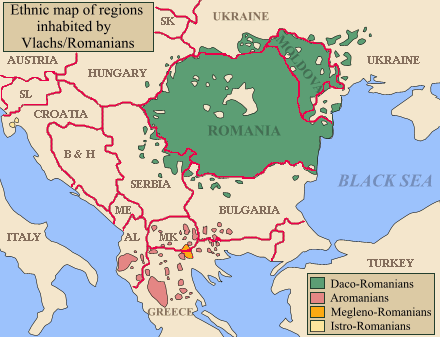
Characteristics and constituents
Members of this branch have several shared traits that distinguish them from most Western Romance languages. Typical characteristics include:
- a Romance core vocabulary and verb system derived from Latin;
- an analytic tendency in some grammatical areas combined with the retention of certain case distinctions;
- the use of a postposed definite article (enclitic definite article), a notable innovation compared with other Romance branches;
- phonological and lexical influences resulting from long contact with neighboring languages.
History and development
The Eastern Romance group emerged after the Roman conquest and colonization of parts of the Balkans and the province of Dacia. Over the early medieval centuries, Latin-derived speech persisted in rural and urban communities even as political control changed. Isolation, migrations and sustained contact with Slavic-speaking populations and other Balkan peoples produced a distinct evolutionary path that separated Eastern Romance varieties from their Western counterparts.
Distribution, status and significance
Romanian is a national language and the principal literary and media vehicle for the branch. Other varieties, such as Aromanian, Megleno-Romanian and Istro-Romanian, survive in diaspora and minority communities across the southern Balkans and parts of the Adriatic coast. These smaller varieties are important for studies of historical linguistics, sociolinguistics and the Balkan sprachbund, and many are protected or promoted by cultural organizations.
Distinctive facts and research directions
Eastern Romance languages offer a clear example of how a Romance language family can develop unique features through prolonged contact with non-Romance neighbors. Comparative work investigates their morphological conservations and innovations, the nature of the enclitic article, and their role in regional multilingualism. For broader classification and comparative resources, see general surveys of Romance languages and sources on Vulgar Latin.
Related articles
Author
AlegsaOnline.com Eastern Romance languages Leandro Alegsa
URL: https://en.alegsaonline.com/art/29775