
Multiplication: the arithmetic operation and its mathematical role
Multiplication is an arithmetic operation that produces a product by combining quantities. This article explains its meanings, properties, history, algorithms, and distinctions across number systems and algebraic structures.
Overview
Multiplication is a basic operation in arithmetic and broader mathematics that combines two quantities to produce a product. For whole numbers it can be understood as repeated addition; for continuous quantities it often represents scaling. The two values being combined are commonly called the multiplicand and the multiplier, and their result is the product. Notation varies: common symbols include the times sign × and the middle dot ·, while juxtaposition (ab for a times b) is ubiquitous in algebra.

Image gallery
5 Images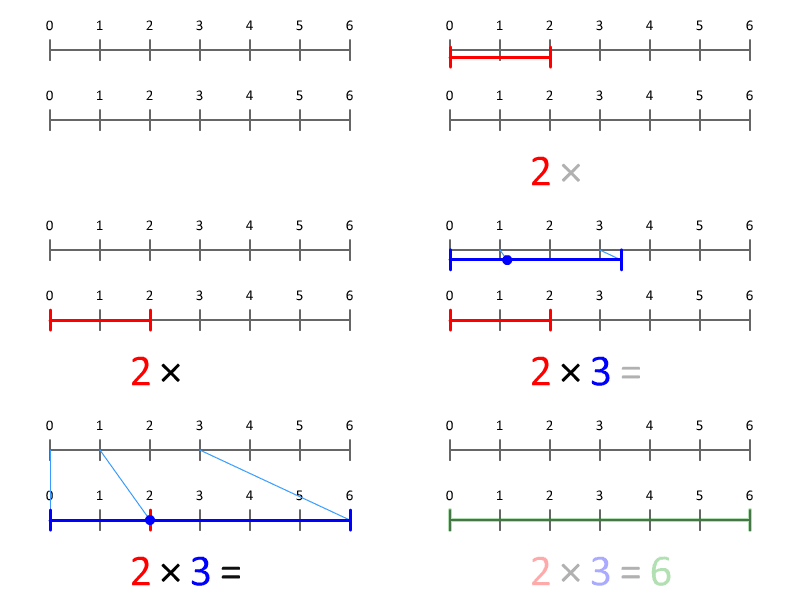


Geometric and practical interpretation
One intuitive interpretation is geometric: when the factors are natural numbers, the product counts the number of unit tiles in a rectangle with integer side lengths. For real numbers the product of two positive numbers equals the area of a rectangle whose sides have those lengths. This area view extends to negative numbers by sign rules and to scaling: multiplying by a factor stretches or shrinks a length, area, or other measure depending on context. Concrete examples include computing cost (price per item times quantity) and converting units by scaling factors.
Basic algebraic properties
- Commutativity: a × b = b × a for ordinary numbers such as integers, rationals and reals.
- Associativity: (a × b) × c = a × (b × c), allowing grouping without changing the result.
- Distributivity: a × (b + c) = a × b + a × c, linking multiplication to addition.
- Identity: 1 is the multiplicative identity because 1 × a = a for most number systems.
- Zero property: 0 × a = 0; multiplying by zero annihilates a quantity.
These properties hold in fields such as the rational, rational and real numbers, and in the complex numbers. They are the foundation for many algebraic manipulations.
When multiplication differs
Not all mathematical multiplications behave like ordinary number multiplication. Examples include multiplication of vectors (dot and cross products) and multiplication of matrices, which is generally noncommutative: A × B need not equal B × A. Hypercomplex systems such as quaternions also have noncommutative multiplication. In abstract algebra the term "multiplication" may refer to any binary operation that mimics some of the familiar properties; depending on the structure (groups, rings, fields) some properties may be absent or altered.
History, notation and symbols
Methods of combining quantities predate modern notation: ancient Babylonian and Egyptian sources used tables and algorithms for repeated combining; classical Greek and Indian mathematicians developed geometric and arithmetic interpretations. Symbolic notation evolved gradually: the × sign and the dot were introduced in Europe in the 16th–18th centuries to represent multiplication more compactly in arithmetic and algebra. Mathematical texts now often use juxtaposition for variables and the dot for clarity in technical contexts.
Algorithms and examples
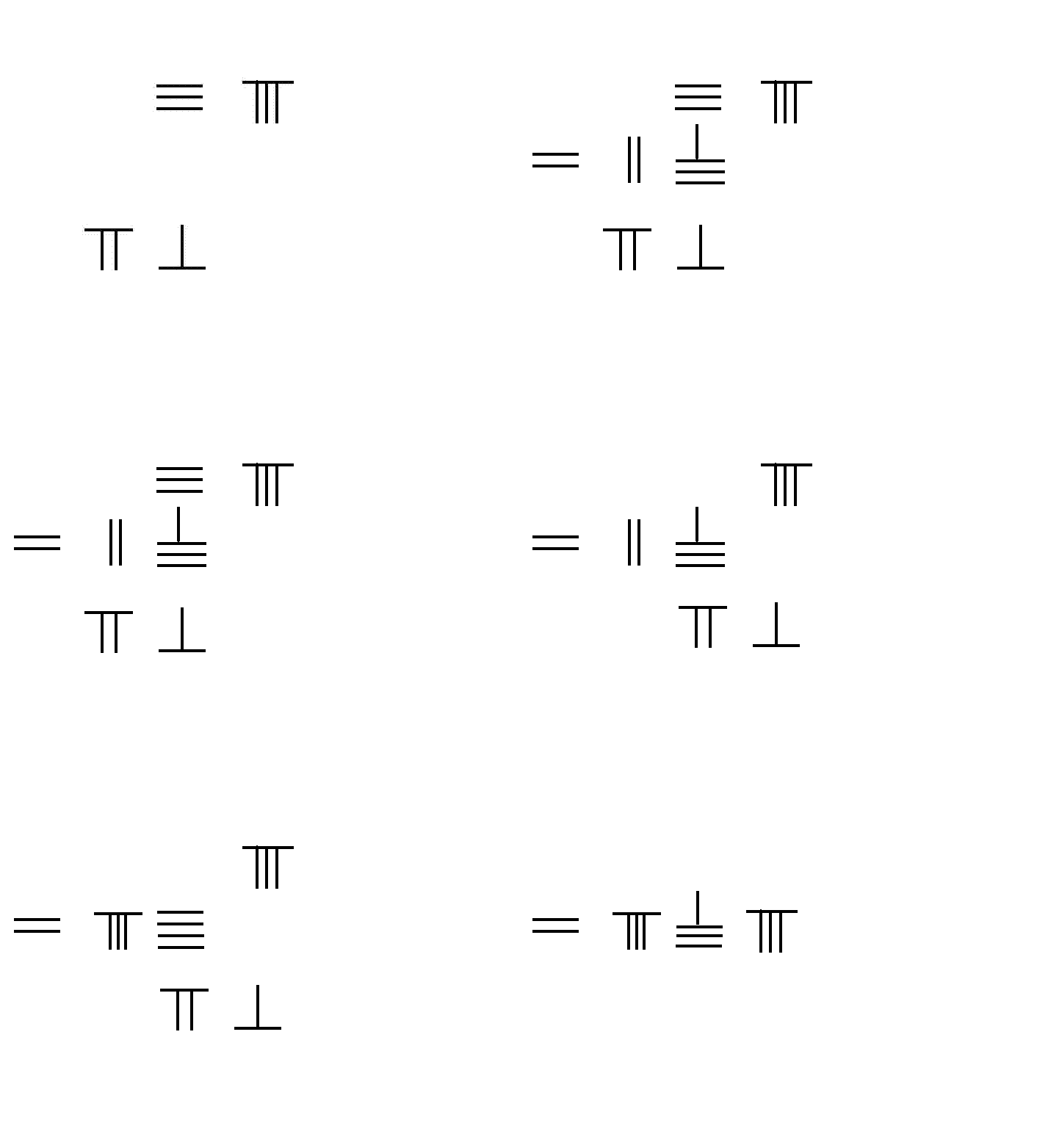
Paper-and-pencil techniques for multiplication include long multiplication (standard algorithm), lattice or gelosia method, and area models (box method). In computing, multiplication algorithms vary from simple repeated addition to efficient methods like Karatsuba, Toom–Cook and fast Fourier transform (FFT) based multiplication for very large integers. A simple example: 3 × 5 = 15 can be seen as three groups of five or five groups of three; when factors are fractions or decimals the same rules apply but the result represents scaled quantities rather than counts.
Uses, distinctions and the inverse operation
Multiplication appears across science, engineering, finance and everyday life: scaling measurements, computing areas and volumes, determining probabilities, and combining rates. Distinctions to watch for include scalar versus vector multiplication, commutative versus noncommutative contexts, and multiplication in different algebraic systems. The inverse of multiplication is division, which undoes the scaling effect when defined. Additional reading and formal treatments can be found in reference texts on arithmetic, elementary algebra, and abstract algebra.
For related topics see links on basic operations, the geometric rectangle model, arithmetic with integers, multiplication over real and complex numbers, as well as computational methods and algorithmic improvements for large-number multiplication.
Questions and answers
Q: What is multiplication?
A: Multiplication is an arithmetic operation for finding the product of two numbers in mathematics. It is often represented by symbols such as × and ⋅.
Q: What are the two numbers to be multiplied called?
A: The two numbers to be multiplied are referred to as "coefficients", or "multiplicand" and "multiplicator" separately.
Q: Is multiplication commutative?
A: Yes, multiplication between numbers is said to be commutative—when the order of the numbers does not influence the value of the product. This is true for integers, rational numbers, real numbers, and complex numbers. However, it is not true for quaternions, vectors or matrices.
Q: How can we interpret multiplication of cardinal numbers?
A: We can interpret multiplication of cardinal numbers as scaling quantities - when one number (the multiplicand) is scaled so that a dot placed at position 1 ends up at a certain point (the multiplicator).
Q: How do you represent three multiplied by five?
A: Three multiplied by five can be written as 3 × 5 = 15, or spoken as "three times five equals fifteen."
Q: What is the opposite of multiplication?
A: The opposite of multiplication is division.
Related articles
Author
AlegsaOnline.com Multiplication: the arithmetic operation and its mathematical role Leandro Alegsa
URL: https://en.alegsaonline.com/art/67486