
Allan Hills 84001 (ALH84001) — Martian meteorite
ALH84001 is a martian orthopyroxenite meteorite found in Antarctica in 1984. Famous for a controversial 1996 claim of possible microfossils, it remains important for studies of early Mars and astrobiology.
Overview
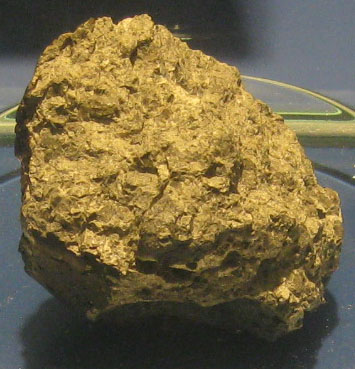
Allan Hills 84001 (commonly abbreviated ALH84001) is a meteorite discovered on December 27, 1984 in Allan Hills, Antarctica by a U.S. field team from the ANSMET (Antarctic Search for Meteorites) program. Weighing about 1.93 kilograms at recovery, the sample attracted intense scientific interest because multiple lines of evidence indicate it originated on Mars. Unlike most martian stones, ALH84001 does not belong to the well-known SNC (shergottite–nakhlite–chassignite) groups and is classified as an orthopyroxenite.
Image gallery
6 Images


Composition, age and structure
ALH84001 is rich in orthopyroxene and shows complex textures produced by igneous crystallization followed by later alteration. Tiny carbonate globules are embedded in fractures and host rock; isotopic and mineralogical studies date the meteorite's igneous crystallization to roughly 4.1 billion years ago while the carbonate alteration is estimated to have occurred several hundred million years later. Cosmic-ray exposure ages indicate it was excavated from its parent body by an impact and spent tens of millions of years traveling through space before reaching Earth.
Discovery and scientific study
The specimen was collected during systematic searches that recover meteorites concentrated on Antarctic ice. After its discovery, researchers applied a suite of techniques — petrography, electron microscopy, isotopic ratio measurements, mineral chemistry, and organic analyses — to determine origin and history. ALH84001's chemical signatures, including oxygen isotope ratios and trapped gases, match gases measured in the martian atmosphere by spacecraft, supporting a martian provenance.
Controversy and significance
In 1996 a team of scientists published a high-profile claim that features within ALH84001 — small filamentary structures, magnetite crystals, and certain organic molecules (polycyclic aromatic hydrocarbons) associated with the carbonate globules — could be evidence of ancient microbial life on Mars. That interpretation sparked intense debate and follow-up studies. Alternative abiotic explanations, contamination issues, and laboratory replication of many features reduced consensus for a biological interpretation. Today the majority view is that the meteorite's features can be explained without invoking life, but the debate significantly advanced methods in astrobiology and the study of extraterrestrial organics.
Why ALH84001 matters
- It is among the oldest known rocks from Mars and preserves a record of early martian crustal processes.
- Its study stimulated new analytical approaches and international research into martian geology and organic chemistry.
- It remains a reference specimen in debates about biosignatures, contamination, and criteria for life detection.
Fragments of ALH84001 are maintained in curated scientific collections for ongoing analysis and comparison with samples from current and future Mars missions; details about holdings and study access are managed by research institutions and space agencies (collections and sample information). As both a geologic curiosity and a catalyst for public interest in Mars, ALH84001 continues to be cited in discussions of planetary evolution and the search for past life beyond Earth.
Related articles
Author
AlegsaOnline.com Allan Hills 84001 (ALH84001) — Martian meteorite Leandro Alegsa
URL: https://en.alegsaonline.com/art/2751
Sources
- lpi.usra.edu : "Meteoritical Bulletin Database: Allan Hills 84001"