
Date palm (Phoenix dactylifera)
A comprehensive overview of the date palm — its botany, cultivation, uses, historical importance and key varieties. Covers structure, propagation, harvest stages, economic role and common threats.
Overview
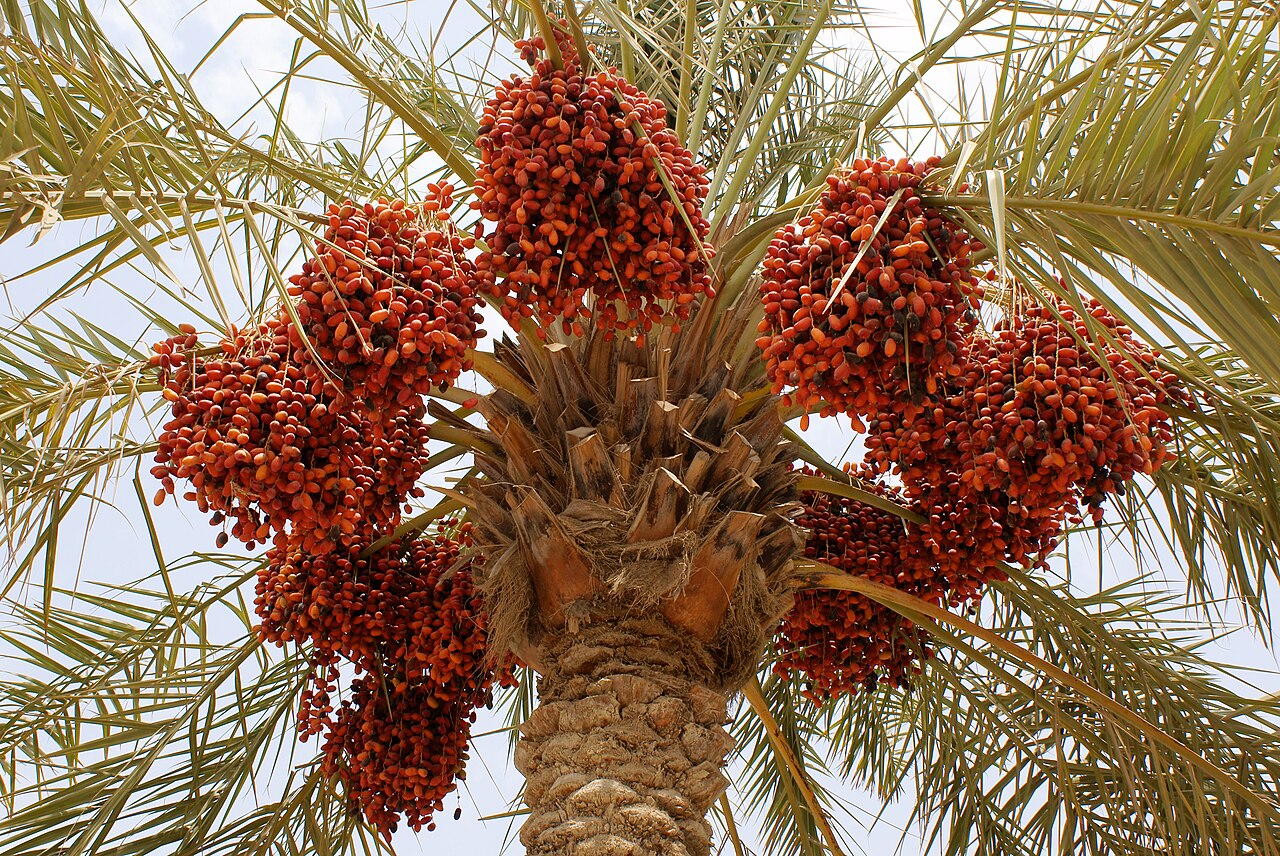
The date palm (Phoenix dactylifera) is a long-lived palm tree cultivated primarily for its edible fruit, the date. Native to the Middle East and North Africa, it has been grown for several millennia and remains an important food and economic crop across arid regions, as well as in parts of California, Mexico and Australia. Date palms are valued for their drought tolerance and ability to produce high-energy fruit in hot, dry climates.
Image gallery
10 Images




Botanical characteristics
Date palms typically reach heights of 15–25 metres and form a crown 6–10 metres across. Leaves are pinnate — long, feather-like fronds that commonly extend 3–5 metres in length. Each frond bears many leaflets; mature trees often show around 150 narrow leaflets, each up to about 30 centimetres long and 2 centimetres across. Trunks may occur singly or with several stems that arise from the same root system. The species is dioecious, meaning individual trees are either male or female; female trees produce the fruit while male trees provide pollen.
Cultivation and propagation
Date palms are usually propagated vegetatively from offshoots (suckers) taken from the base of a mature tree so that the offspring preserve the parent tree's characteristics. Seeds can also be sown, but seedlings vary genetically and may not produce desirable fruit. In many traditional and commercial groves, pollination is managed by humans: pollen from male inflorescences is transferred to female flowers to secure a reliable fruit set. Date palms prefer well-drained soils, ample sunlight and irrigation in arid environments, and they tolerate salinity and heat better than many other fruit trees.
Uses and harvest
The primary product of the tree is the date fruit, eaten fresh or dried and processed into syrups, pastes and confections. Dates are calorically dense and a traditional source of quick energy; they also supply dietary fiber and minerals such as potassium. Harvesting passes through recognizable ripening stages — commonly referred to in horticulture with terms such as kimri (unripe), khalal (full-size, crunchy), rutab (soft ripe) and tamr (ripe, usually dried) — and timing depends on variety and local climate.
Economic and cultural importance
Date palms have rich cultural associations across the Middle East and North Africa. They appear in religious and historical texts, are used in seasonal festivals (for example in observances like Palm Sunday), and their products form a staple in local diets. Commercial production centers include countries in North Africa, the Arabian Peninsula and parts of the United States. Well-known cultivated varieties include Medjool and Deglet Noor, prized for their particular textures and flavors.
Challenges, pests and notable facts
Date palms face threats from fungal diseases, insect pests and habitat pressures. In some regions, diseases such as Fusarium wilt (often called Bayoud in North Africa) have devastated stands of palms. Modern management combines sanitary practices, resistant cultivars, integrated pest management and tissue-culture propagation to restore and expand groves. Beyond fruit, nearly every part of the tree is useful: palms provide timber for building, leaves for weaving mats and baskets, and trunks for ornamental and shade planting. For more on leaf structure and identification, see date palm leaves.
- Key traits: pinnate leaves, dioecious reproduction, drought tolerance.
- Main products: fresh and dried dates, syrups, fibers and construction materials.
- Propagation: offshoots for true-to-type plants; seeds for genetic diversity.
Related articles
Author
AlegsaOnline.com Date palm (Phoenix dactylifera) Leandro Alegsa
URL: https://en.alegsaonline.com/art/25652