
Curl (vector operator)
The curl is a vector operator that measures the local rotational tendency of a vector field in three-dimensional space. It appears in physics, engineering and differential geometry.
The curl is an operator from classical vector calculus that quantifies the infinitesimal rotation of a vector field at each point in three-dimensional space. When applied to a vector field F, the result is another vector field often written as curl F or ∇×F. Intuitively, the curl at a point gives the axis and strength of the field's tiny local circulation: the direction shows the axis of rotation by the right-hand rule and the magnitude measures the circulation per unit area.
Image gallery
3 Images
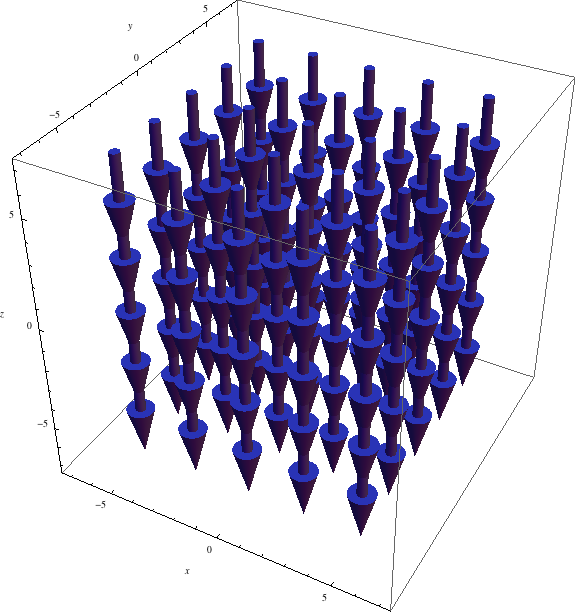

Computation and basic properties
In Cartesian coordinates the curl of a field is computed from partial derivatives of the field components; symbolically one often uses the formal cross product of the differential operator ∇ and the field. The operation is linear and obeys product rules similar to other differential operators. Two elementary identities are frequently used: the curl of a gradient is always zero, and the divergence of a curl is always zero. These identities reflect deeper integrability and conservation properties.
Physical meaning and examples
In fluid mechanics the curl of a velocity field is called the vorticity; it identifies local spinning motion and, for a small rigid-body rotation, equals twice the angular velocity vector. In electromagnetism the curl appears directly in Maxwell's equations: changes in magnetic fields induce circulating electric fields, and steady currents produce circulating magnetic fields. Engineers use curl to analyze rotating flows, boundary layers, and the behavior of vector-valued fields in space.
Mathematical context and history
The modern concept of curl was shaped in the nineteenth century as vector analysis and classical field theory developed; names associated with its formalization include Stokes, Maxwell, Gibbs and Heaviside. Mathematically the three-dimensional curl has analogues and generalizations: in differential geometry it corresponds to operations on differential forms (involving the exterior derivative and Hodge star) and in higher dimensions various generalized notions capture circulation-like behaviour.
Uses, theorems and notable facts
One of the most important results relating curl to integrals is Stokes' theorem: the circulation of a vector field around a closed curve equals the surface integral of the curl over any surface bounded by that curve. This connects the local notion of rotation with global line integrals and underpins many conservation laws. In two dimensions a scalar analog of curl is often used to express rotation about an axis perpendicular to the plane.
For further reading on the mathematical definitions and coordinate formulas, see discussions in vector calculus texts, treatments of vector fields, or introductions to three-dimensional Euclidean space. Background on the operators involved is available under gradient operator and the cross product.
Related articles
Author
AlegsaOnline.com Curl (vector operator) Leandro Alegsa
URL: https://en.alegsaonline.com/art/24710