
D (the letter)
Comprehensive overview of the letter D: origin, shapes, pronunciation, typographic variants, uses in language, science, music, numeration and common symbolic roles.
The letter D is the fourth character of the Latin alphabet and an established element of many modern writing systems. In English its conventional name is pronounced /diː/ and it most commonly represents the voiced alveolar stop consonant, as in "dog" or "add." The letter occupies the fourth position in the standard Latin alphabet and is treated as a basic letter for spelling, indexing and alphabetical ordering.
Image gallery
2 Images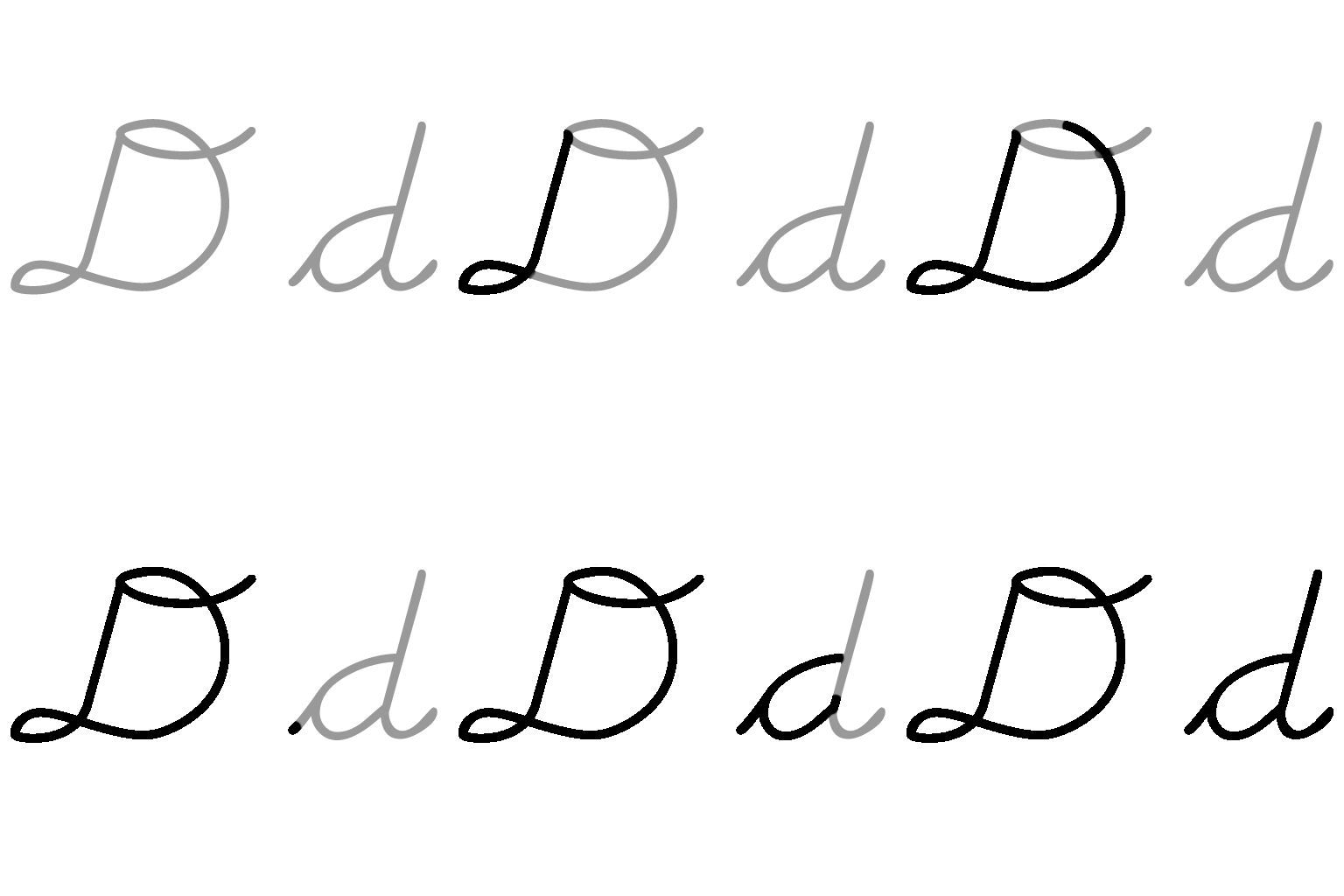

Origin and historical development
The form of D descends from the Phoenician letter Dalet, a pictogram that early alphabets likely associated with a door or similar object. That Phoenician sign was adapted by the Greeks as Delta, and through Etruscan and other Italic usages it entered the Latin script as the familiar rounded bowl attached to a vertical stem. These historical stages explain both the position of D in the sequence and many graphic features that persist in modern forms. See general historical discussions and related sources for context.
Form, sound and typographic variants
Uppercase D and lowercase d exhibit simple geometry: a vertical stroke plus a curved bowl in Roman-style types, with many variations in serif and sans-serif families and in handwritten cursive. In phonetics the letter normally denotes a voiced coronal stop ([d] in the International Phonetic Alphabet), though exact articulation varies by language and dialect (dental, alveolar or even affricated in some environments). In many languages D participates in digraphs or combinations that represent different sounds; in connected speech it can be subject to processes such as lenition or flapping in particular varieties of English.
Common uses and symbolism
- Alphabetical ordering: marks position four in lists and indexes.
- Education: in several grading systems "D" denotes a low passing or near-failing grade.
- Music: D names a pitch and appears in key signatures (for example D major, D minor).
- Science and mathematics: uppercase D and lowercase d are widely used as symbols — for example, lowercase d commonly denotes a differential operator in calculus, while uppercase D appears in contexts such as displacement fields in electromagnetism or to label diffusion coefficients in physics and engineering.
- Chemistry and biology: the letter D is sometimes used as a symbol for deuterium and as an abbreviation in compound names or stereochemical labels.
- Numeration and computing: in Roman numerals D represents 500; in hexadecimal notation the digit "D" equals decimal thirteen. In computing environments a capital D is also commonly used as a drive letter or as an identifier in programming.
Distinctions and cultural notes
D is visually and functionally distinct from nearby letters such as B or P, though type designers choose forms that create family likeness across glyphs. Its stable presence and relatively consistent phonetic association have contributed to its longevity across alphabets that derive from the Phoenician-Greek-Latin tradition. For introductory resources on letters and alphabets consult general references and specialized entries using the links above for further reading.
This entry summarizes the letter's lineage, typical sounds, typographic behaviour, and common symbolic uses across language, science, music and numeration. For additional illustrative examples and deeper historical material, follow the referenced links and specialist literature.
Related articles
Author
AlegsaOnline.com D (the letter) Leandro Alegsa
URL: https://en.alegsaonline.com/art/25011