
Copper(II) carbonate
Copper(II) carbonate (CuCO3) is an inorganic copper salt of the carbonate ion. It is notable for its green–blue color, limited stability in water, and relation to common copper carbonate minerals.
Overview: Copper(II) carbonate is the inorganic compound with the nominal formula CuCO3. It contains copper in the +2 oxidation state coordinated to carbonate anions. The substance is part of the broader family of copper carbonates that includes well-known minerals and basic carbonates. For general reference see compound overview.
Image gallery
5 Images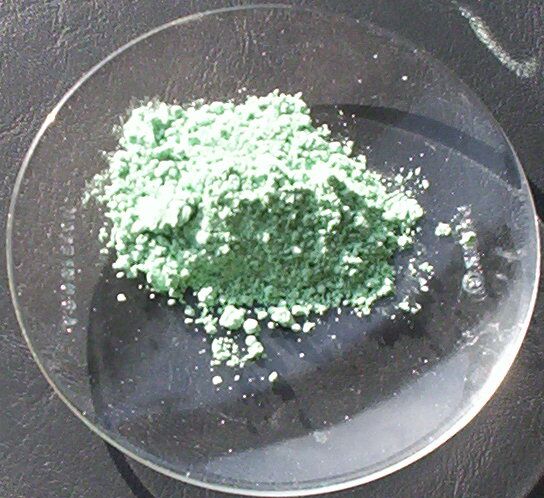


Properties and structure
Pure, anhydrous CuCO3 is comparatively uncommon; in practice copper and carbonate commonly form basic carbonates that also contain hydroxide. The material is typically green to blue-green in appearance, insoluble in water, and reacts with acids to give soluble copper(II) salts with release of carbon dioxide. On heating it decomposes to copper(II) oxide and carbon dioxide.
Occurrence and history
Natural copper carbonate minerals such as malachite and azurite are historically important pigments and ores of copper. These minerals are chemically related to CuCO3 but contain hydroxide groups and different stoichiometries. Historically, ground malachite served as a green pigment and as a source of copper metal after smelting. For mineral data and context see mineral information.
Preparation and reactions
Laboratory attempts to make CuCO3 by mixing soluble copper(II) salts with carbonate often yield basic copper carbonates rather than the pure carbonate, because water and hydrolysis favor hydroxide formation. The carbonate reacts with acids to produce carbon dioxide and copper(II) salts; it can be converted to copper oxide by thermal decomposition. For synthetic methods and experimental notes consult preparation references.
Uses and safety
Copper carbonates and related minerals are used as pigments, teaching specimens, and in some copper compound manufacturing processes. Copper compounds are biologically active; handling requires care to avoid ingestion or inhalation, and safety data should be consulted before use. Relevant safety and regulatory information is available at safety guidance.
Distinctions and notable facts
- CuCO3 as the simple, anhydrous carbonate is less commonly encountered than basic copper carbonates (e.g., malachite and azurite).
- Coloration (green to blue-green) comes from copper(II) electronic transitions in the solid state.
- Copper carbonate chemistry illustrates common inorganic behaviors: low solubility, acid decomposition to CO2, and conversion to oxide on heating.
For broader chemical context and related compounds consult general inorganic chemistry resources or a chemical database entry: additional reading.
Related articles
Author
AlegsaOnline.com Copper(II) carbonate Leandro Alegsa
URL: https://en.alegsaonline.com/art/22966