
Copper(II) sulfate (CuSO4)
Copper(II) sulfate is a blue inorganic salt (formula CuSO4), commonly encountered as the pentahydrate. It is used as a reagent, fungicide, teaching chemical and in metal processing; handle with care.
Copper(II) sulfate is an inorganic compound with the formula CuSO4. The solid most often encountered in laboratories and trade is the pentahydrate, CuSO4·5H2O, a vivid blue crystalline material historically called "blue vitriol" or "bluestone." In this compound copper is in the +2 oxidation state and the sulfate anion (SO4)2− provides charge balance. The blue color and many characteristic behaviors are a consequence of copper's coordination to water and oxygen atoms.
Image gallery
10 Images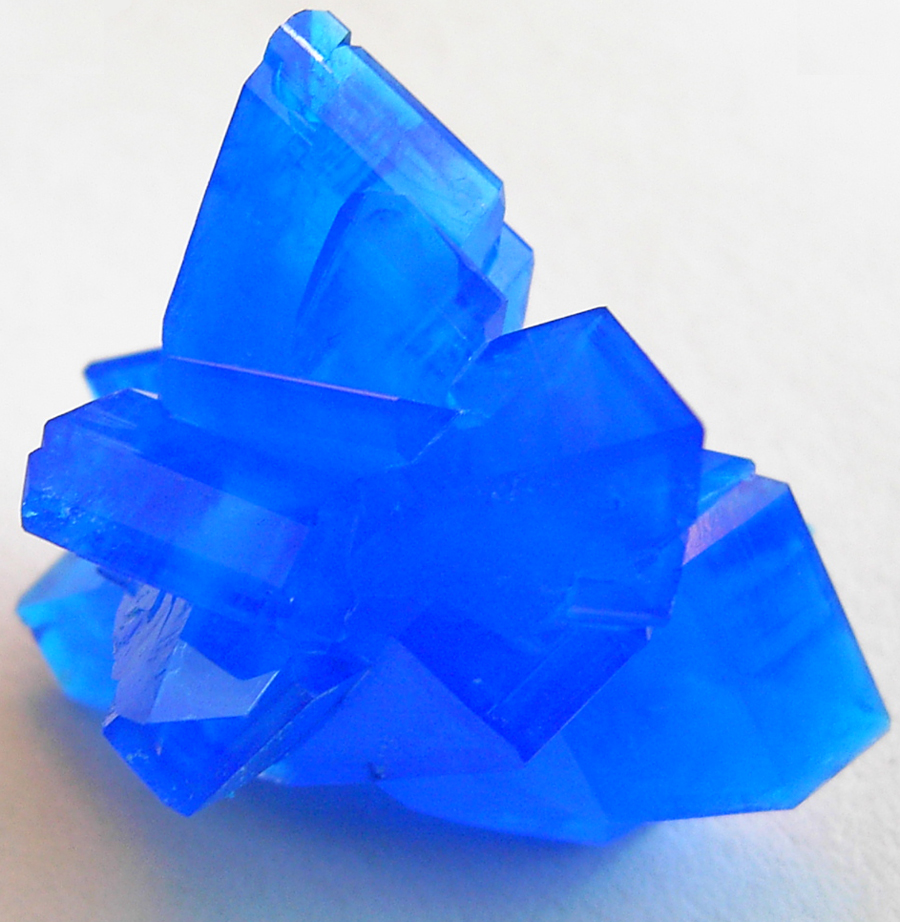


Chemical characteristics and forms
The anhydrous salt is typically a white or gray powder; addition or loss of water converts it between the anhydrous and hydrated forms. The pentahydrate is water-soluble and yields blue aqueous solutions. Its color, solubility and reactivity are governed by typical transition-metal coordination chemistry. When heated the hydrated crystals lose water and change color as the coordination environment of the Cu2+ ion changes.
Preparation and occurrence
Copper(II) sulfate can be produced by treating copper or copper-containing materials with dilute sulfuric acid or by oxidizing copper(I) compounds. It also appears as a secondary mineral in oxidized copper deposits and can form by weathering of copper ores. In industry and the laboratory it is manufactured and sold in several grades, including reagent and agricultural grades.
Uses and applications
Because of its reactivity and relative stability, CuSO4 has a wide range of applications. Typical uses include:
- As a fungicide and algicide in agriculture and water treatment, where controlled applications limit fungal and algal growth.
- As a common reagent in chemical education and demonstration experiments, for example crystal growth, qualitative tests for copper, and displacement reactions.
- In metallurgy and electroplating to purify or plate copper and to prepare other copper compounds.
- As an analytical reagent in laboratories for tests and synthesis involving copper chemistry.
Safety, handling and environmental notes
Copper(II) sulfate is moderately toxic to humans and more toxic to aquatic organisms; ingestion, inhalation of dust, or extended skin contact should be avoided. Appropriate protective equipment and measures for safe disposal are recommended for industrial and laboratory use. Environmental precautions are important because copper ions can accumulate in soils and waterways and affect plants and aquatic life.
History and notable facts
Known since antiquity in various forms, copper sulfate took on the name "blue vitriol" in older sources and has long been used both as a pigment and a preservative for timber and fabrics. In teaching and demonstration it remains popular because its striking color and crystallization behavior illustrate core principles of inorganic chemistry. For more technical summaries and safety data see compound information, historical notes at historical sources, and regulatory or handling guidance at safety resources.
Note: This article summarizes commonly known properties and uses of copper(II) sulfate; for detailed procedures, concentrations, toxicology data and legal restrictions consult specialized literature and safety datasheets.
Questions and answers
Q: What is copper(II) sulfate?
A: Copper(II) sulfate is a chemical compound containing copper in its +2 oxidation state and sulfate ions.
Q: What is the chemical formula of copper(II) sulfate?
A: The chemical formula of copper(II) sulfate is CuSO4.
Q: What is the color of copper(II) sulfate?
A: Copper(II) sulfate is a blue solid.
Q: What are some common names for copper(II) sulfate?
A: Copper(II) sulfate is also known as cupric sulfate, copper sulfate, blue vitriol, or bluestone.
Q: What is the use of copper(II) sulfate in killing fungi?
A: Copper(II) sulfate is known to have antifungal properties and hence can be used for killing fungi.
Q: What is the use of copper(II) sulfate in purifying copper metal?
A: Copper(II) sulfate is used to purify copper metal as it can dissolve impurities present in the copper.
Q: Is copper(II) sulfate commonly used in chemistry sets and practical lessons at high schools?
A: Yes, copper(II) sulfate is quite common in chemistry sets and practical lessons at high school.
Related articles
Author
AlegsaOnline.com Copper(II) sulfate (CuSO4) Leandro Alegsa
URL: https://en.alegsaonline.com/art/22971
Sources
- ptcl.chem.ox.ac.uk : "Copper(II) sulfate MSDS"
- books.google.com : Thermal decomposition of ionic solids
- books.google.com : Inorganic chemistry
- public.asu.edu : "Another copper reaction"
- jchemed.chem.wisc.edu : "Reaction video"
- uncp.edu : "Copper"
- pmep.cce.cornell.edu : "Decomposition"
- jstor.org : "The Early History of Copper Fungicides"
- doi.org : 10.1111/j.1744-7348.1958.tb02225.x
- copper.org : "Uses of Copper Compounds: Copper Sulfate's Role in Agriculture"
- fishyfarmacy.com : "All About Copper Sulfate"
- doi.org : 10.1002/047084289X.rc247
- pediatrics.aappublications.org : "Elevation of serum copper following copper sulfate as an emetic"
- pubmed.ncbi.nlm.nih.gov : 4385403
- artangel.org.uk : "Seizure homepage"