
Copenhagen interpretation of quantum mechanics
A major early interpretation of quantum mechanics emphasizing probabilistic outcomes, wavefunction collapse, and complementarity, chiefly developed by Niels Bohr and Werner Heisenberg in the 1920s.
Overview
The Copenhagen interpretation is one of the earliest and most widely taught ways to understand the mathematical formalism of quantum theory. It presents quantum mechanics as a framework that predicts probabilities for measurement results rather than deterministic outcomes for all properties. The term interpretation refers to the extra conceptual layer that links the abstract mathematical objects of quantum mechanics to experimental observations in physics.
Image gallery
2 Images
Core principles
Key ideas associated with this approach include the use of a wavefunction to encode a system's state, the probabilistic Born rule for extracting measurement probabilities, and the notion that measurement plays a special role. Max Born's statistical rule (often summarized as the Born rule) gives the chance of finding a system in a particular outcome. Influential figures who shaped these concepts include Werner Heisenberg, Niels Bohr, and Max Born. The interpretation also emphasizes complementarity: mutually exclusive experimental setups reveal different, equally necessary aspects of quantum systems.
Historical development
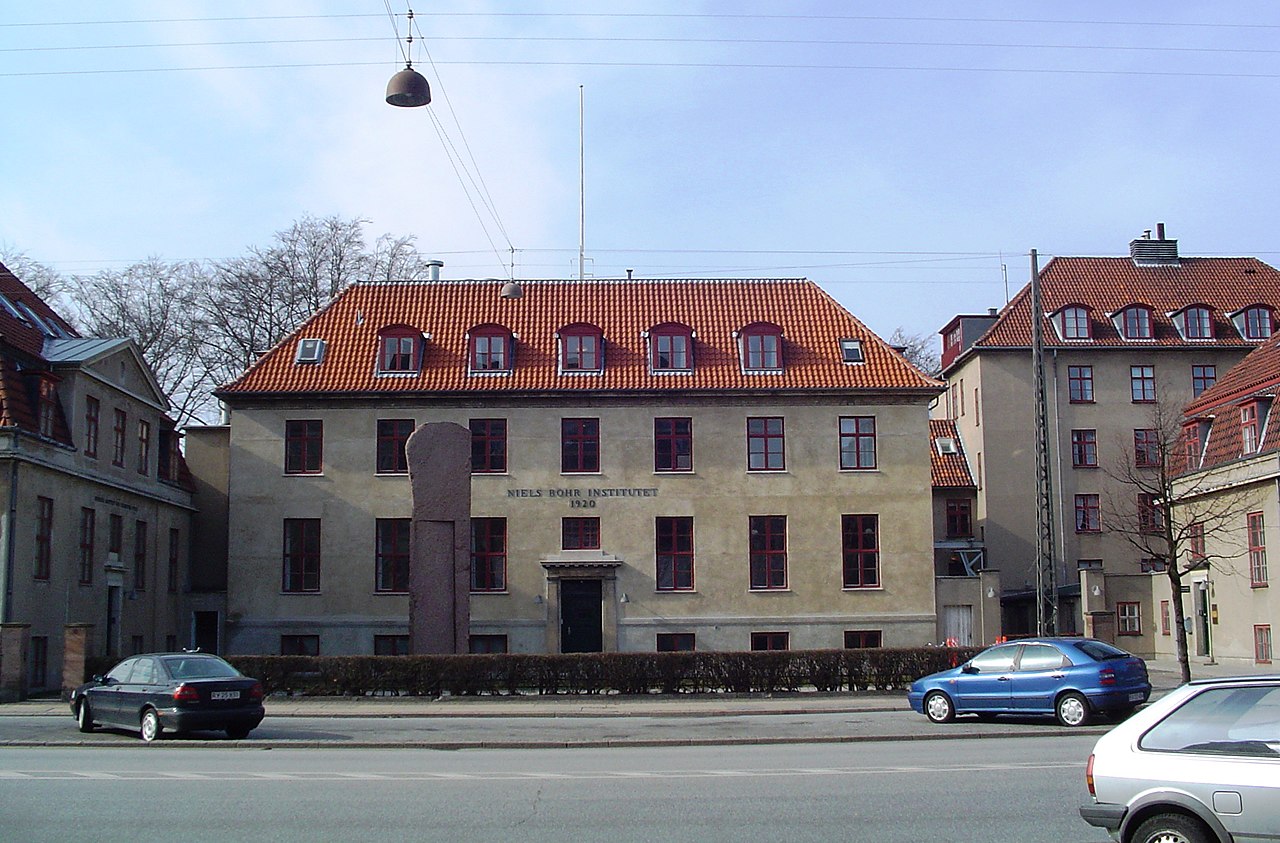
The Copenhagen viewpoint emerged during the 1920s in Copenhagen and nearby scholarly circles, where debates about the proper meaning of the new quantum formalism were intense. Contributors and critics included many leading physicists of the era; for example, Albert Einstein famously questioned whether quantum mechanics provided a complete description of reality. The label also reflects the central role of Copenhagen as a meeting place for these formative discussions (Copenhagen).
Uses, influence and practice
Practically, the Copenhagen interpretation serves as the default working picture for many physicists and is sufficient for calculating and understanding most laboratory experiments. It underpins standard teaching and the widespread use of wavefunctions and operators when predicting probabilities and expectation values. Its pragmatic stance—focus on what can be observed and measured—has been influential in the development of quantum technologies.
Criticisms and alternatives
Despite its utility, the Copenhagen view has spawned long-standing debates. Critics point to the measurement problem and questions about when and how the wavefunction collapse occurs. These issues motivated alternative proposals such as many-worlds, pilot-wave (de Broglie–Bohm), and objective-collapse theories. For readers wanting a deeper discussion of interpretations and ongoing debates, see further resources: overview of interpretations, foundations of quantum mechanics, and curated surveys at specialized sources (physics resources, Heisenberg biography, Bohr archives, Einstein correspondence, Copenhagen history, Born rule details, Max Born work).
Related articles
Author
AlegsaOnline.com Copenhagen interpretation of quantum mechanics Leandro Alegsa
URL: https://en.alegsaonline.com/art/22938