
Niels Bohr: Pioneer of Atomic Structure and Quantum Theory
Danish physicist Niels Bohr (1885–1962) developed the Bohr model of the atom, advanced quantum theory, founded the Copenhagen school, advised wartime nuclear research, and influenced 20th‑century physics.
Overview
Niels Bohr (7 October 1885 – 18 November 1962) was a Danish scientist whose work helped shape modern atomic physics and quantum theory. Trained as an experimental and theoretical physicist, he proposed models and principles that redefined how physicists understand the atom and the behavior of electrons. He received the Nobel Prize in Physics in 1922 for his contributions to the investigation of atomic structure and radiation.
Image gallery
10 Images



Key contributions
Bohr's most widely known idea is the Bohr model of the atom (1913), which introduced the notion that electrons occupy discrete energy levels and emit or absorb quanta of energy when jumping between them. That insight built on early quantum hypotheses and helped make sense of atomic spectra. Later he became a principal figure in the Copenhagen interpretation of quantum mechanics and formulated the complementarity principle, which emphasizes that wave and particle descriptions of quantum objects are mutually necessary but cannot be applied simultaneously in full. These concepts influenced generations of physicists and remain central to discussions of quantum foundations.
Life and career
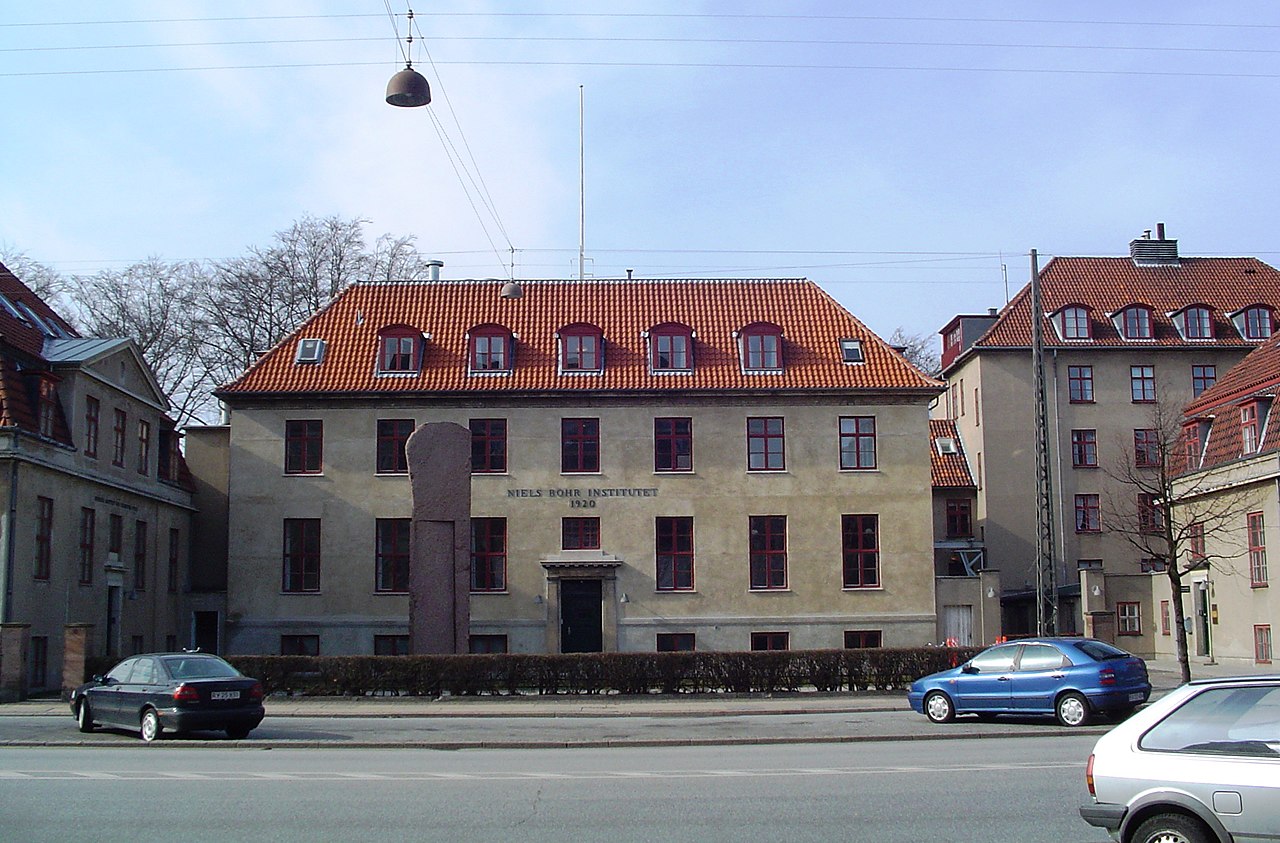
Born in Copenhagen, Bohr studied physics at the University of Copenhagen and completed doctoral work that led him into areas crossing theory and experiment. In 1921 he established the Institute for Theoretical Physics in Copenhagen (often called the Bohr Institute), which became a major international center where many leading physicists gathered. Bohr collaborated and debated with contemporaries such as Albert Einstein, engaging in famous exchanges about determinism, probability, and the interpretation of quantum mechanics.
Wartime work and policy
During World War II Bohr escaped German-occupied Denmark and reached Britain and the United States, where he had contacts with Allied research programs. He offered scientific advice, discussed implications of nuclear fission with colleagues, and supported efforts to understand and control atomic energy. After the war he advocated international cooperation and political measures to prevent unchecked proliferation of nuclear weapons rather than celebrating their military use.
Importance, students and family
Bohr's influence extended through his students and the institutional culture he fostered. The Copenhagen school became synonymous with one influential approach to quantum theory. His son Aage Bohr also became a distinguished physicist and shared the Nobel Prize in 1975 for work in nuclear structure, a rare instance of both father and son receiving Nobel recognition. Bohr's career blended theoretical insight, experimental sensibility, mentorship, and public engagement on science policy.
Notable facts and distinctions
- Prize: Nobel Prize in Physics, 1922, for work on atomic structure and radiation.
- Model: Introduced quantized electron orbits that explained atomic spectral lines.
- Philosophy: Articulated the complementarity principle and helped develop the Copenhagen interpretation.
- Institute: Founded the Institute for Theoretical Physics in Copenhagen, a hub for international research.
- Collaboration and debate: Intensely engaged with peers such as Albert Einstein on the meaning of quantum theory.
- War-era role: Consulted with Allied research efforts and argued for international control of nuclear energy.
For further reading on Bohr's scientific legacy and institutional influence, consult specialized biographies and histories of quantum mechanics and 20th‑century physics. His life combined technical breakthroughs in understanding the structure of the atom with sustained public reflection on the societal consequences of scientific discovery. Bohr is remembered as a central figure of modern physics whose ideas continue to appear in both technical work and philosophical discussion.
Bohr also figures in many historical summaries as one of Denmark's most prominent scientists and is often described simply as a Danish physicist whose intellectual contributions shaped decades of research and debate.
Questions and answers
Q: Who was Niels Bohr?
A: Niels Bohr was a Danish physicist who helped discover quantum physics, the structure of the atom, and the atomic bomb. He was awarded the Nobel Prize in 1922 for discovering the quantization of atomic energy levels.
Q: When did Niels Bohr marry Margrethe Nørlund?
A: Niels Bohr married Margrethe Nørlund in 1912.
Q: Who was one of his sons?
A: One of his sons was Aage Bohr, who was also an important physicist and won a Nobel prize in 1975.
Q: What project did he work on with other physicists?
A: Niels Bohr worked on a project with other physicists known as Manhattan Project.
Q: Did he collaborate with Albert Einstein?
A: Yes, Niels Bohr collaborated with Albert Einstein.
Q: Is he considered one of the most important physicists of the 20th century?
A: Yes, Niels Bohr is considered one of the most important physicists of the 20th century.
Related articles
Author
AlegsaOnline.com Niels Bohr: Pioneer of Atomic Structure and Quantum Theory Leandro Alegsa
URL: https://en.alegsaonline.com/art/70081