
CP Violation in Particle Physics: Causes, Experiments, and Cosmological Significance
Explains CP violation: origins in the Standard Model, landmark kaon and B-meson experiments, implications for the matter–antimatter imbalance, and ongoing searches for new sources.
CP violation describes processes in which the combined operations of charge conjugation and parity inversion do not leave the laws of physics unchanged. Charge conjugation converts particles into their antiparticles, while parity inversion produces a mirror image of a physical system. When the outcomes of a process differ after both operations are applied together, the symmetry called CP is said to be violated.
Image gallery
1 Image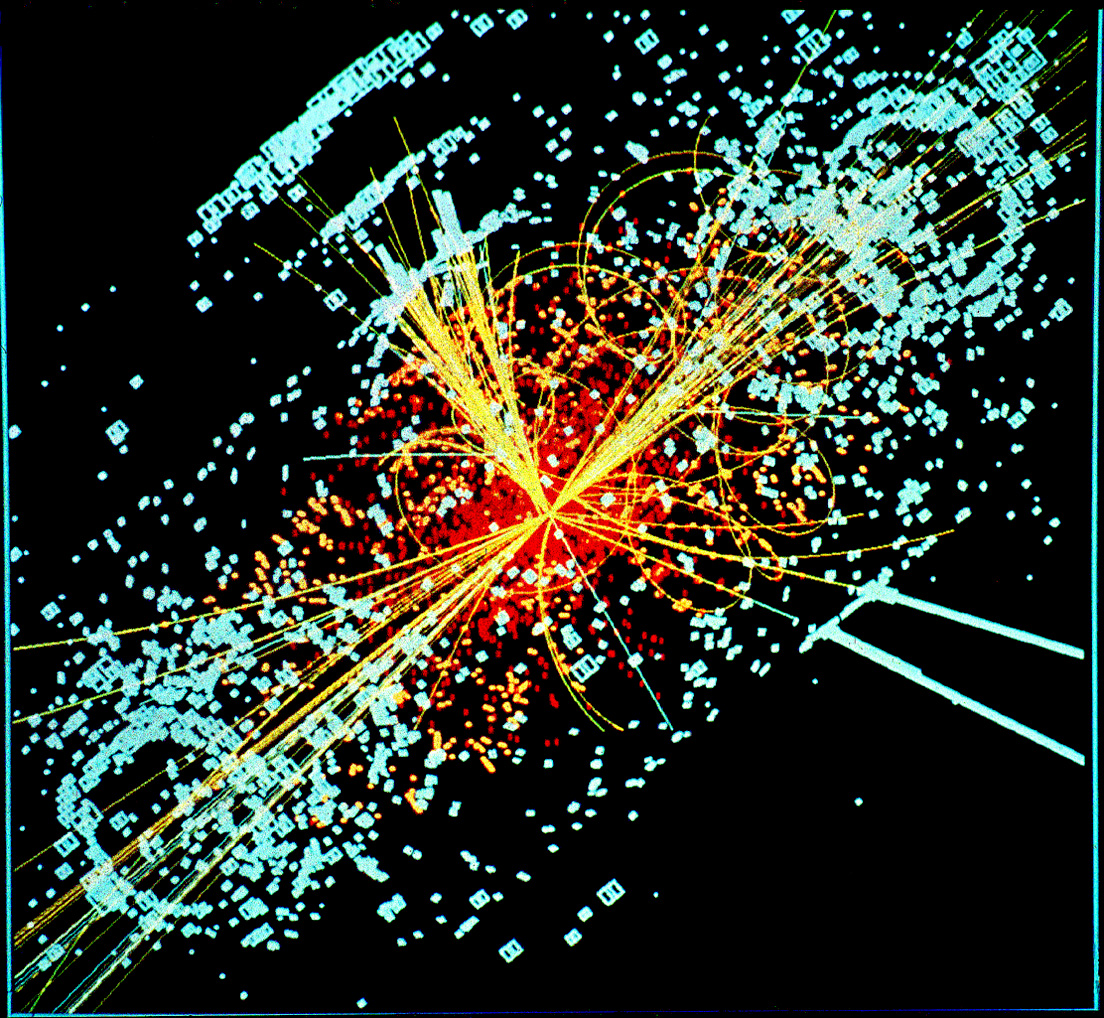
Basic concepts
The two discrete operations involved are often named as follows: charge conjugation (C), which swaps particles with antiparticles, and parity (P), which flips spatial coordinates like a mirror. Under a CP transformation a particle is transformed into the mirror image of its antiparticle. If the fundamental interactions respected CP exactly, the rates and patterns of a reaction and its CP-transformed counterpart would be identical. Observations show this is not always the case.
Historical discovery
CP violation was first observed in 1964 in the neutral kaon system. The experimental discovery that certain neutral kaons decay in ways that distinguish matter from antimatter led to a paradigm shift in particle physics. The finding earned James Cronin and Val Fitch a Nobel Prize and established CP violation as a real effect to be explained by theory.
Theoretical framework
- Within the Standard Model of particle physics, CP violation arises in the weak interaction through complex phases in the quark-mixing matrix (the Cabibbo–Kobayashi–Maskawa, or CKM, matrix). The presence of at least three quark generations is essential for a nonzero CP-violating phase.
- Because of the CPT theorem, which is a central result of relativistic quantum field theory, violation of CP symmetry under ordinary assumptions implies a corresponding violation of time-reversal symmetry (T). Experimental tests probe these relationships directly.
- Standard Model CP violation is small in magnitude and cannot, by itself, explain the observed predominance of matter over antimatter in the universe; this motivates searches for additional sources of CP violation beyond the Standard Model.
Experimental evidence and searches
After the initial kaon result, further CP-violating effects have been measured in B meson decays and are being actively sought in other systems:
- Neutral kaons: the original discovery and detailed studies of indirect and direct CP violation.
- B mesons: precision measurements at B-factory experiments and hadron colliders established additional CP-violating asymmetries consistent with the CKM mechanism.
- Neutrinos and other systems: ongoing and planned experiments aim to determine whether leptons exhibit CP violation and to look for new effects that would signal physics beyond the Standard Model.
Why it matters
CP violation is a key ingredient in theories that attempt to explain the matter–antimatter imbalance in the cosmos; Sakharov’s conditions for baryogenesis require CP violation among other criteria. Understanding the size and origin of CP-violating effects is therefore central to both particle physics and cosmology.
Related articles
Author
AlegsaOnline.com CP Violation in Particle Physics: Causes, Experiments, and Cosmological Significance Leandro Alegsa
URL: https://en.alegsaonline.com/art/23901