
Convex function
Overview of convex functions: definition, key characterizations, common examples, basic properties and applications in analysis, optimization and economics.
Convex function refers to a real-valued function f defined on a convex subset of a vector space that lies below the chord joining any two points of its graph. Formally, for any x and y in the domain and any t in [0,1], f(tx+(1-t)y) ≤ t f(x) + (1-t) f(y). This inequality captures the geometric idea of "no dents" and is the basis for many useful consequences; see a general overview at convex functions overview.
Image gallery
2 Images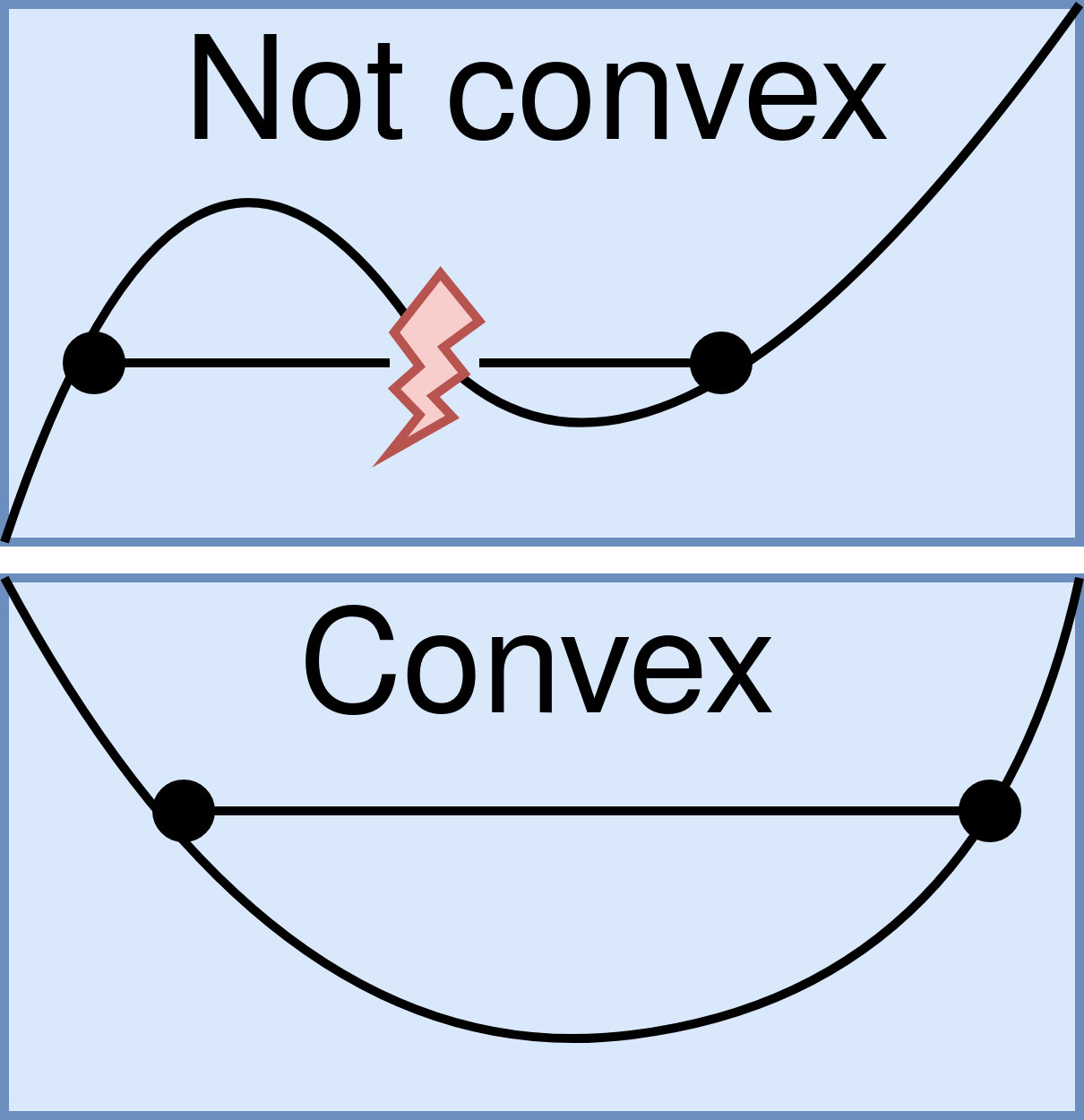
Characterizations and criteria
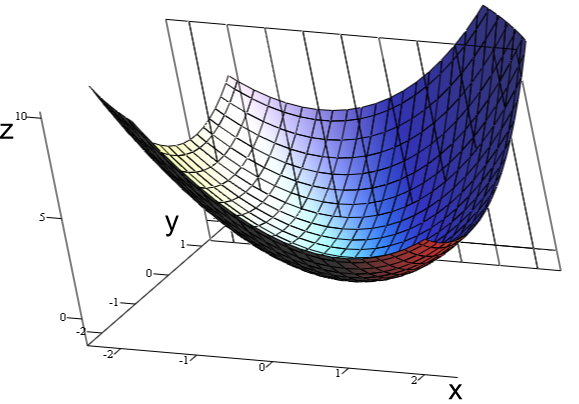
Several equivalent descriptions are commonly used. One is via the epigraph: f is convex if and only if its epigraph (the set of points lying on or above the graph) is a convex set; further discussion is available at epigraph criterion and convex sets. For differentiable functions, convexity is equivalent to the first-order condition f(y) ≥ f(x) + ∇f(x)·(y−x) for all x,y. If f is twice differentiable on an open set, convexity is equivalent to the Hessian being positive semidefinite at every point.
Examples and simple facts
- All linear functions are both convex and concave.
- Norms, the absolute value, quadratic forms with positive semidefinite matrices, the exponential function on R and functions like -log x on (0,∞) are standard convex examples.
- Strict convexity strengthens the defining inequality and, when a minimizer exists, implies uniqueness of the minimizer.
Operations that preserve convexity
Convex functions are closed under nonnegative weighted sums, pointwise supremum, and composition with increasing convex functions in many settings. Jensen's inequality connects convexity with averages and expectations; for a probabilistic viewpoint see weighted average and Jensen. Subgradients and supporting hyperplanes generalize derivatives and are central when f is nondifferentiable.
Applications and history
The modern formal study grew from convex geometry and inequalities. Convex functions are fundamental in convex optimization because any local minimum is a global minimum, a fact exploited across economics (utility and cost models), statistics and machine learning (convex loss functions), and control theory. For inequality techniques and further background consult resources on convexity inequalities and applied texts at epigraph and variational methods.
For introductory material and detailed treatments of theory, algorithms and applications see the linked resources and surveys: overview, convex sets, and specialized expositions that develop supporting hyperplane theory, Legendre transforms and duality in optimization.
Related articles
Author
AlegsaOnline.com Convex function Leandro Alegsa
URL: https://en.alegsaonline.com/art/22843