
Conway's Game of Life: a cellular automaton and zero-player simulation
A concise encyclopedia overview of Conway's Game of Life: rules, typical patterns, history, significance in computation and examples of use in mathematics, art, and education.
Overview
Conway's Game of Life, commonly called simply "Life," is a cellular automaton devised in 1970. It is played on a two-dimensional grid of cells where each cell is either "alive" or "dead." The system evolves in discrete time steps according to a small set of deterministic rules; once a starting configuration is set, the evolution proceeds without further input, which is why Life is often described as a "zero-player game." Life is a well-known example of emergent complexity arising from simple local rules and is frequently discussed in mathematics and computer science as an accessible model of self-organization. For more on the family of similar systems, see cellular automata.
Image gallery
5 Images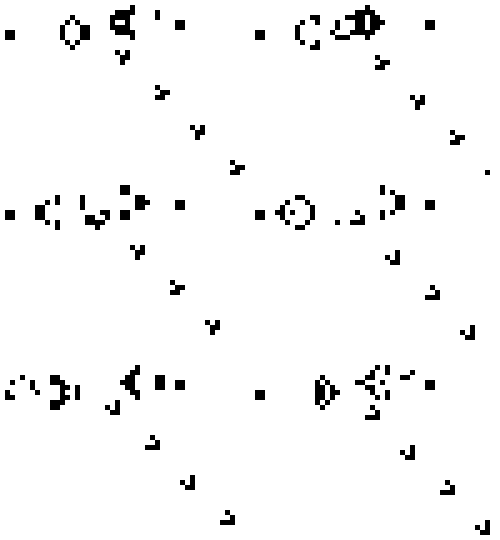


Basic rules and behavior
The standard form of Life uses the following rule set, often written as B3/S23 (birth on 3, survival on 2 or 3):
- If a live cell has fewer than two live neighbors, it dies (loneliness).
- If a live cell has two or three live neighbors, it survives to the next generation.
- If a live cell has more than three live neighbors, it dies (overcrowding).
- If a dead cell has exactly three live neighbors, it becomes alive (birth).
These simple local interactions produce a wide range of outcomes: stable patterns (still lifes), periodic patterns (oscillators), mobile patterns (spaceships, the best-known being the glider), and patterns that grow indefinitely. Typical categories help classify observed behavior and aid in constructing larger devices.
Patterns, examples and significance
Some canonical configurations illustrate Life's diversity: still lifes such as the block or beehive; oscillators like the blinkers and pulsar; spaceships including gliders; and engineered constructs such as the Gosper glider gun, which produces an endless stream of gliders. These patterns have been used to demonstrate surprising capabilities, including information transmission and logic operation inside the simulation. Because of these capabilities, Life is known to be capable of universal computation: suitably arranged patterns can simulate a Turing machine.
History and development
Life was proposed by the British mathematician John Horton Conway in 1970. It quickly attracted attention from hobbyists and researchers who explored its behavior by hand and with computer programs. Over subsequent decades the community discovered many complex mechanisms—guns, puffers, breeders—and developed software to search and catalog patterns. For background on Conway himself see John Horton Conway and for contemporary biographical or institutional context consult relevant biographical sources.
Uses, variations and resources
Life is used for teaching concepts in computer science, mathematics, and complexity theory, and it appears in algorithmic art and experimental computing. Numerous variants change the grid, neighborhood, or rule numbers to explore different dynamics; some variants model natural processes in simplified form. For tutorials, pattern collections, and interactive implementations see general resources such as online archives and software repositories. Historical publications and notable findings are cataloged in specialized collections and community-managed databases; see also further reading.
Notable facts: Life is deterministic yet unpredictable in practice; tiny differences in starting conditions can lead to drastically different long-term behaviors. Its popularity stems from the contrast between minimal rules and the richness of emergent structures, making it a perennial subject for both recreational exploration and formal study.
Questions and answers
Q: Who created the Game of Life?
A: The Game of Life was created by the British mathematician John Horton Conway.
Q: When was the Game of Life created?
A: The Game of Life was created in 1970.
Q: Is the Game of Life a robot game?
A: Yes, the Game of Life is an imaginary robot game, also known as a cellular automaton.
Q: Why is the Game of Life called a game?
A: The Game of Life is called a game because people who play it can set it up in different ways to make it do different things, and sometimes they change the initial setup to watch what happens.
Q: What does it mean when the Game of Life is referred to as a zero-player game?
A: The Game of Life is a zero-player game because it changes without anybody playing after the starting position is chosen.
Q: Can two players play the Game of Life together?
A: No, the Game of Life is not designed for two players to play together. Another type of game allows two players to set up imaginary robots to see which one is better.
Q: Is the Game of Life a popular game?
A: Yes, the Game of Life has become quite popular and has been used as a model in various fields such as science, art, and philosophy.
Related articles
Author
AlegsaOnline.com Conway's Game of Life: a cellular automaton and zero-player simulation Leandro Alegsa
URL: https://en.alegsaonline.com/art/22856
Sources
- mathworld.wolfram.com : "Game of Life"
- pi.math.cornell.edu : "Conway's Game of Life'"
- rendell-attic.org : "A Turing Machine in Conway's Game of Life, extendable to a Universal Turing Machine"
- ojuice.teamslack.net : ojuice.teamslack.net
- ericweisstein.com : "Pulsar -- from Eric Weisstein's Treasure Trove of Life C.A."