
Coat of arms of Serbia
National emblem of Serbia featuring a white double-headed eagle and a red shield with a cross and four fire‑steels (ocila); adopted 17 August 2004 and used on official seals and flags.
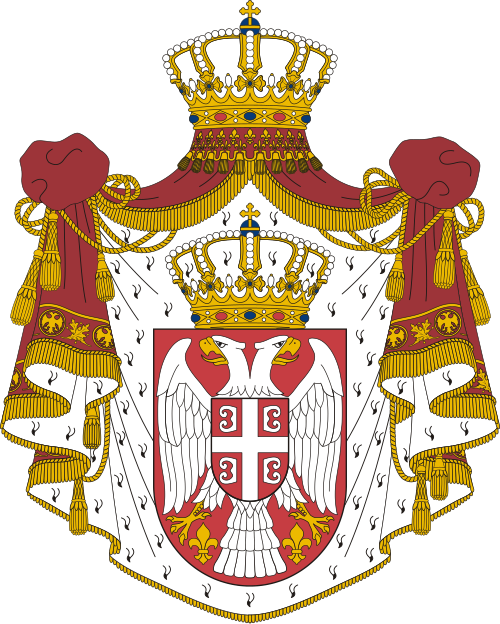
The coat of arms of Serbia is the country's principal heraldic emblem, formally adopted in its present form on 17 August 2004. It combines a white (silver) double-headed eagle on a red field with a smaller red escutcheon bearing a white cross and four fire‑steels (ocila). The device serves as a symbol of state authority and national identity and appears on official documents, flags, currency and government insignia.
Image gallery
1 Image
Components and symbolism
The composition has several distinct elements: the double-headed eagle, the central shield (inescutcheon) with a cross and four fire‑steels, and the crown often placed above the whole. The eagle traces its visual language to Byzantine imperial imagery and was used by medieval Serbian dynasties as a mark of sovereignty and continuity. The cross and the fire‑steels are a traditional Serbian motif; the four fire‑steels are sometimes stylized in a way that resembles the Cyrillic letter often associated with a national motto.
Formal description
Heraldically, the emblem may be described by its blazon. In plain terms: on a red field a silver double-headed eagle displayed; on the eagle's chest a smaller red shield charged with a silver cross between four fire‑steels. For an official blazon and technical details see the formal entry: Blazon. A general overview of the symbol is available at Coat of arms of Serbia.
History and development
The basic motifs date to the medieval Serbian state and were influenced by Byzantine heraldry. During the centuries of Ottoman rule and through the 19th‑century national revival, versions of the eagle and cross reappeared in seals and military standards. The modern republic standardized the design in the late 20th and early 21st centuries, culminating in the 2004 law that fixed proportions, colors and official uses while distinguishing between small and greater variants for different ceremonial purposes.
Uses and variants
- State and government: used on official seals, ministries and parliamentary materials.
- Documents: appears on passports, identity documents and legal instruments.
- Military and public institutions: forms part of insignia and flags for state services.
- Variants: a "lesser" (simpler) and a "greater" (more elaborate, crowned) version are prescribed for different contexts.
As a widely recognized national emblem, the coat of arms of Serbia combines historical references with a legally regulated modern design. Its elements are protected and prescribed by law to ensure consistent use in public symbolism and state representation.
Related articles
Author
AlegsaOnline.com Coat of arms of Serbia Leandro Alegsa
URL: https://en.alegsaonline.com/art/21266