
Coat of arms of Somalia
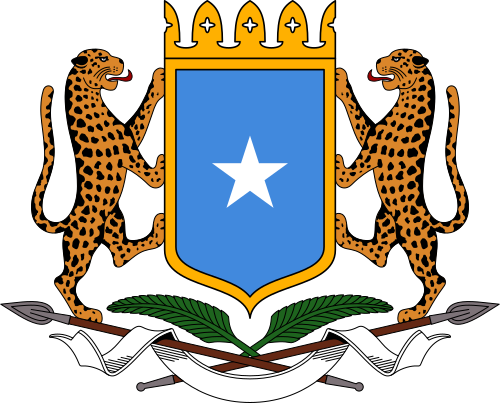
The national emblem adopted 10 October 1956: a blue shield bearing a white five‑pointed star, supported by two leopards. It echoes earlier Italian Somaliland arms and symbolizes unity and sovereignty.
Overview
The coat of arms of Somalia is the country's official heraldic emblem. It was adopted on 10 October 1956 and is widely used by state institutions. The most prominent elements are a blue shield charged with a white five‑pointed star and two leopards serving as supporters. The composition links the modern Somali state to visual motifs used in earlier colonial-era arms.
Image gallery
4 Images


Design and symbolism
The principal device is a shield whose field is the same blue associated with the Somali national flag; at its centre sits a white five‑pointed star. These elements are commonly interpreted as representing the Somali people and the unity of Somali territories. Two leopards stand on either side of the shield as supporters; their naturalistic depiction emphasizes strength and vigilance.
Principal components
- Shield: blue field with a central white five‑pointed star.
- Supporters: two leopards standing upright beside the shield.
- Base and accoutrements: the emblem is often rendered with decorative elements or a ribbon beneath the supporters in official contexts, though styles can vary between reproductions.
History and development
The white star and leopards had appeared on earlier heraldic devices in the region. Variants used during the period of Italian administration incorporated similar imagery: for example, a 1919 badge displayed a shield divided by a wavy white line with a leopard and a white star on a blue field. The 1956 arms formalized a simplified composition that more directly reflected the national flag and the idea of Somali unity. For visual references and official descriptions see official sources and historical examples of the arms used under colonial administration at Italian Somaliland references.
Uses and variants
The coat of arms appears on government documents, stationery, seals, some currency issues and at official buildings. Regional and institutional variants exist; these may alter proportions, color tones or surrounding ornament while retaining the shield, star and leopards as core motifs. Reproductions made for ceremonial, diplomatic or educational purposes also show modest stylistic differences.
Notable facts and distinctions
Although the shield and star visually echo the national flag, the heraldic format and the use of animal supporters are characteristics of traditional European-style coats of arms. This combination reflects both indigenous symbolism and the historical influence of colonial heraldic practice on state imagery. The emblem remains an important national symbol and a focus of identity for Somalis at home and abroad.
Related articles
Author
AlegsaOnline.com Coat of arms of Somalia Leandro Alegsa
URL: https://en.alegsaonline.com/art/21269