
Coat of arms of Slovenia
National heraldic emblem of Slovenia featuring Mount Triglav, three stars and wavy lines; designed by Marko Pogačnik and adopted in 1991. Symbolism, history, uses and variations explained.
The coat of arms of Slovenia is the country's principal heraldic emblem. It was designed by the artist Marko Pogačnik and officially adopted on 24 June 1991 during the period of Slovenian independence. The badge combines a stylised depiction of Mount Triglav with a set of stars and wavy lines, arranged on a shield in the national colours.
Image gallery
2 Images
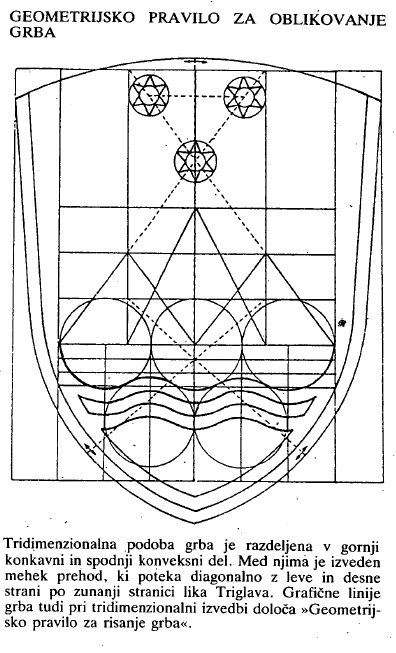
Design and main elements
The composition is compact and symbolic. Key parts include:
- Shield field — a blue shield, traditionally outlined in red, reflecting the pan-Slavic tricolour used by Slovenia.
- Mount Triglav — a white, stylised three-peaked figure at the centre representing Slovenia’s highest mountain and a widely recognised national symbol.
- Stars — three six-pointed golden stars placed above the mountain, borrowed from the historical arms associated with the noble Counts of Celje.
- Wavy lines — two horizontal blue wavy lines at the base that are commonly interpreted as rivers and the coastal sea area.
Symbolism and interpretation
The elements are intended to express geographic, cultural and historical identity: Triglav for the alpine core of the country, stars that reference medieval heraldry and continuity, and the waves for water connections. Colour choices echo the national flag and traditional heraldic palettes. Over time the arrangement has become a concise visual shorthand for Slovenian statehood and public institutions.
History and adoption
The emblem was introduced during the early months of Slovenia’s independence from Yugoslavia. Designed by Marko Pogačnik, it was selected as a modern heraldic solution that also referenced older regional symbols. Since adoption in 1991 the coat of arms has appeared on official documents, government buildings and other state uses; it replaced earlier emblems used in the socialist period.
Usage, variations and legal status
The coat of arms is used by central state authorities and appears on official items such as seals, standard documents and certain insignia. There are simplified and stylised variants for practical reproduction (for example on flags, signage and digital media), but official versions are defined by regulation and protected by law against improper use. Municipalities and historical regions continue to use their own local arms which differ from the national emblem.
Further reading and resources
For official descriptions, historical notes and reproductions consult government and cultural resources: see the official description, an illustrative image catalogue, a biographical note about the designer, and texts summarising relevant legislation and rules. These sources give authoritative guidance on correct colours, proportions and permitted uses.
Related articles
Author
AlegsaOnline.com Coat of arms of Slovenia Leandro Alegsa
URL: https://en.alegsaonline.com/art/21268