
Chicago Temple Building
A 1924 skyscraper in downtown Chicago that houses the First United Methodist Church, combining worship space and offices in a 23-floor, 173 m structure noted for its tower and urban prominence.
Overview
The Chicago Temple Building is a prominent early 20th-century skyscraper-church located at 77 W. Washington Street in downtown Chicago. Completed in 1924, it rises to about 173 meters (568 feet) and contains 23 floors used for a mix of religious and commercial purposes. The structure serves as the home of the First United Methodist Church of Chicago and has been an enduring landmark in the city's Loop district. For basic building data and visitor resources see building information.
Image gallery
1 Image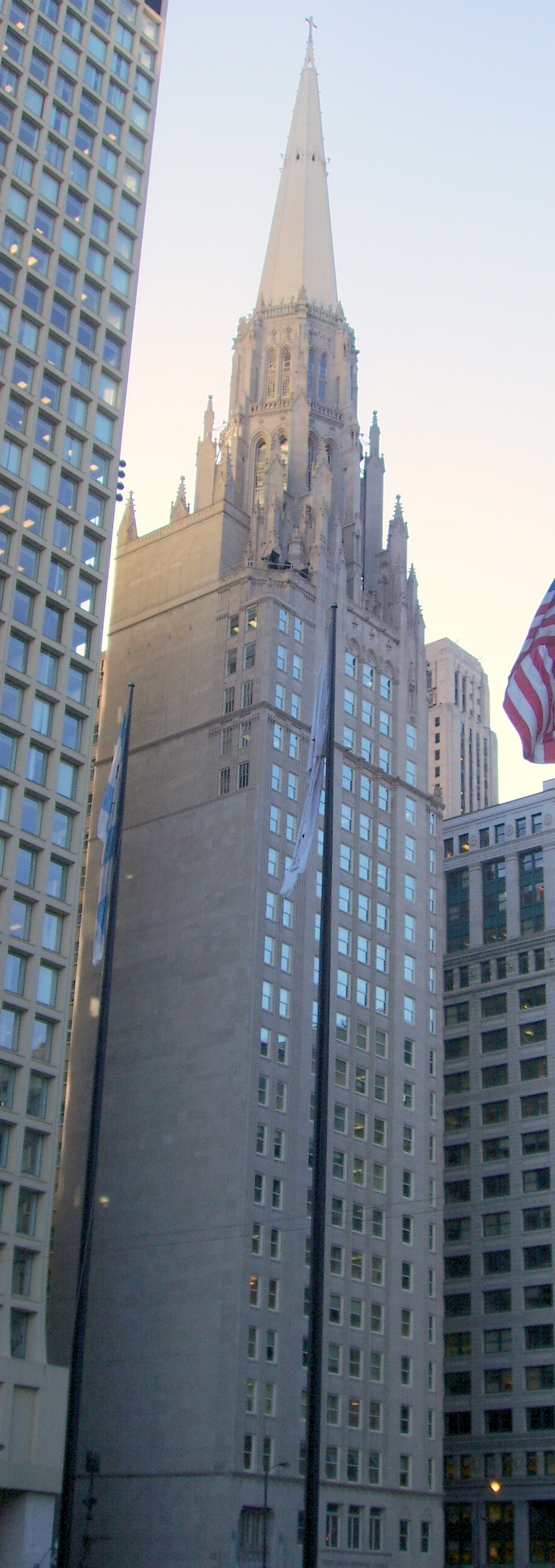
Physical characteristics
The tower blends ecclesiastical motifs with the vertical lines typical of office high-rises of its era. Exterior ornamentation recalls Gothic detailing while the overall massing follows an urban, stepped profile. Internally the building accommodates worship areas alongside leased office floors, a combination that allowed the congregation to remain in a central commercial location while generating rental income to support maintenance and mission work. General location and address details are available at the city listing and related resources at property and office pages.
History and development
Constructed in the early 1920s, the building was developed to consolidate the congregation's activities into a single downtown property at a time when skyscrapers were reshaping American city centers. Its completion reflected both the economic ambitions and the spatial constraints of an urban church seeking visibility and permanence. Historical summaries and archival references can be consulted via denominational or preservation links such as church archives and municipal heritage pages at regional resources.
Uses and significance
Today the Chicago Temple Building continues to function as an active house of worship while also hosting offices and meeting spaces. Its dual role—religious sanctuary and commercial building—illustrates a pragmatic approach some congregations have taken to remain financially viable in downtown locations. The building is often cited in discussions of religious architecture in urban contexts; researchers and visitors may find additional commentary and practical visitor information at visitor resources.
Notable distinctions
- The Chicago Temple Building is frequently described as one of the tallest church buildings because it contains an active congregation within a high-rise structure.
- It is important to distinguish between different measures of "tallest"—some religious buildings such as Ulm Minster are taller when measured by spire or tower height, while the Chicago Temple is notable for combining church functions with a multi‑story commercial tower.
- Its location in the Loop gives it a particular urban and historical context among Chicago's collection of landmark skyscrapers and ecclesiastical sites.
The building remains of interest to students of architecture, urban history, and religious studies as an example of how congregations adapted to the commercialized downtown landscape of American cities in the early 20th century.
Related articles
Author
AlegsaOnline.com Chicago Temple Building Leandro Alegsa
URL: https://en.alegsaonline.com/art/19535