
Chrysler Building — New York City Art Deco skyscraper
Art Deco skyscraper in Manhattan completed in 1930, noted for its stainless-steel crown, automobile-inspired ornament, brief status as world's tallest building, and status as an architectural icon.
Overview
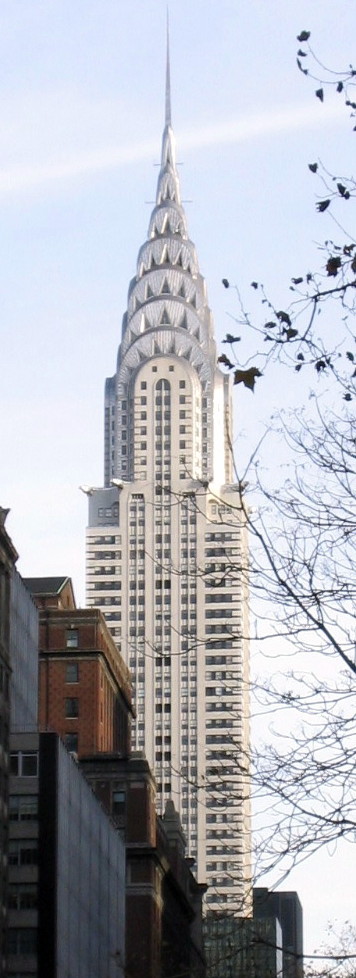
The Chrysler Building is a landmark skyscraper on Manhattan's East Side that exemplifies the Art Deco style. Rising to about 319 metres (1,046 feet) with 77 floors, it was completed at the end of the 1920s and opened in 1930. Located in New York City, in the United States, the structure is widely regarded for its distinctive crown and ornamental detailing rather than for being a modern office tower.
Image gallery
10 Images




Design and architectural features
Designed by architect William Van Alen for Walter P. Chrysler as a corporate showpiece, the building combines a steel frame with traditional masonry cladding and extensive stainless-steel detailing. The most recognizable element is the multi-tiered, radiating stainless-steel crown with a sunburst pattern and triangular windows. Decorative motifs include stylized eagles, hood ornament–inspired forms, and radiator-cap shapes that reference the automobile industry. Because of its cladding and internal construction, it is often cited as the tallest brick building in the world.
History and construction
Construction began in the late 1920s amid a period of intense competition to build the tallest skyscraper. The project is famous for the secret assembly of a spire that was concealed inside the building and then hoisted into place, a tactic that allowed it to claim the title of world's tallest building briefly. That status lasted until the completion of the Empire State Building the following year. The building's completion coincided with the end of the prewar skyscraper boom and remains a high point of the era's architectural ambition.
Significance and legacy
The Chrysler Building is celebrated as one of the purest examples of Art Deco skyscraper design in the United States. It influenced later towers through its emphasis on ornament, silhouette, and urban presence. While it no longer holds the overall height record, it continues to be recognized for its aesthetic contribution to the Manhattan skyline and is frequently reproduced in photographs, films, and popular culture.
Notable facts and distinctions
- Briefly the world's tallest building (1930–1931) before being surpassed by the Empire State Building.
- Often described as the tallest brick building in the world and notable for its stainless-steel crown.
- Its decorative program draws on automobile imagery reflecting its original patron; hood ornaments and radiator motifs appear throughout the facade.
- It is frequently discussed alongside other international landmarks such as the Eiffel Tower when comparing early 20th-century engineering and skyline-making ambitions.
Visiting, access and resources
The building's ornate lobby and exterior are accessible to the public at street level; interior access to upper floors is typically restricted because the tower functions as commercial office space. For further architectural descriptions and historical context see resources about the building and its neighborhood, including general pages on the brick construction tradition and broader guides to New York City and American skyscrapers. Additional archival and interpretive materials are available through museum and preservation organizations that document the building's place in architectural history.
Chrysler Building, New York City, United States, references to the Empire State Building, construction materials such as brick, and comparisons with the Eiffel Tower are common entry points for further reading and study.
Questions and answers
Q: What is the Chrysler Building?
A: The Chrysler Building is a skyscraper located in New York City, United States.
Q: How tall is the Chrysler Building?
A: The Chrysler Building is 319 meters (1046 feet) tall and has 77 floors.
Q: When was the Chrysler Building built?
A: The Chrysler Building was built in 1931.
Q: Was the Chrysler Building ever the tallest building in the world?
A: Yes, the Chrysler Building was the tallest building in the world from 1930 to 1931.
Q: What building was the tallest in the world before the Chrysler Building was built?
A: Before the Chrysler Building was built, the Bank of the Manhattan Company Building was the tallest building in the world, now known as The Trump Building.
Q: Is the Chrysler Building still one of the tallest buildings in the world?
A: The Chrysler Building is no longer one of the tallest buildings in the world, but it is still the tallest brick building in the world.
Q: What was the tallest structure in the world before the Chrysler Building was built?
A: Before the Chrysler Building was built, the Eiffel Tower was the tallest structure in the world.
Related articles
Author
AlegsaOnline.com Chrysler Building — New York City Art Deco skyscraper Leandro Alegsa
URL: https://en.alegsaonline.com/art/20236