
Chamaeleon (constellation)
Chamaeleon is a faint southern constellation named for the lizard, notable for its dark clouds and star-forming regions.
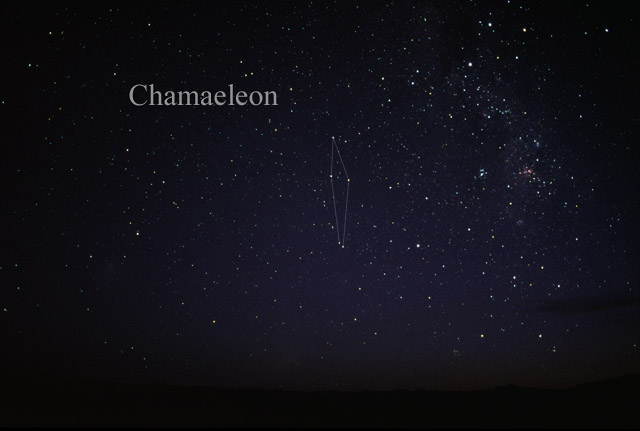
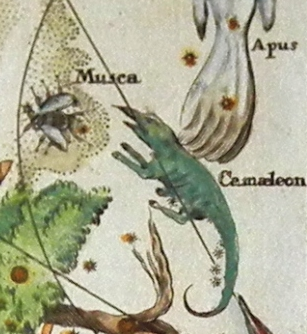
Chamaeleon is a faint constellation in the southern sky. Its name refers to the chameleon, the lizard known for its ability to change color. Like several other southern constellations, it was added to star maps during the era of European exploration and is now part of the modern set of 88 recognized constellations.
Image gallery
6 Images



Overview
Chamaeleon lies close to the south celestial pole, so it is best seen from the Southern Hemisphere. It is not known for bright stars or obvious patterns, which makes it less familiar than many northern constellations. Instead, its interest comes from its position in a rich region of the Milky Way and from the many clouds of gas and dust found within and around it.
The constellation was introduced in the late 16th century by Dutch cartographers who were compiling observations from southern voyages. It reflects a common pattern in constellation history: new southern skies were mapped after European navigators reached far enough south to see stars not visible from Europe. Chamaeleon remains a useful example of a modern constellation that is historical rather than mythological in origin.
Notable features
- Chamaeleon I, Chamaeleon II, and Chamaeleon III are important molecular cloud complexes associated with star formation.
- The constellation contains dark nebulae and young stellar objects that are studied by astronomers interested in how stars and planetary systems form.
- Because it is relatively small and dim, it is usually observed with binoculars or telescopes under dark skies.
Although it has no especially famous bright stars, Chamaeleon is important in modern astronomy. Regions such as Chamaeleon I are among the nearer active star-forming areas, making the constellation valuable for research on young stars, disks, and interstellar dust. For observers, it is a reminder that a constellation can be scientifically significant even when it is visually subtle.
Tags
Related articles
Author
AlegsaOnline.com Chamaeleon (constellation) Leandro Alegsa
URL: https://en.alegsaonline.com/art/18404
Sources
- iau.org : "Chamaeleon, constellation boundary"