
Catenary: the curve of a hanging chain and its properties
A catenary is the curve formed by a flexible, uniform chain hanging under gravity. This article explains its equation, physical meaning, history, and common applications in engineering and architecture.
Overview
A catenary is the distinctive curve adopted by an ideal flexible chain or cable suspended from two supports and acted on by uniform gravity. Unlike a parabola, which arises in different loading conditions, the catenary reflects the equilibrium of a chain with constant linear weight and no bending stiffness. The name derives from the Latin word for chain, and the curve is sometimes called an alysoid or chainette. More on the curve and the idealized chain model are discussed below.
Image gallery
10 Images




Mathematical form and parameters
In Cartesian coordinates the standard form of the catenary centered at the lowest point is given by the equation y = a cosh(x/a), where cosh is the hyperbolic cosine. Equivalently this can be written using exponentials as y = a (e^{x/a} + e^{-x/a})/2. The constant a controls the "tightness" or sag of the curve: larger a gives a flatter shape, smaller a gives a deeper sag. The parameter a is determined by the ratio of the horizontal component of the chain's tension to its weight per unit length, so it encodes both mechanical loading and the chain's linear density. For background on the formula see equation and Cartesian coordinates.
Physical interpretation and properties
- The catenary is the static equilibrium curve for a flexible, inextensible chain of uniform density under gravity; see ideal chain and uniform gravitational force.
- Its curvature and slope vary smoothly; the lowest point is symmetric when supports are at equal height, and the shape adjusts when supports differ in height.
- Although it resembles a parabola visually, the two curves are distinct: a parabola models uniformly distributed vertical load on a rigid beam, while the catenary models a freely hanging chain. Compare with parabola.
History and derivation
The mathematical study of the catenary dates from the 17th century. Early mathematicians investigated the shape after recognizing that a hanging chain did not follow a parabola, and they derived the cosh formula using differential equations and statics. The term itself comes from Latin catena, meaning "chain". Classical derivations connect the local slope and tension along the chain and integrate to obtain the hyperbolic cosine form; additional expositions connect the curve to variational principles and energy minimization.
Applications and notable facts
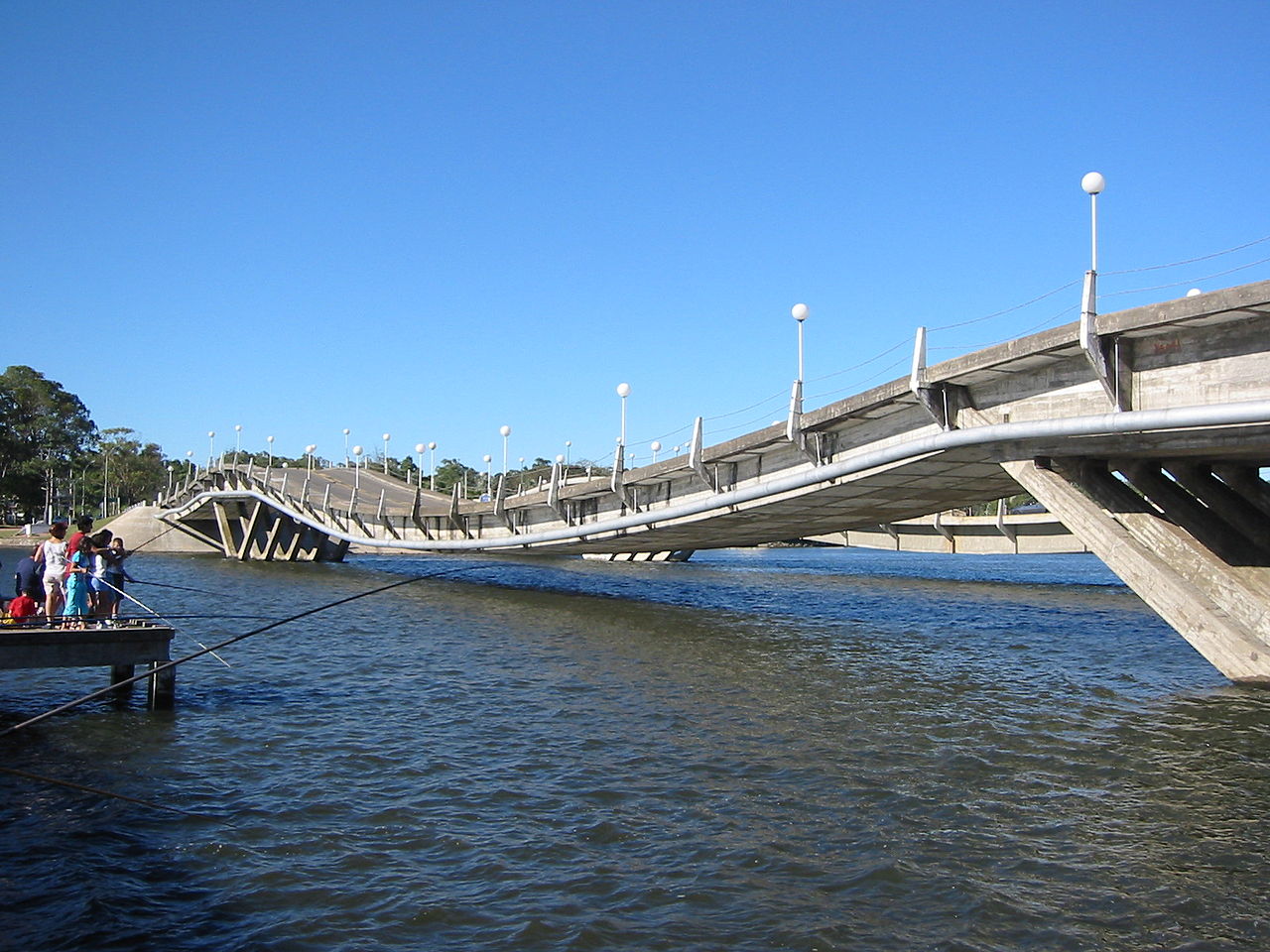
Catenaries appear in engineering and design wherever flexible cables or suspended chains are used. Architects and bridge engineers use catenary principles when designing arches and suspension elements because an arch shaped like an inverted catenary supports its own weight efficiently. Simple examples include the natural sag of power lines, ornamental chain-hung signage, and historical masonry arches approximating the ideal form. Practical designs often adjust for nonuniform loads, stiffness, or fixed endpoints.
Further reading and distinctions
- For introductory explanations and diagrams see material on linear density.
- To compare derivations and engineering use, consult sources linked from parameter and modelling references.
- General overviews and historical accounts are available at introductory mathematics and history of science treatments: curve resources and specialist expositions at conic comparisons.
Notable distinctions: the catenary is distinct from the parabola and from other special curves (cycloid, circle) both in its generating physical assumptions and in analytic form. Understanding the forces that produce it clarifies when the curve applies and when alternate models should be used.
For mathematical derivations, engineering examples, and visualization tools, follow the referenced links above.
Tags
Related articles
Author
AlegsaOnline.com Catenary: the curve of a hanging chain and its properties Leandro Alegsa
URL: https://en.alegsaonline.com/art/17608
Sources
- mathworld.wolfram.com : "Catenary" · web.archive.org
- people.math.aau.dk : "Catenary"
- mathforum.org : "Catenary and Parabola Comparison"
- math24.net : "Equation of Catenary"