
Butene (C4H8): structure, isomers, production and uses
Butene is a four‑carbon alkene (C4H8) with a carbon–carbon double bond; it has four isomers and serves as a feedstock for polymers, fuels and chemical intermediates.
Butene (also called butylene) is a small unsaturated hydrocarbon belonging to the alkene family. Its molecular formula is C4H8, and it is often described simply as a four‑carbon chemical compound containing one carbon–carbon double bond. At ordinary temperatures and pressures the common isomers of butene exist as flammable gases. Because of the double bond they participate readily in addition reactions and polymerization, properties that make them important building blocks in the chemical industry.
Image gallery
6 Images




Structure and basic properties
Butene molecules consist of four carbon atoms bonded to hydrogen atoms by covalent bonds. Each formula unit contains eight hydrogens (linked to hydrogen atoms) and a single double bond between two carbon atoms; the arrangement and location of that double bond determine the different isomers. The double bond is the defining feature of the molecule and governs its reactivity: it is the site where many addition reactions occur, and it also allows for geometric (cis/trans) stereoisomerism in some configurations of the molecule.
Isomers
There are four principal structural isomers of butene. Each has the same molecular formula but a distinct connectivity or geometry:
- 1‑Butene (but‑1‑ene) — a terminal double bond.
- cis‑2‑Butene — a double bond between the middle carbons with substituents on the same side.
- trans‑2‑Butene — similar to cis‑2‑butene but with substituents on opposite sides (geometric isomer).
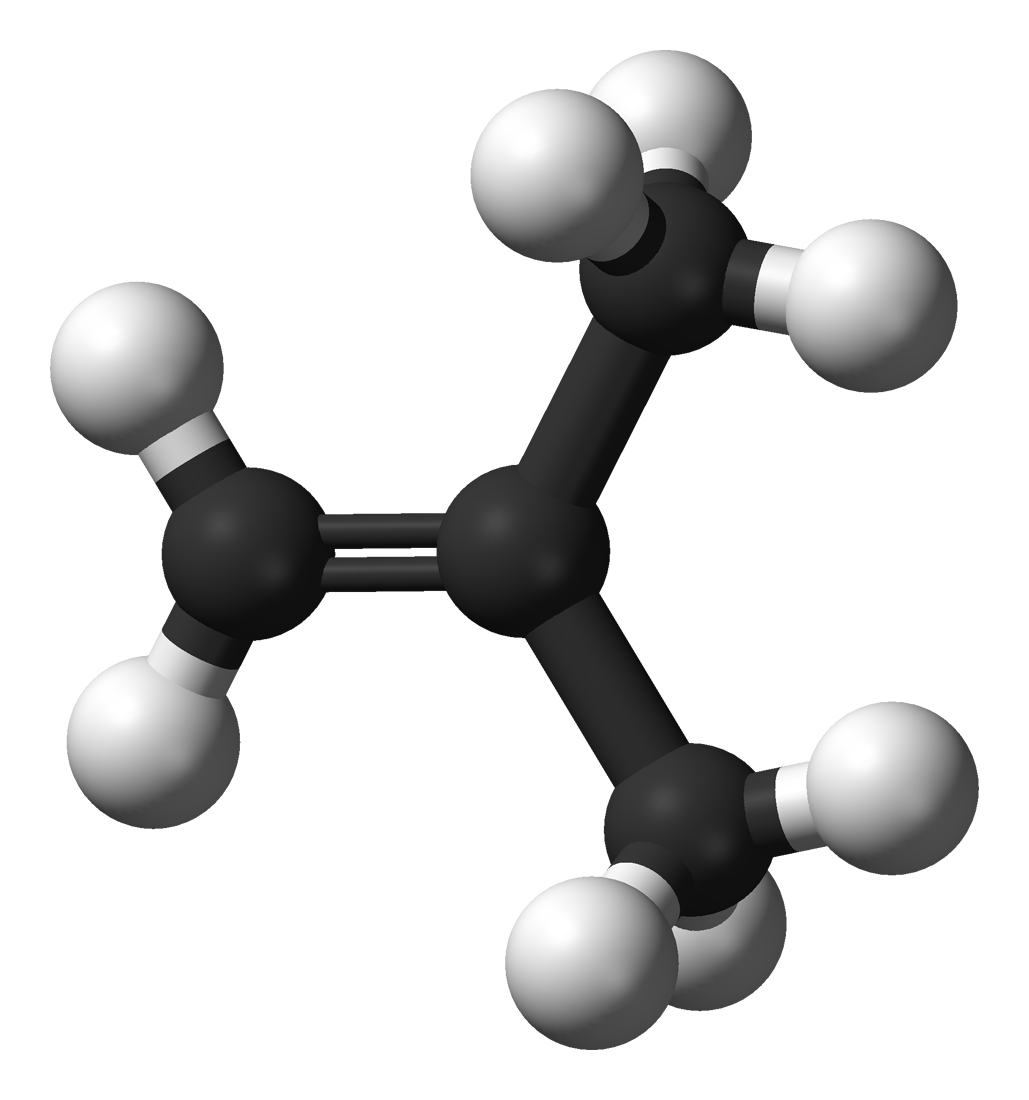
- Isobutene (2‑methylpropene) — a branched isomer where one carbon is methyl‑substituted.
Production and occurrence
Industrially, butenes are produced as part of the cracking of larger hydrocarbons in petroleum refining and by steam cracking of natural gas liquids and naphtha. Laboratory preparations can include dehydration of appropriate alcohols or controlled dehydrogenation of butane derivatives; for example, catalytic methods are used to convert saturated hydrocarbons to the corresponding alkenes in specialized laboratory and pilot processes. Certain isomers, notably isobutene, are also isolated from refinery streams for specific chemical syntheses.
Uses, handling and distinctions
Butenes are versatile intermediates: they are polymerized or copolymerized to make polybutene and other plastics, used as alkylating agents in fuel production, and serve as precursors to oxygenates and elastomers. For instance, isobutene is a starting material for tert‑butyl ether additives and specialty rubber monomers. Safety-wise, butenes are flammable gases that can form explosive mixtures with air; industrial handling requires gas‑detection, ventilation and controls on ignition sources. Compared with butane (a saturated alkane), butene’s double bond makes it more chemically reactive and suitable for addition and polymer chemistry.
For further technical details and references consult specialized chemical texts or industrial data sheets; introductory overviews of related topics are available for carbon chemistry and the broader class of alkenes. Additional resources on molecular terminology and bonding can be found through linked educational pages and chemical databases (compound entries, bonding descriptions, hydrogen roles, bond types, structural counts, molecular models, and process notes at C4H8-focused resources).
Tags
Related articles
Author
AlegsaOnline.com Butene (C4H8): structure, isomers, production and uses Leandro Alegsa
URL: https://en.alegsaonline.com/art/15643