
Bromine dioxide (BrO2) — properties, structure and reactivity
Bromine dioxide (BrO2) is an unstable, oxidizing bromine oxide species. This article summarizes its structure, preparation, reactions, limited uses, hazards and how it differs from related oxides.
Overview
Bromine dioxide is an inorganic species with the empirical formula BrO2. It is treated in the literature as a transient or labile chemical compound containing bromine in a formal +4 oxidation state bound to oxygen atoms. Unlike the more familiar chlorine dioxide, bromine dioxide is much less stable and is encountered mainly as a short‑lived radical or as a reactive intermediate in gas‑phase and photochemical processes.
Image gallery
2 Images
Structure and characteristics
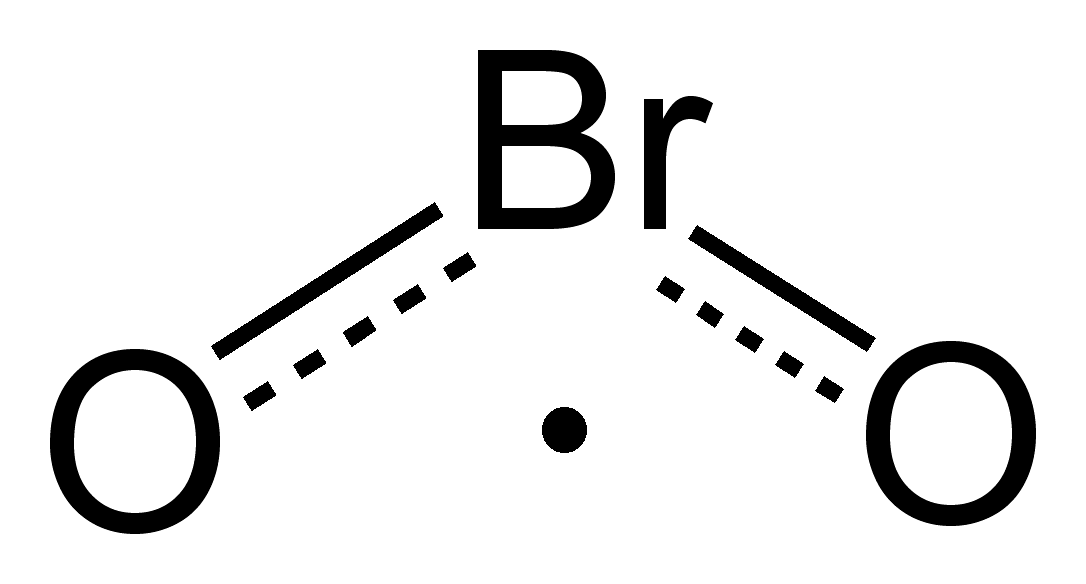
Spectroscopic studies indicate that BrO2 behaves like an odd‑electron species with a bent geometry analogous to other group 17 dioxides. Its electronic configuration and high oxidation level make it a strong oxidizing agent. Physical isolation of pure BrO2 under ambient conditions is generally not reported; when produced it is monitored by techniques such as UV–visible spectroscopy, infrared absorption, or electron paramagnetic resonance.
Preparation and reactions
BrO2 has been generated experimentally by energetic or oxidative routes that combine bromine and oxygen under non‑equilibrium conditions: for example, electrical discharge, photolysis, or reaction of bromine-containing precursors with ozone or other oxidants. Once formed, it tends to undergo further disproportionation or react with substrates to give more stable bromine oxides, oxyanions, or brominated products.
- Typical reactions: oxidation of organic or inorganic substrates; decomposition to bromine and oxygen-containing species.
- Relation to ions: contrasts with stable oxyanions such as bromate; it is not equivalent to simple oxide or oxide ions.
Uses, hazards and notable facts
Bromine dioxide has no large‑scale commercial applications because of its instability. Its importance is primarily academic: understanding halogen oxide chemistry, atmospheric bromine cycles and oxidative mechanisms. Like other high‑valent halogen oxides, it is potentially corrosive and an oxidizer; experimental work requires appropriate precautions due to toxicity and reactivity. Historically, its detection contributed to comparative studies of halogen dioxides and to models of atmospheric halogen chemistry.
Distinctions and context
Bromine dioxide should be distinguished from stable bromine compounds (such as molecular bromine or bromate salts) and from lower‑valent bromine oxides and radicals encountered in combustion or the atmosphere. Its fleeting existence underscores the diversity of halogen oxide chemistry and the difference between isolable compounds and transient intermediates observed spectroscopically.
Related articles
Author
AlegsaOnline.com Bromine dioxide (BrO2) — properties, structure and reactivity Leandro Alegsa
URL: https://en.alegsaonline.com/art/14653