
Bromine trifluoride (BrF3)
An overview of bromine trifluoride, an interhalogen compound used as a powerful fluorinating agent and oxidizer; covers structure, properties, handling, uses and notable distinctions.
Overview
Bromine trifluoride is an interhalogen molecular compound with the formula BrF3. It is a highly reactive, corrosive liquid at ordinary laboratory temperatures that releases pungent fumes. BrF3 is widely recognized as a strong fluorinating agent and oxidizer in specialized inorganic and industrial chemistry applications. For basic reference information see chemical data sources.
Image gallery
3 Images

Structure and bonding
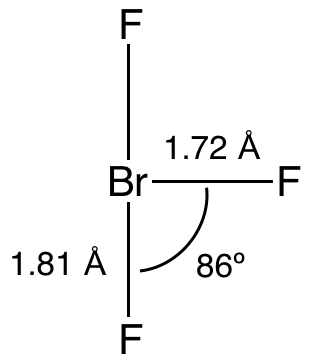
BrF3 is a covalently bonded molecule in which a central bromine atom is bonded to three fluorine atoms and also bears two lone pairs. VSEPR theory predicts a T-shaped molecular geometry arising from five electron domains around bromine; this gives the molecule distinctive bond angles and a polar character. The formal oxidation state of bromine in BrF3 is +3. Although the compound is molecular, molten BrF3 shows ionic behaviour due to partial autoionization (formation of species such as BrF2+ and BrF4-), a point often discussed in advanced inorganic chemistry texts (structure references).
Physical and chemical properties
BrF3 typically appears as a pale yellow to colorless liquid that fumes in moist air. It reacts vigorously with water and many organic materials, releasing hydrofluoric acid and other corrosive products; therefore it must be handled under dry, inert conditions. Compared with chlorine trifluoride (ClF3), bromine trifluoride is generally less energetic but still capable of severe oxidation and fluorination reactions. It dissolves or reacts with many metals to form fluorides and is a useful reagent when direct fluorination with elemental fluorine is impractical.
Preparation and uses
Industrial and laboratory preparation of BrF3 is usually carried out by controlled reaction of bromine with fluorine gas under conditions that restrict side reactions. Its principal uses are as a selective fluorinating agent in inorganic synthesis, for converting metal oxides or chlorides to fluorides, and in certain niche applications within the nuclear fuel cycle and specialized organic transformations. Because of its reactivity it is primarily used in closed systems designed for corrosive fluorinating chemistry (applications overview).
Handling, hazards and materials
Bromine trifluoride is highly toxic and corrosive; contact with skin, eyes or inhalation of vapors can cause severe injury. It reacts violently with water and many organic compounds, sometimes igniting them. Equipment for storing or transporting BrF3 must be constructed from compatible materials (nickel alloys, some fluoropolymers, or other fluorine-resistant materials) and operations require rigorous moisture exclusion, gas scrubbing and emergency neutralization provisions. For safety and regulatory guidance consult authoritative sources and material safety data sheets (safety guidance).
Notable distinctions and related compounds
- BrF3 is one member of the interhalogen family; others include ClF3 and BrF5, which differ in oxidation state and reactivity.
- It is less reactive than chlorine trifluoride but more manageable for some fluorination tasks where extreme reactivity is unnecessary.
- Unlike simple ionic salts, BrF3 is a covalent molecular compound that can exhibit ionic character under certain conditions (for example, when molten).
Because of its combination of strong fluorinating power and hazardous behavior, bromine trifluoride is a specialist reagent confined to experienced laboratories and industrial settings with appropriate engineering controls. It remains an important example of interhalogen chemistry and the practical challenges of working with powerful fluorinating agents.
Related articles
Author
AlegsaOnline.com Bromine trifluoride (BrF3) Leandro Alegsa
URL: https://en.alegsaonline.com/art/14656