
British Rail DP2 (Diesel Prototype 2)
DP2 was a 1962 English Electric prototype Type 4 diesel-electric locomotive built at Vulcan Foundry to demonstrate a single high‑power engine alternative to twin‑engined Deltics and to influence the later Class 50 design.
British Rail DP2, officially Diesel Prototype number 2, was an experimental Type 4 mainline diesel-electric locomotive completed in 1962. Built by English Electric at the Vulcan Foundry, it was intended as a demonstrator and test-bed for a high-power single‑engine layout to British Railways (BR). Externally DP2 resembled the contemporary Class 55 Deltics, but it was a distinct machine that explored different internal arrangements and cooling systems.
Image gallery
3 Images

Design and technical characteristics
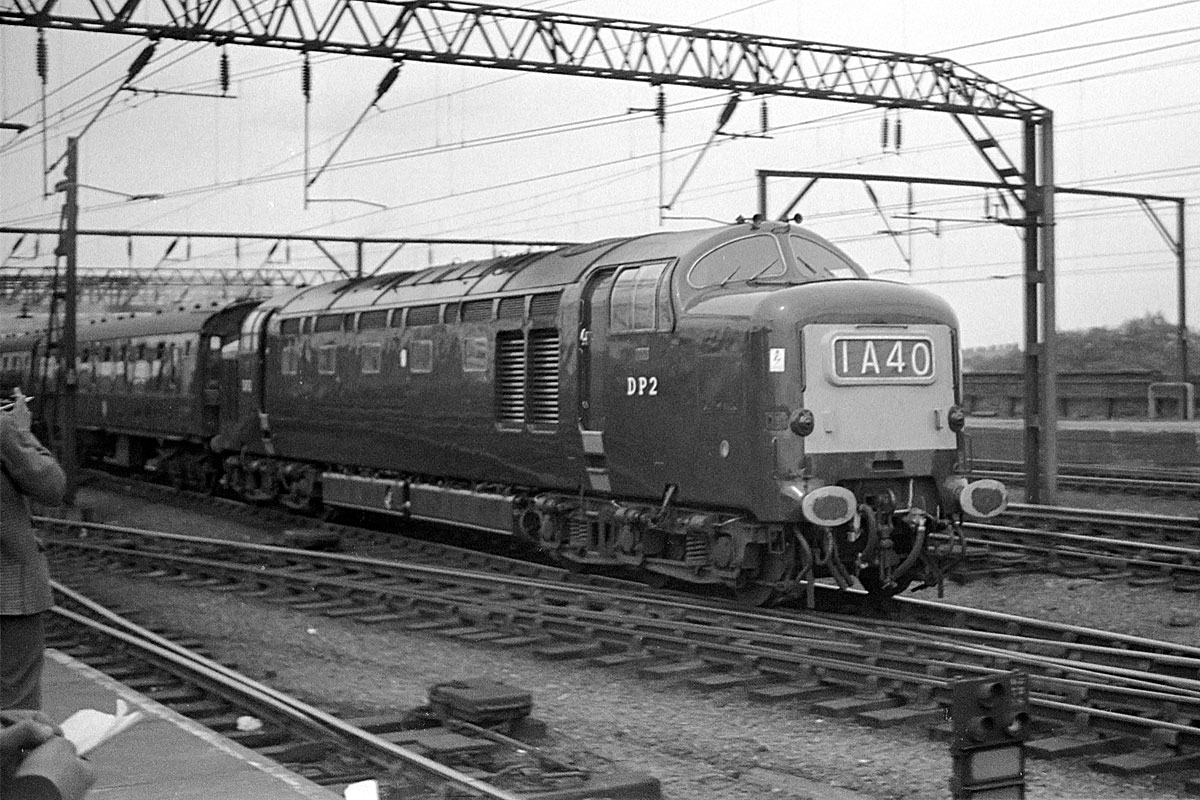
DP2 adopted a familiar long-hood British mainline outline, sharing the general body form used on the Deltic production line; the bodyshell used for DP2 is commonly described as one of the later shells produced for that series. However, several visible features set it apart. One end of the locomotive carried large bodyside radiator openings to serve a single high-capacity cooling installation, and the roof carried only one central fan instead of the four symmetrically placed fans found on the twin-engined Deltics. Internally, DP2 was fitted with a single, high‑power English Electric diesel engine coupled to electrical transmission and Co-Co bogies—an arrangement that foreshadowed later Type 4 designs.
Purpose and development
The principal aim for DP2 was to demonstrate to BR that a single‑engine Type 4 could meet mainline requirements for power and reliability, offering an alternative to the twin‑engine Class 55 family. Although it was produced on the same production line as the Deltics and looked similar in outline, it was a unique prototype rather than the first of a production run. The alterations visible on the flanks—especially the prominent radiator vents—and the simplified roof layout were practical choices driven by the different thermal and mechanical needs of a single prime mover.
Operational use and influence
After construction, DP2 underwent trial runs and evaluation on BR routes to assess performance, cooling, and maintainability under real traffic conditions. Although DP2 itself did not become a mass-produced class, the lessons learned from its engineering and testing directly influenced the specification and construction of later production Type 4 locomotives. Most notably, its single‑engine concept and many component choices helped shape the subsequent Class 50 locomotives, which became an important part of BR's motive power roster in the late 1960s and 1970s.
Distinguishing features and legacy
- Prototype designation: Diesel Prototype number 2 (DP2), built as an experimental demonstrator.
- Visual similarity to the Class 55 Deltic outline, but with distinct cooling and roof arrangements.
- Single high‑power engine layout tested as an alternative to twin‑engine designs common at the time.
- Served as a technical stepping stone toward production Type 4s, especially the Class 50 family.
DP2 occupies an important place in the story of British diesel traction as an example of mid‑20th century experimentation: it bridged established twin‑engine practice and the later adoption of reliable single‑engine high‑power locomotives. While not a production type itself, DP2's role as a prototype illustrates how manufacturers such as English Electric and builders like Vulcan Foundry used bespoke demonstrators to refine designs before committing to large orders for British Railways. The visible differences from the Deltics—notably the large radiator vents and single roof fan—remain helpful identifiers for modelers and historians comparing prototype and production Type 4 machines.
Related articles
Author
AlegsaOnline.com British Rail DP2 (Diesel Prototype 2) Leandro Alegsa
URL: https://en.alegsaonline.com/art/14545