
British Rail Class 141 Pacer diesel multiple unit
Overview of the British Rail Class 141, the first production Pacer DMU: design concept, technical characteristics, history, service use, criticisms and legacy for regional rail in Britain.
The British Rail Class 141 was the first production member of the Pacer family of diesel multiple units (DMUs) introduced as a low-cost solution to a shortage of regional rolling stock. Pacers were conceived to provide cheap, reliable service on short, less-busy routes by adapting bus technology to railway use. The Class 141 embodied that philosophy: simple construction, modest performance, and an emphasis on economy rather than passenger comfort.
Image gallery
7 Images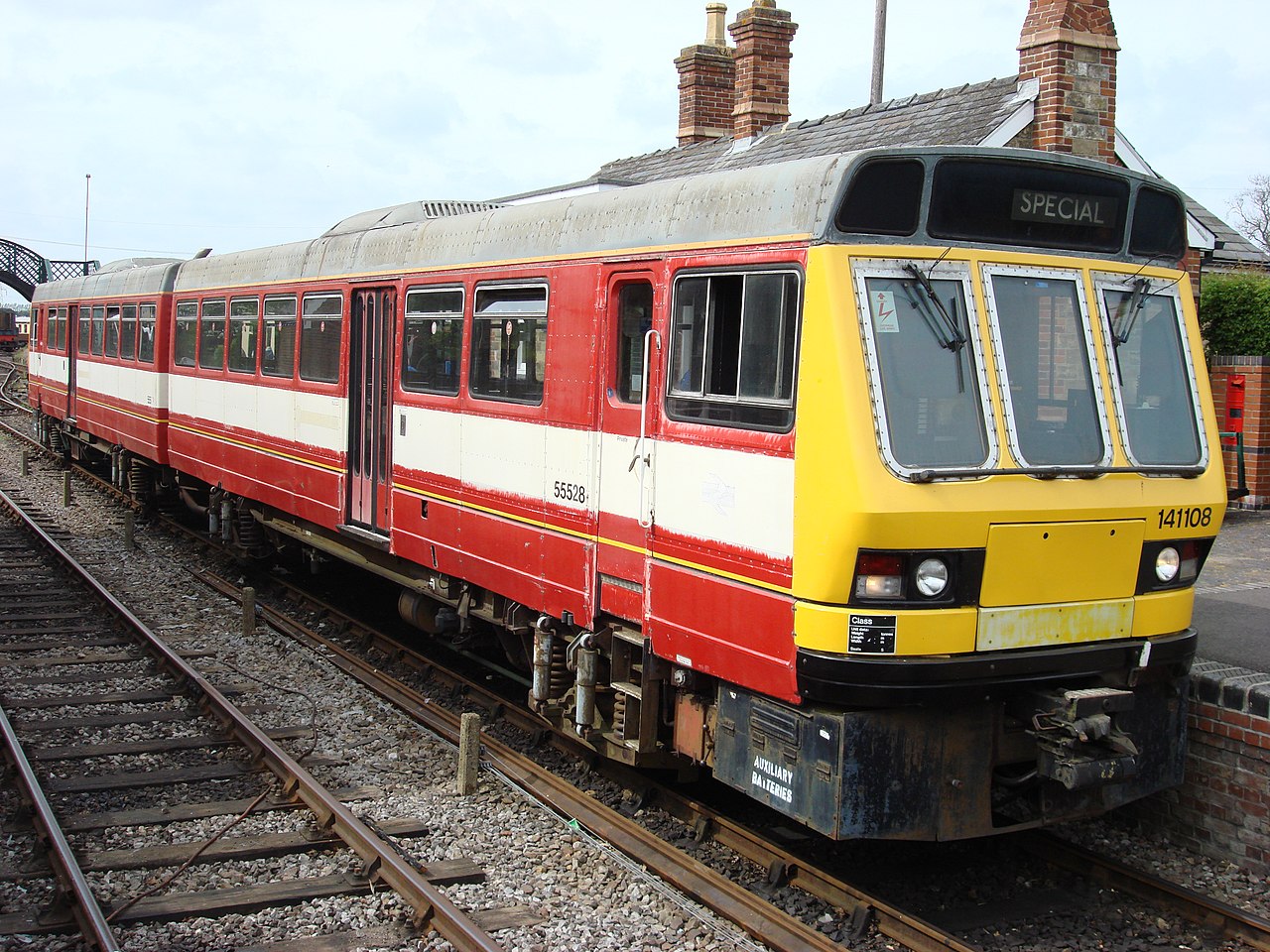


Design and key characteristics
The Class 141 combined bus-derived bodywork with a basic rail underframe. Each unit was typically formed of two vehicles and used conventional diesel power to drive the wheels. A distinguishing technical feature of Class 141 and other early Pacers was the absence of conventional bogies beneath each carriage; instead each vehicle used a two-axle (four-wheel) arrangement. This simplified construction reduced manufacturing cost and weight but had important consequences for ride quality.
- Bodywork: bus-style panels and interior layout adapted for rail use.
- Running gear: short wheelbase two-axle underframes rather than bogies.
- Power: diesel engines typical of contemporary DMUs, with straightforward transmission systems.
- Capacity and fittings: seating and basic amenities intended for short journeys.
Origins and development
Development of the Class 141 took place against a backdrop of constrained budgets and a pressing need to replace elderly branch-line trains. Manufacturers with bus-building experience provided bodies that could be mounted on economical rail frames, making rapid, lower-cost production feasible. The Class 141 was followed by other Pacer variants that refined the concept to varying degrees, but all shared the aim of minimizing initial expenditure.
Service use and performance
Class 141 units served on local and rural passenger services where demand and track conditions made expensive new trains hard to justify. They were used on short, frequent runs and commuter services rather than on long-distance expresses. Operators appreciated their low purchase cost and relatively simple maintenance, but the units were less popular with passengers and staff because of their noisy ride and limited suspension.
Criticism, modifications and legacy
From the start the Class 141 attracted criticism for rough ride characteristics and audible wheel/rail interaction known as flanging or squeal, particularly on tight curves. The bus-derived suspension and short wheelbase made these effects more pronounced than on conventional bogie-equipped trains. During their lives several units were modified or refurbished to improve interiors, reliability and noise insulation, and later Pacer subclasses incorporated incremental improvements. Over time, most Class 141s were withdrawn and replaced by modern lightweight DMUs and refurbished units with better ride quality and accessibility.
Notable facts and distinctions
The Class 141 is notable chiefly as the first production Pacer design: an influential experiment in low-cost regional rolling stock that highlighted trade-offs between capital expense and passenger comfort. While often maligned for ride quality, Pacers—including the Class 141—played a pragmatic role in maintaining services on secondary routes until more suitable trains became available. Some examples found their way into heritage collections or were repurposed for non-passenger duties after withdrawal from frontline service. For further institutional context see British Rail.
Overall, the Class 141 illustrates how economic pressure can drive unconventional engineering solutions: inexpensive and functional enough to fill a need, but with compromises that limited their longevity as preferred passenger vehicles.
Related articles
Author
AlegsaOnline.com British Rail Class 141 Pacer diesel multiple unit Leandro Alegsa
URL: https://en.alegsaonline.com/art/14341
Sources
- therailwaycentre.com : "Class 141"
- barrowmoremrg.co.uk : Vehicle Diagram Book No. 220 for Diesel Multiple Unit Trains (Railcars)