
British Rail Class 127 diesel multiple unit
First-generation four-car DMUs built by BR Derby in 1959 for suburban commuter services; notable for their 4-car DMBS+TSL+TS+DMBS formation and role in postwar British Rail modernization.
Overview
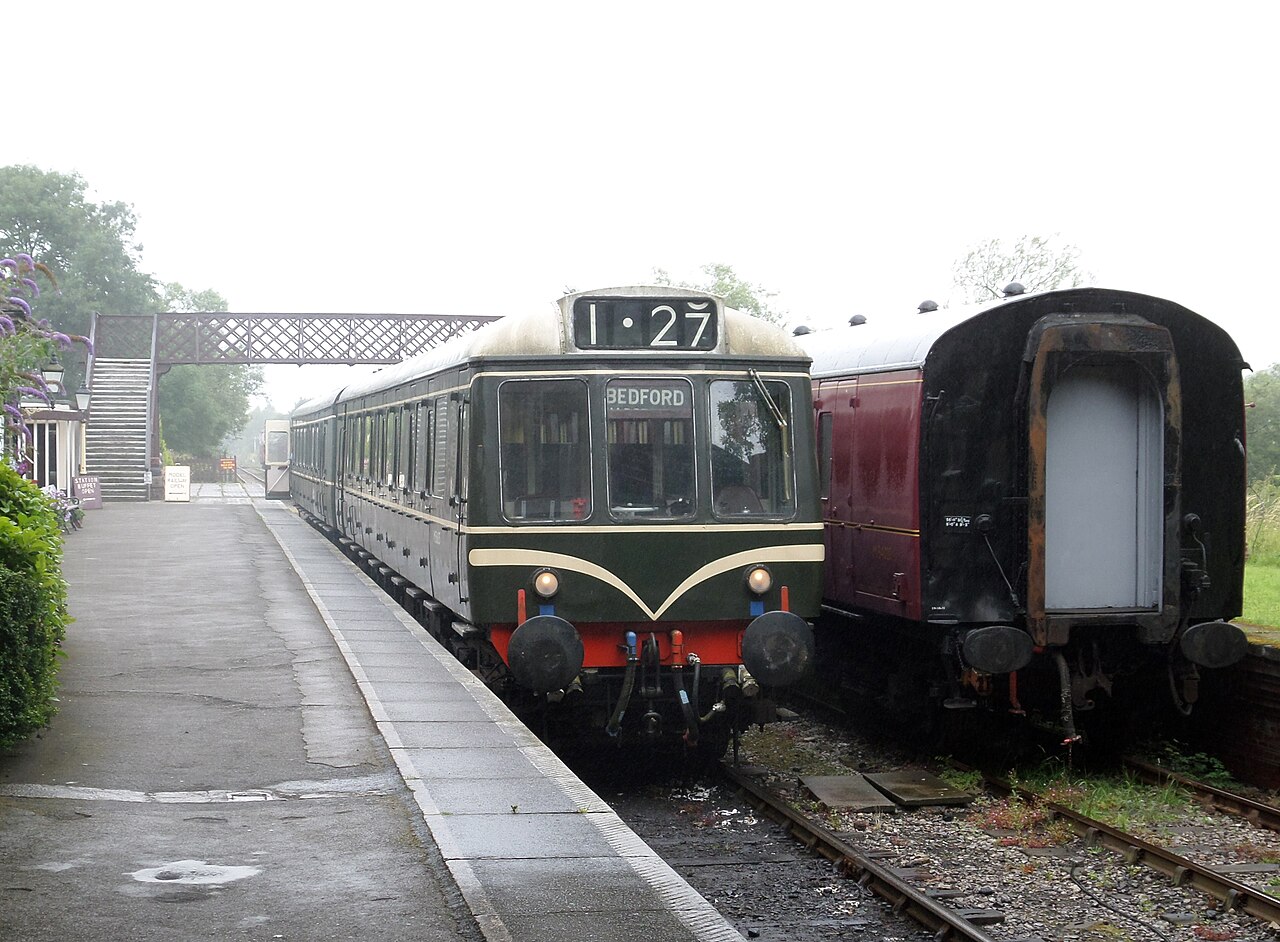
The British Rail Class 127 was a group of first-generation diesel multiple units (DMUs) constructed by BR Derby in 1959. A total of thirty four-car sets were produced. They were purpose-built for intensive suburban and commuter duties and became one of the recognizable types introduced during British Railways' modernization program of the late 1950s and early 1960s.
Image gallery
5 Images



Design and formation
Each Class 127 set comprised two driving motor vehicles at the outer ends and two intermediate trailer cars between them. The standard technical formation is recorded as DMBS + TSL + TS + DMBS, where DMBS denotes Driving Motor Brake Second, TSL denotes Trailer Second with Lavatory, and TS denotes Trailer Second. This layout provided a mix of powered driving ends, passenger accommodation and a guard/brake compartment.
Characteristics and operation
Class 127 units were designed for short, frequent-stop services. Their layout and construction emphasized rapid boarding and alighting, robustness for high‑turnover commuter use, and simple maintenance compatible with contemporaneous depot facilities. They formed fixed four-car sets rather than loose-coupled single cars, which simplified operation on busy suburban routes.
Service history
Introduced into traffic in 1959, the Class 127s served on a range of suburban services where their formation and performance matched the needs of commuters and short-distance travelers. They remained part of the BR DMU fleet through the 1960s and beyond, contributing to the replacement of steam traction on many local routes. Over time, as newer rolling stock and operational changes arrived, the Class 127s were gradually superseded and withdrawn from regular service.
Legacy and notable facts
The Class 127 is often cited as an example of the early-generation DMUs that represented a major shift in British suburban rail travel after World War II. They are distinguished by their four-car fixed sets and the DMBS bookend arrangement. A small number of vehicles are known to have survived into preservation and enthusiasts' circles, which has helped to keep the class' history accessible to the public.
Further reading
- General histories of British first-generation DMUs and the modernization plan: see publications and online summaries at Class 127 overview.
- Technical details and unit diagrams are available in specialist sources and preservation group notes: diesel multiple units references.
- Information about BR Derby and the works that built these units: BR Derby works.
Related articles
Author
AlegsaOnline.com British Rail Class 127 diesel multiple unit Leandro Alegsa
URL: https://en.alegsaonline.com/art/14334