
Malcolm X (El‑Hajj Malik El‑Shabazz): life, ideas, and legacy
Biography of Malcolm X—born Malcolm Little—covering his early life, conversion to Islam, leadership in the Nation of Islam, pilgrimage to Mecca, break with the NOI, assassination, and lasting influence.
Malcolm X (born Malcolm Little, May 19, 1925 – February 21, 1965), later known as El‑Hajj Malik El‑Shabazz, was a prominent African American activist and Muslim leader whose speeches and writings reshaped mid‑20th century discussions about race, identity, and human rights in the United States. He rose to national attention as a minister and spokesperson for the Nation of Islam, later left that movement, embraced orthodox Islam after a pilgrimage, and founded organizations that emphasized Black self‑determination and international human rights.
Image gallery
10 Images

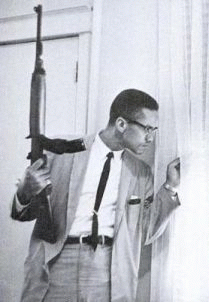


Early life and formative experiences
Malcolm was born in Omaha, Nebraska, into a family active in Black community organizing. His father, Earl Little, was a Baptist preacher and supporter of Black self‑help movements; his mother, Louise, struggled to support the family after Earl’s death when Malcolm was a child. The family experienced harassment from white supremacist groups, and financial hardship led to traumatic separations during Malcolm’s youth. As a young man he moved between Boston and Harlem and became involved in street life and petty crime.
Prison, conversion, and rise in the Nation of Islam
Arrested in 1946 for armed robbery, Malcolm spent several years in prison. There he encountered the teachings of the Islam as interpreted by the Nation of Islam and converted. On release he adopted the surname "X" to signify the loss of his African ancestral name and became a vocal and charismatic minister for the Nation. His critique targeted systemic racism and urged Black pride, economic self‑reliance, and self‑defense; these positions contrasted with the nonviolent integrationist approach then associated with other civil‑rights leaders.
Pilgrimage, change in outlook, and new organizations
In 1964 Malcolm made the pilgrimage to Mecca, after which he took the name El‑Hajj Malik El‑Shabazz and announced that his experiences led him to a broader, global view of racial justice. He began to embrace Sunni Islam and to speak in terms of human rights on an international stage. Following public differences with Nation leadership, he left the movement and founded the Muslim Mosque, Inc. and the Organization of Afro‑American Unity, seeking to link domestic struggles to anti‑colonial movements abroad.
Ideas, rhetoric, and public impact
Malcolm X is remembered for forceful rhetoric that emphasized dignity, self‑respect, and the right of oppressed people to defend themselves. His phrases and speeches, such as "by any means necessary," captured his willingness to challenge American institutions and to press for immediate change. He also evolved toward a more inclusive vision late in life, advocating collaboration across racial and national lines while maintaining emphasis on Black agency.
Assassination and contested aftermath
On February 21, 1965, Malcolm X was assassinated while preparing to address a crowd at the Audubon Ballroom in New York City. Three men were convicted in the deaths; questions and investigations about the circumstances and possible broader conspiracies have persisted and shaped discussions about the period. Malcolm’s death intensified his stature as a martyr for many who sought radical change in American society.
Legacy and cultural presence
Malcolm X’s influence extends through political movements, literature, music, and film. His autobiography, developed with Alex Haley, remains widely read; his speeches and life story continue to inspire debate on race, religion, and strategy for social change. He helped shape what became known as the Black Power era and remains a complex, frequently cited figure in histories of the American civil‑rights movement.
Further reading and notable works
- The Autobiography of Malcolm X (with Alex Haley) — a widely read account of his life and evolution.
- Collected speeches and interviews, including "The Ballot or the Bullet" and other addresses that illustrate his changing views.
- Historical studies of the Nation of Islam and mid‑20th century Black activism provide context for his role and influence.
For more information on Malcolm X's role in African American nationalism, see materials on African‑American nationalism and civil rights movements (civil rights). Biographical and religious contexts are available through resources on the Baptist tradition, the challenges faced by family members such as his mother (Louise Little), and discussions about race and colorism in American history (skin color, racial pride). Additional archival and scholarly sources may be found via general collections and institution pages (religion, biography, Nation of Islam).
Questions and answers
Q: Who was El-Hajj Malik El-Shabazz?
A: El-Hajj Malik El-Shabazz was a prominent African American activist and nationalist, also known as Malcolm X.
Q: What was Malcolm X's original name?
A: Malcolm X's original name was Malcolm Stuart Little.
Q: How did Malcolm X's parents influence him?
A: Malcolm X's parents taught him to be proud of being black in an openly anti-black society.
Q: How did Malcolm X join the Nation of Islam?
A: Malcolm X was introduced to the Nation of Islam and Islam while he was in jail, and he joined the Nation after he was released.
Q: Why was Malcolm X arrested in 1946?
A: Malcolm X was arrested in 1946 for armed robbery when he was 20 years old.
Q: How long was Malcolm X in jail for?
A: Malcolm X was in jail for 8 years after being arrested for armed robbery in 1946.
Q: When did Malcolm X die?
A: Malcolm X died on February 21, 1965.
Related articles
Author
AlegsaOnline.com Malcolm X (El‑Hajj Malik El‑Shabazz): life, ideas, and legacy Leandro Alegsa
URL: https://en.alegsaonline.com/art/125735