
John Horton Conway
English mathematician known for the Game of Life, work in group theory, knot theory, number theory, combinatorial game theory and influential recreational mathematics.
John Horton Conway (26 December 1937 – 11 April 2020) was an English mathematician whose work combined deep research and playful invention. He made influential contributions across several mathematical areas and became widely known to the public for a simple but profound computer simulation. He was elected a Fellow of the Royal Society and later held an emeritus chair in the United States.
Image gallery
2 Images
Areas of work
Conway's research spanned both pure and applied topics. He published on knot theory, number theory, and combinatorial game theory, and he also contributed to coding theory. His papers often connected abstract algebraic ideas with concrete combinatorial constructions and puzzles.
Game of Life and recreational mathematics
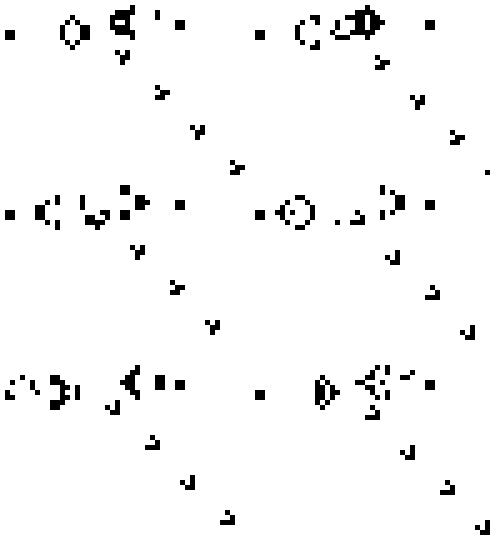
Conway popularized a class of discrete models called cellular automata by introducing the best-known example: the Game of Life. This two-dimensional rule set produces surprisingly rich behavior from simple local rules and has become a standard example in complexity, emergence and computer simulation. Beyond Life, Conway devised many games, puzzles and number systems that captured public imagination.
Career and honours
He worked in both the United Kingdom and the United States and is widely associated with advanced research and teaching. He served as Professor Emeritus of Mathematics at Princeton University and spent much of his career interacting with colleagues and students across disciplines. He also had connections to the mathematical community in New Jersey and elsewhere.
Legacy and notable ideas
Conway invented or popularized several concepts that continue to be studied: constructions in finite group theory, the family known as the Conway groups, lively developments in combinatorial games and the creation of surreal numbers (a comprehensive class of numbers that extend the real line). His style—combining rigorous proof with striking examples and recreational appeal—left a lasting imprint on how mathematics is communicated.
Death
Conway died on 11 April 2020. His death, reported as related to COVID-19, occurred in New Brunswick, New Jersey. Obituaries and remembrances highlighted both his technical achievements and his gift for making mathematics approachable to broad audiences.
- Fields mentioned: knot theory, number theory, combinatorial game theory, coding theory
- Famous inventions: Game of Life (cellular automaton)
- Affiliation: Princeton University in New Jersey
Related articles
Author
AlegsaOnline.com John Horton Conway Leandro Alegsa
URL: https://en.alegsaonline.com/art/122501
Sources
- ukwhoswho.com : "CONWAY, Prof. John Horton"
- royalsociety.org : The Royal Society: John Conway Biography
- genealogy.math.ndsu.nodak.edu : John Horton Conway
- doi.org : 10.1080/10586458.1996.10504585
- doi.org : 10.1109/18.59931
- doi.org : 10.1016/0097-3165(93)90070-O
- neilsloane.com : "Fast quantizing and decoding and algorithms for lattice quantizers and codes"
- doi.org : 10.1109/TIT.1982.1056484
- doi.org : 10.1016/0097-3165(90)90057-4
- dailyvoice.com : COVID-19 Kills Renowned Princeton Mathematician, 'Game Of Life' Inventor John Conway In 3 Days