
Cellular automaton: definition, structure, history, and applications
A cellular automaton is a discrete model of computation and dynamical systems built from a grid of simple cells that update by local rules; used in mathematics, computer science, physics and modeling.
Overview
A cellular automaton is a discrete, abstract system made of a regular lattice of cells, each of which can hold a finite number of states. Time advances in uniform steps; at each step every cell updates its state simultaneously according to a local rule that depends only on its own current state and the states of nearby cells. Cellular automata are studied across computer science and mathematics as simple models that can produce complex behavior from simple rules.
Image gallery
9 Images



Structure and rules
Typical cellular automata are defined by a few elements: the shape of the lattice (one-, two- or higher-dimensional), the set of possible states for each cell, the neighbourhood pattern that determines which adjacent cells influence updates, and the transition function or rule that maps neighbourhood configurations to new states. Neighbourhoods are often small (for example, the immediate orthogonal and diagonal neighbours in a grid), and rules are deterministic, although probabilistic variants also exist.
History and development
The concept emerged in the mid-20th century as researchers explored discrete models of computation and self-reproducing systems. Early work by researchers such as Stanislaw Ulam and John von Neumann introduced the idea of cellular automata as a framework for studying self-reproduction and complex dynamical processes; see Ulam and von Neumann for foundational context. Later examples and popularizations, including Conway's Game of Life, brought wider attention to the field.
Behavior, examples, and typical phenomena
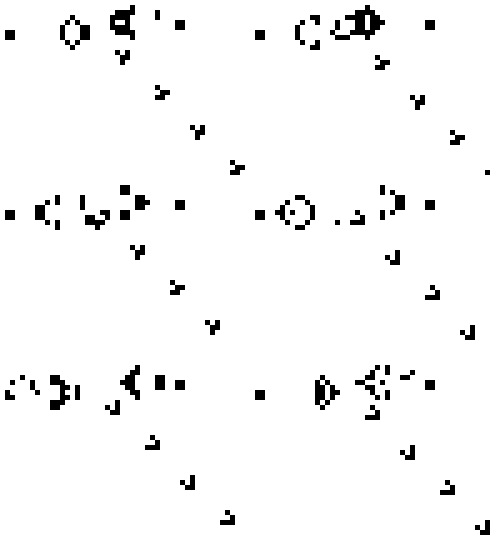
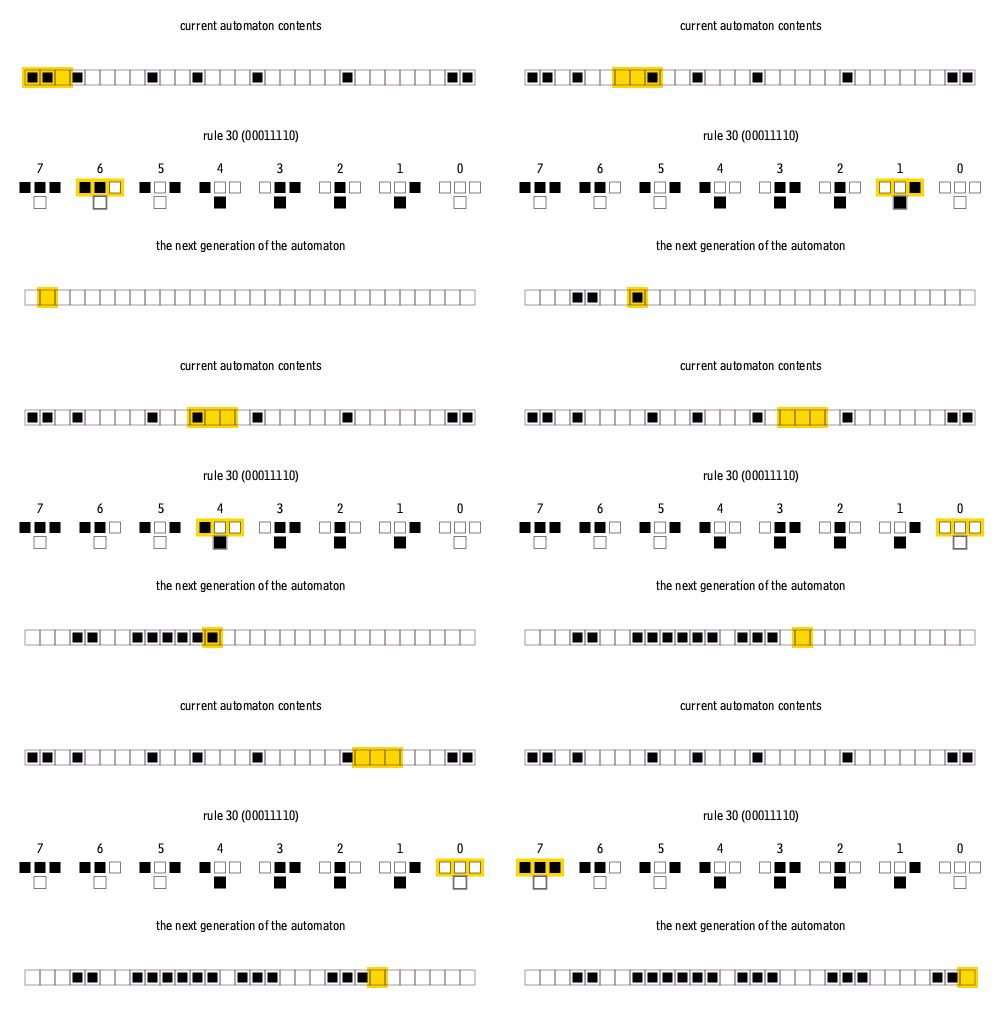
Cellular automata can display a wide range of behaviors: fixed points, periodic oscillations, propagating structures, chaotic evolutions, and patterns that appear to compute. Famous instances include Conway's Game of Life, elementary one-dimensional rules such as Rule 30 and Rule 110, and many probabilistic lattice models used in physics. These systems are often explored experimentally to classify rule classes and emergent phenomena.
Applications and significance
Beyond theoretical interest, cellular automata serve as tools and metaphors in multiple domains. They are used to model physical processes (diffusion, crystal growth, fluid flow approximations), biological patterns (morphogenesis and population spread), and computation (parallel, decentralized algorithms and simulations). Their simplicity makes them useful for teaching concepts of emergence and for prototyping models where locality and discrete time are natural assumptions.
Notable distinctions and further notes
- Deterministic vs probabilistic: many classical automata are deterministic, but randomness can be incorporated.
- Reversible automata: some rules allow unique backward evolution; others do not.
- Universality: certain rules can emulate general-purpose computation, a property explored in theoretical computer science.
For introductory surveys and formal definitions, readers can follow materials in computer science and mathematical literature that examine both specific examples and general classification methods. Cellular automata remain a compact, versatile framework for studying how complex, large-scale patterns can arise from simple, local interactions.
Questions and answers
Q: What is a cellular automaton?
A: A cellular automaton is a model used in computer science and mathematics that models a dynamic system by using a number of cells. Each cell has one of several possible states, and with each iteration the state of the current cell is determined by its current state and the states of the neighbouring cells.
Q: Who first described cellular automata?
A: Stanislaw Ulam and John von Neumann first described cellular automata in the 1940s.
Q: What is an example of a cellular automaton?
A: An example of a cellular automaton is Conway's Game of Life, which was first shown in the 1970s.
Q: How does a cellular automaton work?
A: A cellular automaton works by modeling a dynamic system using cells, each with one of several possible states. With each iteration or "turn", the state of the current cell is determined by its current state and the states of its neighbouring cells.
Q: When was Conway's Game Of Life first shown?
A: Conway's Game Of Life was first shown in the 1970s.
Related articles
Author
AlegsaOnline.com Cellular automaton: definition, structure, history, and applications Leandro Alegsa
URL: https://en.alegsaonline.com/art/17908
Sources
- maths.nott.ac.uk : The Geometry and Pigmentation of Seashells
- pnas.org : "Evidence for complex, collective dynamics and emergent, distributed computation in plants"
- ui.adsabs.harvard.edu : 2004PNAS..101..918P
- doi.org : 10.1073/pnas.0307811100
- ncbi.nlm.nih.gov : 327117
- pubmed.ncbi.nlm.nih.gov : 14732685
- gilly.stanford.edu : gilly.stanford.edu