
Jerome Karle: Nobel laureate and pioneer of X‑ray crystallographic methods
Overview of Jerome Karle (1918–2013), his work on direct methods for X‑ray crystallography, Manhattan Project involvement, leadership in crystallography organizations, and scientific legacy.
Overview
Jerome Karle (born Jerome Karfunkle; June 18, 1918 – June 6, 2013) was an American physical chemist best known for his central role in developing practical methods to determine crystal structures from X‑ray diffraction data. For this work he shared the 1985 Nobel Prize in Chemistry with Herbert A. Hauptman. Karle's research transformed how chemists and crystallographers deduce the three‑dimensional arrangement of atoms in molecules and solids.
Image gallery
5 Images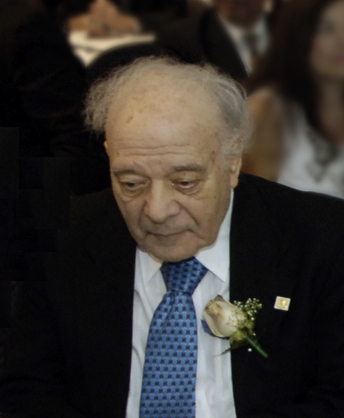


Scientific contributions
Karle specialized in the interpretation of X‑ray scattering patterns to produce electron density maps of crystals. The challenge he addressed — the so‑called "phase problem" of crystallography — arises because diffraction experiments measure only intensities and not the phases of scattered waves. Working in close theoretical partnership with Herbert A. Hauptman, Karle developed and implemented "direct methods," a set of mathematical and computational techniques that estimate phase information from intensity data. These approaches made it possible to determine structures more rapidly and with less prior information than many earlier techniques.
Career and wartime work
During World War II, Karle and his wife, Isabella Karle, contributed to wartime research efforts, including work connected with the Manhattan Project. Much of Karle's scientific career was associated with government research laboratories, where experimental and theoretical work on diffraction, electron densities, and computational algorithms advanced hand in hand. His collaborations combined chemical intuition, mathematical analysis, and practical computation.
Roles, honors and institutional service
Karle held leadership roles in the international crystallography community. He served as president of the American Crystallographic Association (ACA) in 1972 and as president of the International Union of Crystallography (IUCr) from 1981 to 1984. He was elected to the National Academy of Sciences in 1976 and became a member of the American Philosophical Society in 1990. The Nobel Prize citation recognized his contributions to the "direct analysis of crystal structures" using X‑ray techniques (direct analysis of crystal structures).
Impact and applications
Direct methods had an immediate and lasting effect on small‑molecule crystallography, allowing chemists to determine new organic and inorganic structures more quickly and reliably. The improved ability to solve crystal structures underpins advances in many areas: rational drug design, materials science, mineralogy, and the characterization of catalysts. While other techniques (such as molecular replacement and anomalous dispersion) became important for very large biological macromolecules, Karle's methods remain foundational for routine structure determination in chemistry and materials research.
Legacy and later years
Karle received many awards and honors over his career and was widely respected for combining theoretical insight with experimental practicality. His wife, Isabella Karle, was also a prominent crystallographer whose work complemented his. Jerome Karle died of liver cancer on June 6, 2013, in Annandale, Virginia. His influence continues through the widespread use of direct methods in crystallographic software and through the generations of scientists he trained and inspired.
Notable facts
- Co‑recipient with Herbert A. Hauptman of the 1985 Nobel Prize in Chemistry.
- Active in professional societies: ACA president (1972) and IUCr president (1981–1984).
- Early career involvement in wartime research during World War II, associated with projects including the Manhattan Project.
- Member of the National Academy of Sciences and the American Philosophical Society; work cited for enabling the direct analysis of crystal structures.
For further reading about specific methods, historical context, and contemporary applications, consult specialized texts on X‑ray crystallography and the history of postwar physical chemistry research (wartime science, institutional histories, and scientific biographies provide additional perspective).
Related articles
Author
AlegsaOnline.com Jerome Karle: Nobel laureate and pioneer of X‑ray crystallographic methods Leandro Alegsa
URL: https://en.alegsaonline.com/art/121863
Sources
- nrl.navy.mil : NRL Scientists Receive 1985 Nobel Prize in Chemistry
- washingtonpost.com : Jerome Karle, who shared the 1985 Nobel Prize in chemistry, dies at 94.