
Gérard Mourou: laser physicist and co-inventor of chirped pulse amplification
Overview of Gérard Mourou, his role in developing chirped pulse amplification, later research on nonlinear beam propagation, major applications, and recognition including the Nobel Prize.
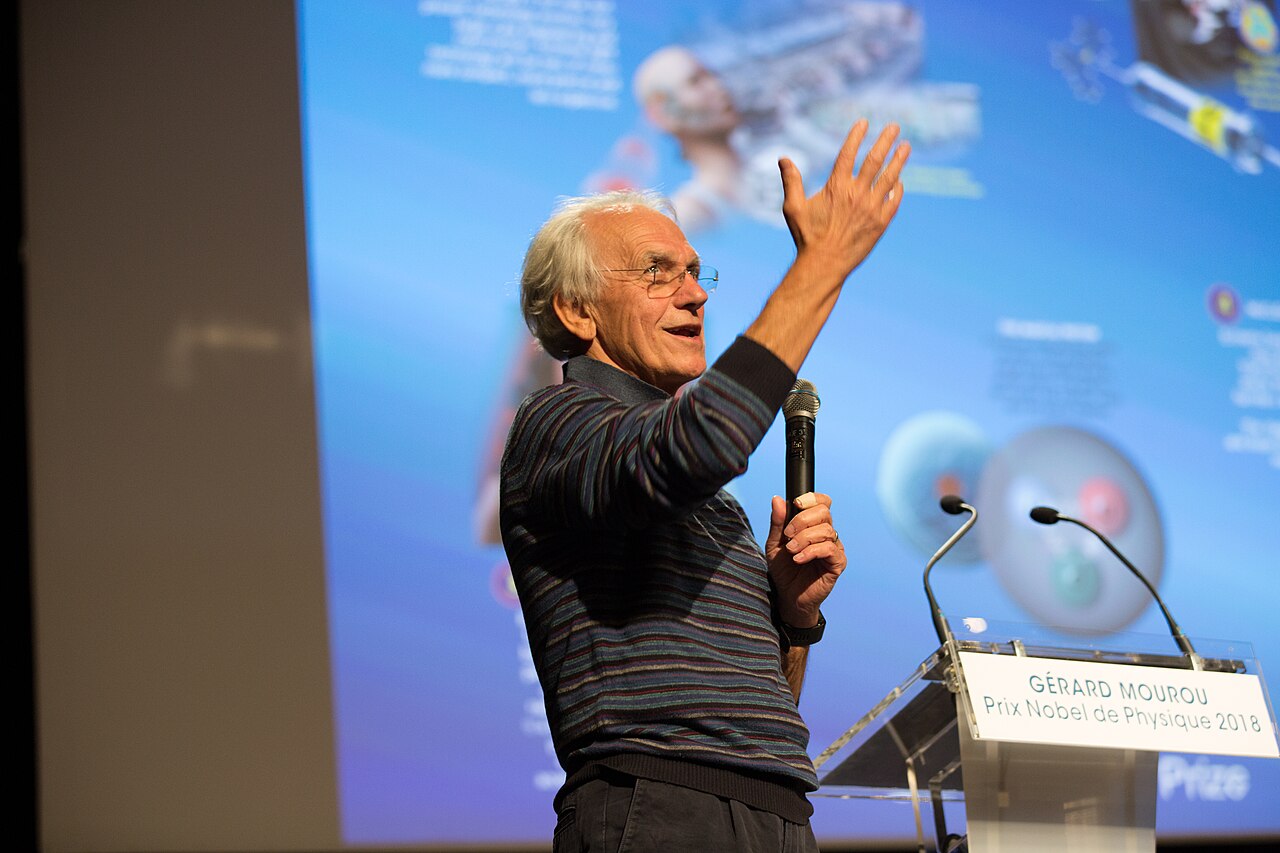
Gérard Albert Mourou is a French physicist and electrical engineer best known for pioneering techniques that made ultra‑short, ultra‑intense laser pulses practical. His work transformed laser science by enabling amplification of femtosecond pulses to very high peak power without damaging amplifying media, and it helped open new fields in fundamental physics, medicine and industry.
Image gallery
4 Images


Early career and academic positions
Mourou trained in France and built a career spanning academic posts and research centers in Europe and North America. Over decades he held positions in university laser laboratories and collaborated widely with experimental and theoretical groups. His research combined electrical engineering concepts with nonlinear optics and pulse shaping to address limits on power scaling in laser amplifiers.
Chirped pulse amplification (CPA)
In the mid‑1980s Mourou, working with colleagues including Donna Strickland, developed chirped pulse amplification (CPA). The method stretches a short pulse in time to lower its peak power, amplifies the stretched pulse safely, then recompresses it to restore a very short, extremely intense pulse. CPA solved the problem of amplifier damage and made table‑top high‑peak‑power lasers feasible.
- Basic steps: stretch → amplify → recompress.
- Impact: enabled femtosecond lasers with terawatt and petawatt peak powers.
- Applications: precision surgery, micromachining, attosecond science, particle acceleration and high‑field physics.
Nonlinear propagation and later findings
In the 1990s Mourou and collaborators at institutions including the University of Michigan investigated how intense laser beams propagate in air and other media. They explored how competing nonlinear effects — Kerr self‑focusing and defocusing mechanisms produced by plasma from ionization or related processes — can balance to guide beams over distances. Related phenomena such as self‑diffraction and filamentation influence beam quality and applications in remote sensing and laser‑atmosphere interactions.
Recognition and legacy
For the invention of CPA Mourou and Strickland received the Nobel Prize in Physics, an acknowledgment of the technique's foundational role in modern laser science. Mourou's contributions continue to shape research into ultra‑fast phenomena, high‑field interactions, compact particle sources and medical technologies that exploit controlled, high‑intensity light pulses. His work bridges fundamental optics and practical applications where precise, extreme light conditions are required.
Related articles
Author
AlegsaOnline.com Gérard Mourou: laser physicist and co-inventor of chirped pulse amplification Leandro Alegsa
URL: https://en.alegsaonline.com/art/119315
Sources
- web.archive.org : Gérard Mourou Profile