
Donald Knuth
American computer scientist and professor, author of The Art of Computer Programming, creator of TeX and literate programming, and a major figure in the analysis of algorithms.
Overview
Donald E. Knuth (born January 10, 1938) is an American computer scientist and professor widely regarded for founding modern analysis of algorithms and for authoring the multi-volume series The Art of Computer Programming. He was born in Milwaukee and raised in Wisconsin. A longtime faculty member at Stanford University, Knuth's work spans algorithm design, mathematical exposition, programming practice and digital typography. More background and biographical details are available from biographical sources and institutional pages (further reading).
Image gallery
3 Images

Major works and projects
Knuth's best-known publication is The Art of Computer Programming, a carefully structured sequence of volumes that treats fundamental algorithms, data structures and mathematical techniques for their analysis. He also created TeX, a high-quality typesetting system aimed at technical documents; METAFONT, a companion tool for designing fonts; and the concept of "literate programming," embodied in tools such as WEB and CWEB that combine human-readable documentation with source code.
Contributions and influence
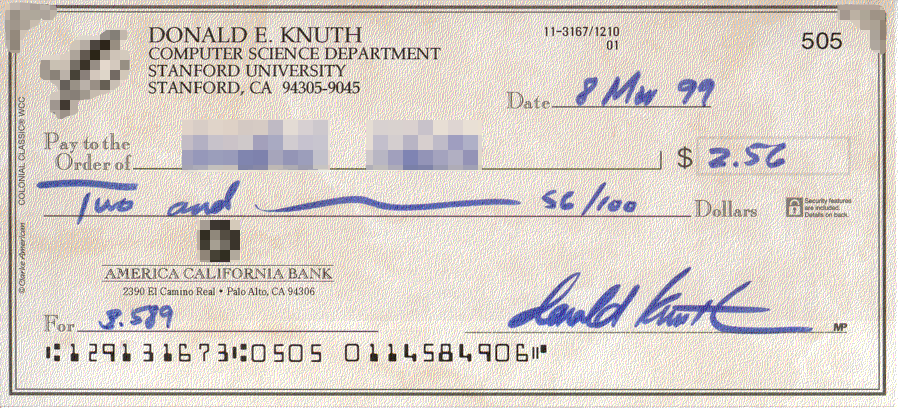
His research popularized rigorous algorithm analysis, fostering the use of precise asymptotic and combinatorial methods in computer science. Knuth coauthored or contributed to several algorithms and techniques that bear his name; his influence extends through textbooks, software tools and the many students and researchers he advised. He also introduced notational devices, such as up-arrow notation for very large integers, and maintained a distinctive practice of issuing small reward checks to readers who report errors in his books.
Recognition and legacy
Knuth's awards include major honors from computing and scientific communities. Beyond formal prizes, his work changed how generations of practitioners and theorists approach program design, proof, and documentation. TeX remains a standard for academic publishing in mathematics and related fields, and The Art of Computer Programming is still cited as a foundational reference for algorithmic thinking.
Notable facts
- Advocated literate programming to improve clarity and maintainability of code by intertwining narrative and source.
- Developed TeX to produce consistent high-quality typeset mathematics after experiencing unsatisfactory proofs quality in printed works.
- Maintains an active errata policy and a tradition of personalized reward checks for reported mistakes.
For readers seeking a detailed curriculum vitae, a list of publications, or descriptions of specific algorithms and software, the cited links provide curated entry points and references to authoritative materials. Knuth's blend of mathematical rigor, practical tools and attention to exposition continues to shape computing research, education and scholarly publishing.
Related articles
Author
AlegsaOnline.com Donald Knuth Leandro Alegsa
URL: https://en.alegsaonline.com/art/117798
Sources
- nndb.com : "Donald E. Knuth"