
Athelstan (Æthelstan): First King to Rule a Unified England, c.924–939
Athelstan (c.893–939) consolidated Anglo-Saxon kingdoms into a single English monarchy, issued laws, supported the church, and won the decisive Battle of Brunanburh; his reign reshaped 10th‑century Britain.
Athelstan (Old English Æthelstan; born c.893/894, died 27 October 939) is widely regarded as the first king to rule most of what later became England. Athelstan combined military skill, legal initiative and active patronage of the church to give the English monarchy new coherence. Though later chroniclers sometimes styled him "the Glorious," modern scholarship emphasizes his role in state-building across the early tenth century.
Image gallery
10 Images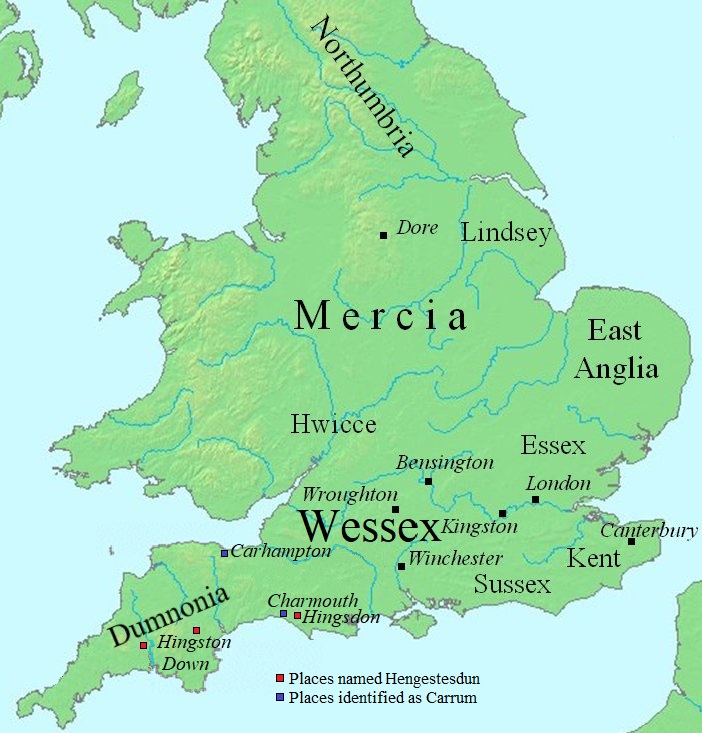




Family background and accession
Athelstan was the son of Edward the Elder and a grandson of Alfred the Great. His father had strengthened the Anglo‑Saxon realm assembled by Alfred, sometimes called the Kingdom of the Anglo‑Saxons. On Edward's death, succession was contested: Athelstan quickly became ruler in Mercia while his brother Ælfweard had stronger support in some English regions but died shortly thereafter. By 925–927 Athelstan had secured recognition as king across much of the country and was crowned with wide acclaim.
Territory and consolidation
Athelstan extended his rule into the Viking-dominated north. After arranging a dynastic marriage between a sister and the Norse ruler of York, Northumbria, he moved to take direct control when the alliance collapsed. By the later 920s his authority reached an area comparable to much of modern England. Contemporary sources report that other rulers in the island accepted his overlordship at places such as Bamburgh, indicating his influence across parts of what is now Great Britain.
Government, law and the church
Athelstan presided over a court that issued charters and legal provisions aiming to bind nobles and bishops to royal authority. He promoted the church and monastic reform, inviting scholars and collecting relics to strengthen ecclesiastical support for the crown. His laws and administrative measures sought consistency in coinage, land tenure and justice; they represent an early attempt to organize royal government over several formerly distinct kingdoms.
Military and foreign policy
Athelstan combined diplomacy with decisive military action. In 937 he led English forces to victory at the Battle of Brunanburh against a coalition of Norse, Scottish and other rulers — a battle celebrated in contemporary verse as securing England's independence from rival claimants. He also maintained diplomatic contacts with continental courts and arranged marriages and fostered ties to consolidate alliances.
Death, succession and legacy
Athelstan died at Gloucester in 939 and was succeeded by his half‑brother Edmund I. He appears to have left no legitimate children. Historians credit him with creating the political framework for a united English kingdom: his reign strengthened royal institutions, church relations and legal practice in ways that shaped the later medieval monarchy.
Notable facts and accomplishments
- First ruler to control most territories later called England.
- Patron of the church and of learning; his court attracted clerical scholars.
- Issued laws and charters that centralized royal authority.
- Won the decisive Battle of Brunanburh (937), a key moment in early English history.
Athelstan's reputation grew in later centuries: he is often remembered as a founder of the English kingdom even though the process of unification and state formation continued after his death. His reign stands as a turning point in the transformation of several Anglo‑Saxon realms into a more centralized monarchy.
Questions and answers
Q: Who was Athelstan?
A: Athelstan, also known as Æthelstan, was the first King of England who reigned from 924 to 939. He was the son of King Edward the Elder and grandson of Alfred the Great.
Q: How did Athelstan become king?
A: When his father, Edward, died Athelstan quickly became King of Mercia but he was not immediately accepted as King of England. His brother, Ælfweard had more support in England but died soon after Edward which made it easier for Athelstan to become king.
Q: What steps did Athelstan take to gain allies?
A: A year after his crowning he married one of his sisters to the Viking King of Northumbria, Sithric. However, Sithric died only a year later and Athelstan seized Northumbria which made him king of more land than any other before him - roughly the same as modern England. Historical records indicate that other rulers in Great Britain accepted him as king at Bamburgh around this time.
Q: When did Athelstan die?
A: Athelstan died at Gloucester in 939.
Q: Who succeeded him?
A: He was succeeded by his half-brother Edmund I.
Q: What importance does Athlestan's reign have in history?
A: Athlestan's reign is sometimes overlooked but it is considered very important due to its political developments during 10th century Britain.
Related articles
Author
AlegsaOnline.com Athelstan (Æthelstan): First King to Rule a Unified England, c.924–939 Leandro Alegsa
URL: https://en.alegsaonline.com/art/114687
Sources
- bbc.co.uk : Short Athelstan biography on the BBC History website
- everything2.com : Everything2.com