
624 Hektor — largest Jupiter Trojan and elongated contact‑binary candidate
624 Hektor is the largest known Jovian Trojan asteroid, an elongated D‑type object in Jupiter’s leading L4 swarm, notable for its stretched shape and a small satellite discovered by adaptive optics.
Overview
624 Hektor is the largest of the Jupiter Trojan asteroids, a population that shares Jupiter's orbit around the Sun. It was discovered in 1907 (discovery record) by the German astronomer August Kopff. Hektor occupies the leading Lagrangian point (L4) of the Sun–Jupiter system, often called the "Greek" camp of Trojans, and is classified as a dark, reddish D‑type object.
Image gallery
2 Images
Orbit and classification
Trojan asteroids congregate near Jupiter's two stable Lagrangian points, L4 (leading) and L5 (trailing). Hektor resides in the L4 or "Greek" node (L4), but it bears the name of the Trojan hero Hektor, making it one of the few Trojans that is nominally assigned to the opposite side of the legendary Trojan War; the other well‑known misplaced example is 617 Patroclus in L5. As a D‑type object, Hektor has a dark, reddish surface consistent with primitive, carbon‑rich material common among outer main‑belt and Trojan bodies.
Physical characteristics
Hektor is unusually elongated for an asteroid of its scale. Observational studies indicate dimensions on the order of about 370 × 200 kilometres, making it comparable in volume to some mid‑sized moons and notably larger than most Trojans. Because of its extreme shape, astronomers have long considered the possibility that Hektor is a contact binary — two lobes touching each other — similar to other unusual bodies such as 216 Kleopatra. Early observations with the Hubble Space Telescope in 1993 did not clearly resolve an elongated profile (1993 observations), but improvements in ground‑based adaptive optics later provided stronger evidence for an elongated or bilobed configuration.
Discovery of a satellite
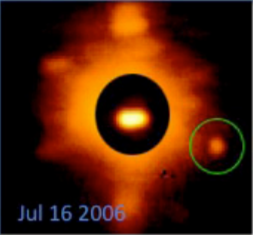
High‑resolution imaging using the Keck II 10‑metre telescope with its laser guide star adaptive optics system produced images in July 2006 that supported a stretched shape for Hektor and revealed a small companion. The moon, provisionally designated S/2006 (624) 1, was reported at a distance of roughly 1,000 kilometres from the primary and is estimated to be on the order of tens of kilometres across, with a frequently quoted approximate diameter of about 15 km. This discovery made Hektor the first known Trojan in the L4 swarm with a confirmed satellite, and the presence of the companion enables direct dynamical estimates of Hektor's mass and bulk density when sufficient orbital measurements are available (Keck AO).
Scientific importance and context
Hektor is of particular interest because of its size, unusual shape and satellite. Binaries and contact binaries among small bodies allow astronomers to derive masses and infer internal structure and porosity; those properties in turn help reconstruct conditions in the early Solar System. As a D‑type Trojan, Hektor likely preserves primitive materials that may be rich in organics and volatiles, so studies of its surface composition and thermal properties inform models of planetesimal formation and migration. Comparative study with the binary system 617 Patroclus, which consists of two roughly equal components in the L5 swarm, highlights the diversity of Trojan systems.
Notable facts and quick summary
- Largest known Jupiter Trojan asteroid, located near Jupiter's L4 (leading) point.
- Classified as a dark, reddish D‑type object indicative of primitive surface material.
- Highly elongated — approximate dimensions ~370 × 200 km — and considered a contact‑binary candidate.
- Has at least one small satellite, S/2006 (624) 1, discovered with Keck adaptive optics in 2006.
- Named after the Trojan hero Hektor, making it a notable example of a Trojan named for the opposite side of the classical naming convention.
Ongoing and future observations — including continued adaptive optics imaging, lightcurve analysis and thermal studies — aim to refine Hektor's shape model, determine the orbit and properties of its satellite more precisely, and constrain its bulk density. These measurements contribute to a broader effort to understand the origins and evolution of Jupiter's Trojan population and the role such bodies played in the early Solar System.
Questions and answers
Q: What is 624 Hektor?
A: 624 Hektor is the biggest of the Jovian Trojan asteroids. It was discovered in 1907 by August Kopff and is a dark and reddish D-type asteroid.
Q: Where does 624 Hektor lie?
A: 624 Hektor lies in Jupiter's leading Lagrangian point, L4, which is also known as the 'Greek' node after one of the two sides in the legendary Trojan War.
Q: What is unique about 624 Hektor?
A: 624 Hektor is one of the most stretched bodies of its size in the solar system, being 370 × 200 km. Additionally, it is believed to be a contact binary (two asteroids joined by gravitational attraction) like 216 Kleopatra and it has been confirmed to have a 15-km moon at 1000 km from it - making it so far, the only known binary Trojan asteroid in the L4 point and the first Trojan with a moon.
Q: Who discovered 624 Hektor?
A: 624 Hektor was discovered by August Kopff in 1907.
Q: What colour is 624 Hektor?
A: 624 Hektor has a dark and reddish colour due to it being classified as a D-type asteroid.
Q: How big is 624 Hektor compared to other objects its size?
A: Compared to other objects its size,624Hektorsizeis370×200kmwhichmakesitoneofthemoststretchedbodiesofitsizeinthesolarsystem.
Related articles
Author
AlegsaOnline.com 624 Hektor — largest Jupiter Trojan and elongated contact‑binary candidate Leandro Alegsa
URL: https://en.alegsaonline.com/art/113007
Sources
- adsabs.harvard.edu : "Pole, albedo and shape of the minor planets 624 Hektor and 43 Ariadne"
- ssd.jpl.nasa.gov : "JPL Small-Body Database Search Engine"
- cfa-www.harvard.edu : "IAUC 8732: S/2006 (624) 1 (Satellite Discovery)"