
617 Patroclus — a binary Jupiter Trojan
A binary minor planet in Jupiter's Trojan population, discovered by August Kopff in 1907. Two similar-sized objects with low density suggesting icy composition; notable as a rare co-orbital binary and Lucy mission target.
Overview
617 Patroclus is a binary minor planet co-orbital with Jupiter, belonging to the population commonly called the Jupiter Trojans. Rather than a single rock, Patroclus consists of two comparably sized components that orbit one another about a shared centre of gravity. It was the second Trojan to be identified and remains one of the best-studied examples of a binary system in that population.
Image gallery
10 Images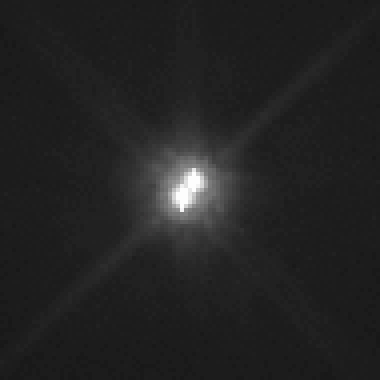


Discovery and name
The object was discovered in the early 20th century by August Kopff; it was reported shortly after the first recognized Jupiter Trojan, making it an early entry in this class of objects. The name Patroclus derives from Greek mythology and follows the naming tradition used for many of the Jupiter co-orbitals. For more on the broader population see Trojan group, and for information about the discoverer see August Kopff.
Physical characteristics
Both components of the Patroclus system are of similar size, each roughly on the order of a hundred kilometres across, and the pair circle each other in a compact mutual orbit. Observations indicate a very low overall density compared with typical inner‑belt asteroids, implying substantial internal ice or a porous structure rather than solid rock. Studies suggesting an icy composition refer to these objects as being more similar to cometary bodies; see summaries of the icy interpretation at icy comet-like bodies and contrasting views of rocky asteroids.
Orbit and classification
Patroclus shares Jupiter's orbital path around the Sun at a stable Lagrange region. Like other Trojans, its long-term motion is tied to Jupiter's gravity, and the system's stability has invited study as a fossil record of the early Solar System. Its status as a binary makes it especially valuable because the mutual orbit allows astronomers to determine the system mass and thus estimate bulk density.
Importance and exploration
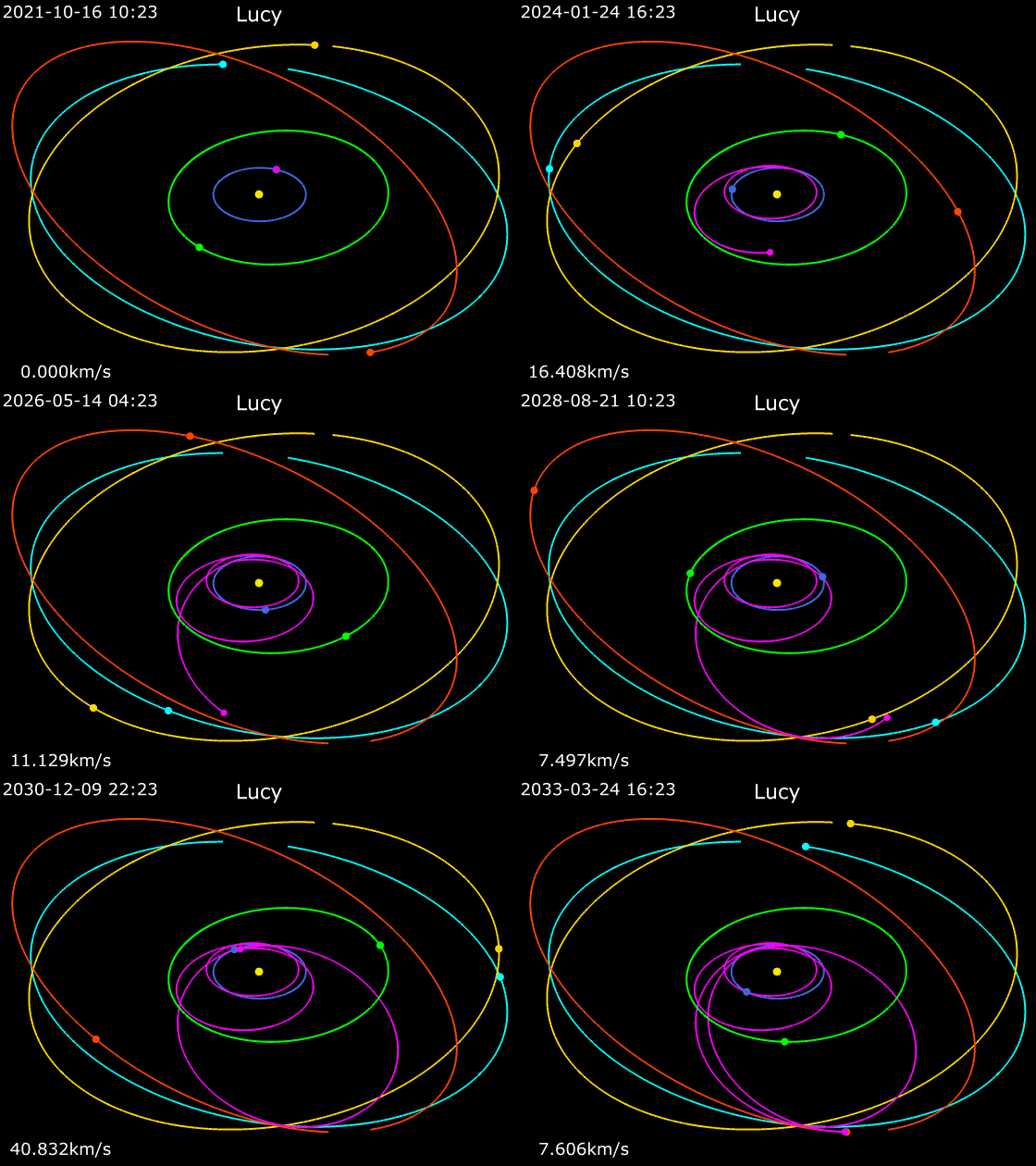
The low density and binary nature of Patroclus make it important for questions about the origin and migration of small bodies: an icy, porous composition supports ideas that some Trojans originated in the outer Solar System and were later captured. Because of its scientific interest, the Patroclus–Menoetius pair has been selected as a target for spacecraft reconnaissance, which will provide higher-resolution data on shape, composition and internal structure.
Notable facts
- One of the earliest-discovered Jupiter co-orbitals and the second known Trojan.
- Unusual among Trojans for being a near-equal-mass binary, allowing direct mass and density measurements.
- Evidence points toward a composition richer in ice than typical main-belt asteroids, influencing models of Solar System evolution.
Questions and answers
Q: What is 617 Patroclus?
A: 617 Patroclus is a binary minor planet made up of two similarly-sized objects orbiting their common centre of gravity.
Q: What is the pronunciation of Patroclus?
A: The pronunciation of Patroclus is pə-troe'-kləs or /pəˈtroʊkləs/.
Q: What is the orbit of 617 Patroclus?
A: 617 Patroclus is a Trojan, sharing an orbit with Jupiter.
Q: Who discovered 617 Patroclus?
A: 617 Patroclus was found in 1907 by August Kopff.
Q: Is 617 Patroclus a rocky asteroid or an icy comet?
A: Recent evidence suggests that the objects that make up 617 Patroclus are icy comets, rather than rocky asteroids.
Q: What does it mean for the objects to be binary?
A: Binary means that there are two objects that are similar in size orbiting a common center of gravity.
Q: How does 617 Patroclus compare to other Trojan asteroids?
A: 617 Patroclus was the second Trojan asteroid to be found.
Related articles
Author
AlegsaOnline.com 617 Patroclus — a binary Jupiter Trojan Leandro Alegsa
URL: https://en.alegsaonline.com/art/113003
Sources
- berkeley.edu : UC-Berkeley press release on cometary origin