
704 Interamnia — large main-belt asteroid
704 Interamnia is one of the largest main-belt asteroids, discovered in 1910. Roughly 350 km across, it is among the most massive belt objects and a subject for studies of primitive Solar System material.
704 Interamnia is a very large asteroid in the outer region of the main asteroid belt. With an estimated diameter of about 350 kilometres, it ranks among the biggest belt objects and is commonly cited as the fifth most massive asteroid after Ceres, Vesta, Pallas and Hygiea. Interamnia orbits the Sun at a mean distance near 3.067 astronomical units and contributes a small but notable fraction of the asteroid belt's total mass.
Image gallery
6 Images

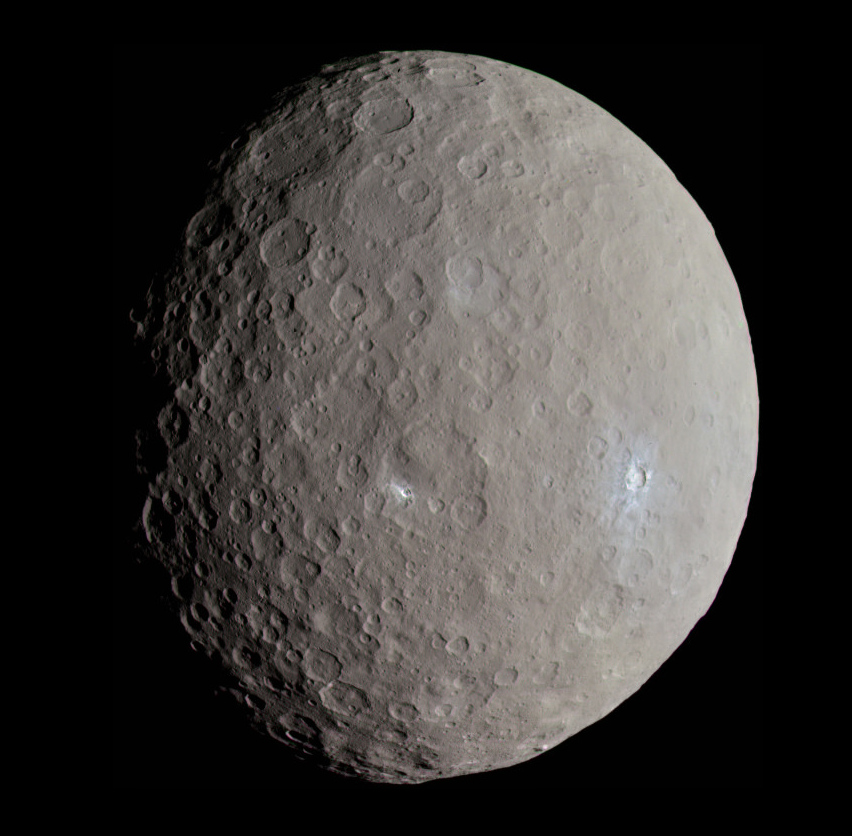


Physical characteristics
Interamnia has a low surface reflectivity (albedo) indicative of a primitive, carbon-rich surface typical of many large outer-belt bodies. Spectral observations place it among the dark, volatile-bearing classes of asteroids, although exact spectral classification varies between surveys. Its shape is not perfectly spherical; adaptive-optics imaging and lightcurve analysis suggest a large, generally rounded body with irregularities and possible large-scale depressions. Estimates of its mass and density are uncertain and depend on the methods used to determine them, but Interamnia is substantial enough to influence measurements of the asteroid belt's mass distribution.
Orbit, rotation and observational properties
Interamnia follows an orbit in the main belt with a semi-major axis near 3.067 AU. Its orbital eccentricity and inclination place it well outside the innermost belt populations. Photometric lightcurves have been used to determine its rotation period and to model its overall spin state; these techniques indicate a rotation on the scale of hours rather than days. Thermal-infrared observations help constrain its size and surface thermal properties, while radar and adaptive optics provide shape and size information when available.
Discovery and name
Interamnia was discovered on 2 October 1910 by the Italian astronomer Vincenzo Cerulli while he was working at the observatory in Teramo. The name Interamnia derives from the classical Latin name for the town of Teramo, honoring the place of discovery and the discoverer’s local connections.
Scientific importance
As one of the most massive bodies in the asteroid belt, Interamnia is important for understanding how mass is distributed among large asteroids and for constraining models of early Solar System accretion and collisional evolution. Its primitive surface makes it a useful target for studies of volatile-rich and carbonaceous material that preserve early Solar System chemistry. No spacecraft has visited Interamnia; current knowledge is built from telescopic photometry, spectroscopy, thermal-infrared measurements and high-resolution imaging from large ground-based telescopes.
Observation history and future study
Ground-based observations over more than a century have refined Interamnia's orbit, rotation state and surface properties. Continued monitoring, advances in adaptive optics and potential future missions could improve estimates of its mass, internal structure and composition. Better constraints on these properties would refine estimates of the total mass in the asteroid belt and offer insights into the diversity of large primitive bodies.
Further reading and references
- Overview of 704 Interamnia
- Orbital parameters and ephemerides
- Astronomical unit (AU) reference
- Discovery date details
- Historical context: 1910 observations
- Etymology: Latin Interamnia
- Teramo, Italy — location of discovery
- Ceres — comparative mass
- Vesta — comparative mass
- Pallas — comparative mass
- Hygiea — comparative mass
Questions and answers
Q: What is 704 Interamnia?
A: 704 Interamnia is a large asteroid that scientists estimate to be 350 kilometers wide.
Q: When was 704 Interamnia discovered?
A: 704 Interamnia was discovered on October 2, 1910 by Vincenzo Cerulli.
Q: What is the meaning behind the name 704 Interamnia?
A: The name 704 Interamnia comes from the Latin name for Teramo, Italy, which is where Cerulli worked.
Q: How far is 704 Interamnia from the Sun?
A: 704 Interamnia's mean distance from the Sun is approximately 3.067 (AU).
Q: What is the mass of 704 Interamnia compared to other asteroids?
A: Scientists believe that 704 Interamnia is the fifth heaviest asteroid after Ceres, Vesta, Pallas, and Hygiea, making up around 2.0% of the mass of the entire asteroid belt.
Q: Who discovered 704 Interamnia?
A: 704 Interamnia was discovered by Vincenzo Cerulli in 1910.
Q: What is the significance of 704 Interamnia's name?
A: The name 704 Interamnia is derived from the Latin name for Teramo, Italy, where Vincenzo Cerulli made his discovery.
Related articles
Author
AlegsaOnline.com 704 Interamnia — large main-belt asteroid Leandro Alegsa
URL: https://en.alegsaonline.com/art/113039