
Wikidata: the Wikimedia structured knowledge base
Wikidata is a free, collaborative, multilingual knowledge base created by the Wikimedia movement. It stores structured data about people, places, concepts and identifiers for reuse by humans and machines.
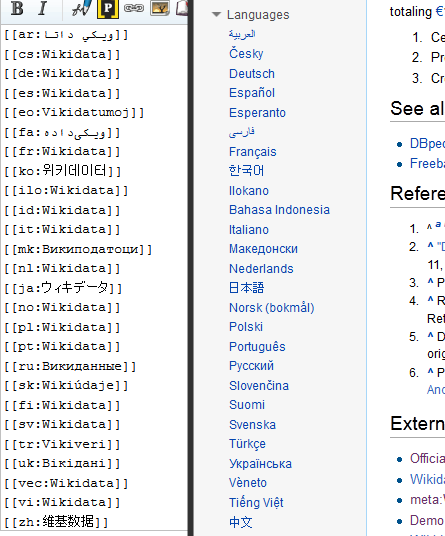
Wikidata is a collaboratively edited, multilingual knowledge base founded by the Wikimedia community to provide structured data to Wikimedia projects and the wider web. Launched in 2012, it centralizes facts in a machine-readable form so that the same statements and interlanguage links can be used across many sites. The project aims to be both human-readable and accessible to software through APIs and query services. For an official entry point see Wikidata.
Image gallery
7 Images


What it contains and how it is organised
The core unit of Wikidata is the "item": an entity described by a unique identifier, a label in multiple languages, aliases and a set of statements. Statements link items to values using properties; they can include qualifiers and references to indicate context and sources. In addition to items and properties, Wikidata supports lexical data (lexemes) and site links that connect a single item to pages in other Wikimedia projects. In technical terms it functions as a structured database of facts and identifiers that can be retrieved programmatically.
History and development
Originally created to centralize interlanguage links and reduce duplicated effort across Wikipedia editions, Wikidata has evolved into a general-purpose knowledge graph. Since its launch it has grown rapidly through manual edits and automated contributions (bots), and its data model has been extended to handle provenance, ranks, and complex qualifiers. The project is governed by community policies and editorial norms developed on project pages and discussion channels.
Access, licensing and tools
Wikidata is designed for reuse: its content is available without restrictive copyright terms and can be queried via web APIs and a public SPARQL endpoint (the Wikidata Query Service). Developers, researchers and other projects consume the data in many ways — from infoboxes on Wikipedia to external applications and data visualizations. The platform also integrates with other Wikimedia resources such as Wikipedia and Wikimedia Commons, and contributes identifiers and reconciled references to the wider web of data (linked data).
Uses and examples
- Providing multilingual labels and centralised facts for Wikipedia infoboxes and lists.
- Serving as an identifier hub that connects concepts to authority files, catalogues and external databases.
- Powering queries and visualizations of structured knowledge in research, journalism and apps.
Because Wikidata stores statements with qualifiers and references, it supports claims that require nuance (for example, time-bounded roles or disputed values). The open nature of the project also means that quality is maintained by a combination of community review, constraint checks and bot edits. For more technical details and community resources consult project pages and query endpoints linked from the main site here.
Related articles
Author
AlegsaOnline.com Wikidata: the Wikimedia structured knowledge base Leandro Alegsa
URL: https://en.alegsaonline.com/art/108027
Sources
- wikidata.org : wikidata.org/wiki/Wikidata:Introduction
- alexa.com : "Wikidata.org Traffic, Demographics and Competitors - Alexa"
- wikidata.org : "Statistics"