
Winchester Model 1897
A widely used pump-action shotgun designed by John Browning, notable for its exposed-hammer design, military 'trench gun' role, and long service in civilian and armed forces roles.
Overview
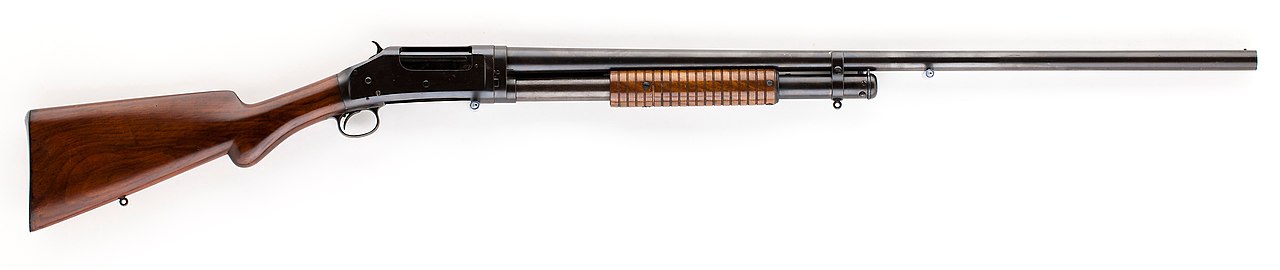
The Winchester Model 1897 is a pump-action shotgun designed by John Moses Browning and introduced by the Winchester Repeating Arms Company in the late 19th century. Often called the Model 97 or simply the "M97," it became one of the era's most recognizable repeating shotguns. It was built to feed from a tubular magazine beneath the barrel and to offer a reliable, simple action for hunters, police, and soldiers alike. For background on pump-action mechanisms, see more on pump-action shotguns.
Image gallery
10 Images






Design and characteristics
The Model 1897 retained an exposed hammer and a slide-action fore-end. It was chambered mainly in 12-gauge (and other gauges in some versions) and accepted multiple types of shot loads, from birdshot to buckshot. A notable operational trait was the ability to "slam-fire" when the trigger was held down continuously while cycling the action, allowing faster successive shots.
- Feeding: tubular magazine under the barrel
- Action: slide (pump) with exposed hammer
- Ammunition: commonly 12-gauge; variants in other gauges
- Construction: steel receiver and wooden stock and fore-end
History and military service
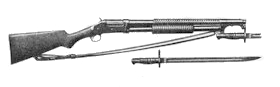
After its release Winchester refined the earlier Model 1893 into the stronger 1897 design to handle smokeless powder and heavier loads. The shotgun saw notable adoption by the United States military, which procured specialized short-barreled versions for close-quarters combat. These military patterns—frequently called "trench guns"—were fitted with heat shields and bayonet lugs for frontline use. The Model 1897 served in major conflicts of the early 20th century, including World War I and later conflicts such as World War II, and appears in many armament histories of the period (military use).
Variants and civilian uses
Beyond the military trench gun, Winchester produced sporting and law-enforcement variants. Short-barrel riot models were popular with police and security services, while longer-barrel hunting versions remained common among civilians. The shotgun's robust simplicity made it a practical choice for many roles, from field sports to home defense and patrol work. Contemporary collectors prize both civilian and service models.
Legacy, controversies and notable facts
The Model 1897 has a lasting reputation for reliability and stopping power at short range; its wartime nickname and role in trench warfare contributed to its notoriety. Its slam-fire capability and convenience in tight quarters shaped shotgun tactics and prompted discussion about combat ethics and rules of engagement. The design influenced later pump-action shotguns and remains an important milestone in repeating firearm development (design history, performance, trench combat). For further reading on variants and documentation, see reference collections and museum entries (additional resources).
Questions and answers
Q: Who invented the Winchester Model 1897 pump-action shotgun?
A: John Moses Browning invented the Winchester Model 1897 pump-action shotgun.
Q: Was the Winchester Model 1897 widely used during World War I and World War II?
A: Yes, the Winchester Model 1897 was so popular that it was used by the US military during both World War I and World War II.
Q: What was the nickname given to the Winchester Model 1897 by the military?
A: The Winchester Model 1897 was called the "trench gun" by the military.
Q: What is the range of the Winchester Model 1897?
A: The Winchester Model 1897 was a deadly weapon at short range, especially in trenches.
Q: Was the Winchester Model 1897 an automatic weapon?
A: No, the Winchester Model 1897 was a pump-action shotgun.
Q: Could the shooter fire the Winchester Model 1897 quickly?
A: Yes, the shooter could shoot quickly by holding down the trigger while pumping the shotgun.
Q: What makes the Winchester Model 1897 a deadly weapon?
A: The Winchester Model 1897 was a deadly weapon at short range, especially in trenches.
Related articles
Author
AlegsaOnline.com Winchester Model 1897 Leandro Alegsa
URL: https://en.alegsaonline.com/art/108464