
Voltage divider (resistor or potential divider)
A simple circuit that produces an output voltage proportional to an input by using two or more resistive elements; commonly implemented with fixed resistors or a potentiometer.
A voltage divider is a fundamental electrical circuit that produces an output voltage that is a fixed fraction of its input voltage. It is one of the simplest ways to scale voltages in electronics and is often called a resistor divider or potential divider. Most basic dividers use two resistors in series between a supply (Vin) and ground; the output is taken from the junction between them.
Image gallery
2 Images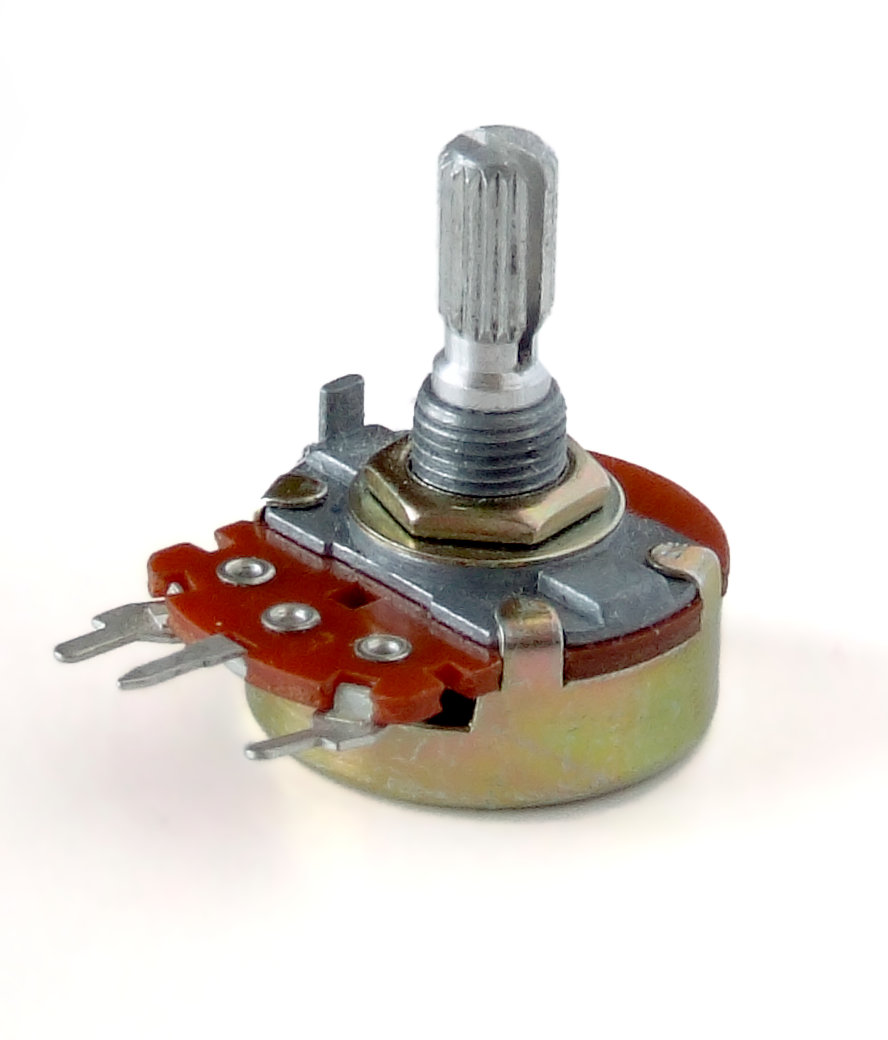

Basic principle and formula
For a two-resistor divider, if R1 is the resistor between Vin and the output node and R2 is between the output node and ground, the unloaded output voltage follows the well-known relation Vout = Vin × R2 / (R1 + R2). This simple expression lets designers choose resistor values to obtain a desired fraction of Vin. A single potentiometer acts as an adjustable divider when its wiper taps the series element.
Parts, behavior and practical considerations
Key characteristics include output impedance, power dissipation and sensitivity to loads. A divider's output node has a source impedance roughly equal to the parallel combination of R1 and R2; connecting a load with resistance comparable to these values changes the voltage (the load appears in parallel with R2). This loading effect is often analyzed by replacing the divider with its Thevenin equivalent.
Common uses and examples
- Voltage reference or biasing for transistor stages and op-amp inputs.
- Signal attenuation to bring larger voltages within the range of analog-to-digital converters.
- Adjustable controls such as audio volume pots (a potentiometer used as a divider).
- Simple sensor circuits where a sensor forms one leg of the divider to convert resistance changes into a voltage change.
Designers must balance trade-offs: using large resistor values reduces standby current but increases output impedance and susceptibility to noise; small values give a stiffer source but waste power as heat. For stable or low-impedance references, active buffering (for example, using an op amp) is preferred to prevent loading errors.
Further reading can clarify specialized topics: basic theory and examples of voltage dividers, practical design notes and calculations at electronics guides like component tutorials, potentiometer usage and wiring shown at potentiometer references. For analysis tools and circuit equivalents consult Thevenin and Norton resources or simulation examples at circuit simulation guides.
Related articles
Author
AlegsaOnline.com Voltage divider (resistor or potential divider) Leandro Alegsa
URL: https://en.alegsaonline.com/art/105883