
Valhalla: The Hall of the Slain in Norse Tradition
Valhalla (Old Norse Valhöll) is Odin’s great hall in Norse myth where warriors chosen by the valkyries dwell as einherjar, feast, and prepare to fight at Ragnarök; attested in medieval Icelandic sources.
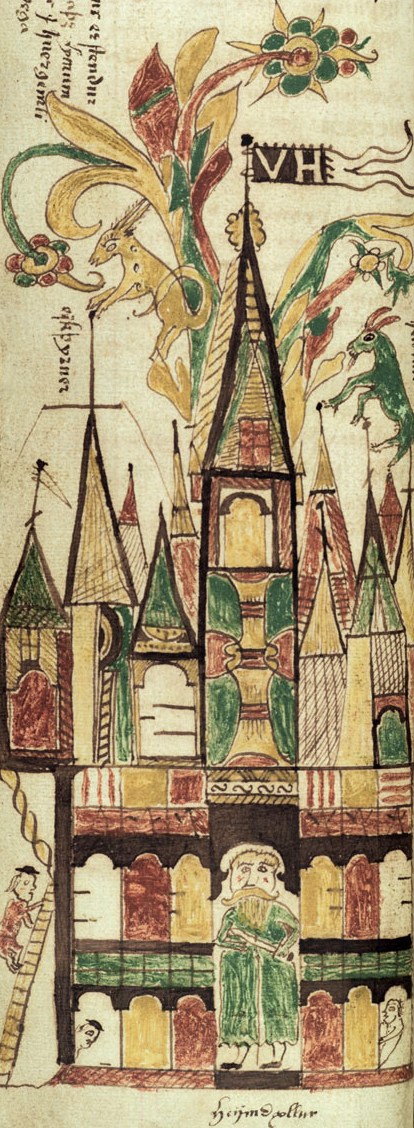
Norse mythology describes Valhalla (Old Norse Valhöll, “hall of the slain”) as a great and glorious hall in Asgard presided over by Odin. In the surviving medieval texts the hall is presented as a destination for those who die in battle and are selected by the valkyries; these chosen dead are commonly called einherjar. The image of Valhalla emphasises a communal afterlife linked to martial honour, feasting, and preparation for a final, apocalyptic conflict known as Ragnarök.
Image gallery
10 Images


Attestations and sources
Primary literary attestations of Valhalla occur in the Poetic Edda and the Prose Edda, compilations of older oral and skaldic material preserved in medieval Iceland. These sources provide vivid but sometimes uneven descriptions: they preserve motifs and names yet do not form a single, unified system. Later saga literature and skaldic verses refer to valkyries, Odin, and the einherjar in ways that echo and adapt the Eddaic material. Modern understanding therefore relies on patching together references and comparing them with broader Germanic ritual and heroic contexts.
Description and inhabitants
Valhalla is often described as a large timbered hall whose rafters gleam with shields and weapons. A mighty tree, named Læraðr, stands at or above the hall; upon its foliage graze the goat Heiðrún, which supplies mead, and the stag Eikþyrnir, whose dripping gives rise to rivers. Outside the hall is Glasir, a tree noted for golden leaves. The residents are the einherjar, who spend their days practising combat and their nights feasting.
Daily life, food, and attendants
The Prose Edda and poetic passages describe a perpetual banquet: a monstrous beast called Sæhrímnir is cooked each day by the divine cook Andhrímnir in the cauldron Eldhrímnir and is renewed each night so the einherjar may feast again. Heiðrún produces an unending supply of mead. Valkyries serve not only as choosers of the slain but as attendants who bring the fallen to the hall where tales of battle are told and weapons are sharpened.
Function and symbolic meanings
Scholars interpret Valhalla as both a theological and ideological construct: it sanctifies the warrior ethos by promising an honoured afterlife for those who die in combat and it creates a collective body—the einherjar—kept ready to fight at the end of the world. Valhalla contrasts with other destinations for the dead, such as Hel and Freyja’s field Folkvangr, where some slain are said to go instead. The hall is thus part of a pluralistic afterlife imagination in Germanic belief.
Reception and later influence
From medieval storytelling through folk memory to modern literature, art, and popular culture, Valhalla’s motifs—hall of shields, choosers of the slain, endless feasting—have been adapted and reinterpreted. Romantic and nationalist movements of the 19th and 20th centuries often drew on such imagery, and in contemporary media Valhalla appears in a wide variety of forms, reflecting changing attitudes toward heroism, war, and myth. Interpretations vary: some stress ritual and funerary parallels in early Germanic practice, others read Valhalla as a literary construction of medieval authors.
Comparative points and open questions
- Comparison: Valhalla sits alongside Folkvangr and Hel in the Norse afterlife topology and highlights divergent outcomes for the dead.
- Ritual echoes: Elements of feasting and the transformation of the slain resonate with known funerary customs and poetic tropes across Germanic sources.
- Ambiguities: The texts leave room for debate over how literally contemporary communities understood Valhalla and how much later authors shaped the image.
Further reading and resources
Readers interested in primary poems and prose narratives should consult editions and translations of the Poetic Edda and Prose Edda, as well as studies of valkyrie motifs and the einherjar tradition. For general overviews of the wider mythic framework see works on Norse myth and on Odin’s role in warrior ideology. Scholarly discussions also compare Valhalla with other Indo-European hero-halls and explore its reception in modern culture; for thematic or popular treatments, many introductions and annotated collections are available that summarize the main attestations and debates.
Valhalla remains one of the most striking and durable images from the Norse corpus: a communal hall of the honoured dead, bounded by rich symbolic detail and linked to the eschatological vision of Odin and the gods as they face the final struggle at Ragnarök. For contextual entries and related articles, see treatments of Asgard, Odin, and the cultural role of valkyries and the einherjar in medieval Nordic literature.
Related articles
Author
AlegsaOnline.com Valhalla: The Hall of the Slain in Norse Tradition Leandro Alegsa
URL: https://en.alegsaonline.com/art/104031