
Vamana — Vishnu’s Brahmin Avatar and the Trivikrama Legend
Vamana is the fifth avatar of Vishnu, who appears as a Brahmin dwarf and then as the cosmic Trivikrama. The story of Bali, the three strides, and the festival of Onam highlight themes of dharma, humility, and kingship.
Overview
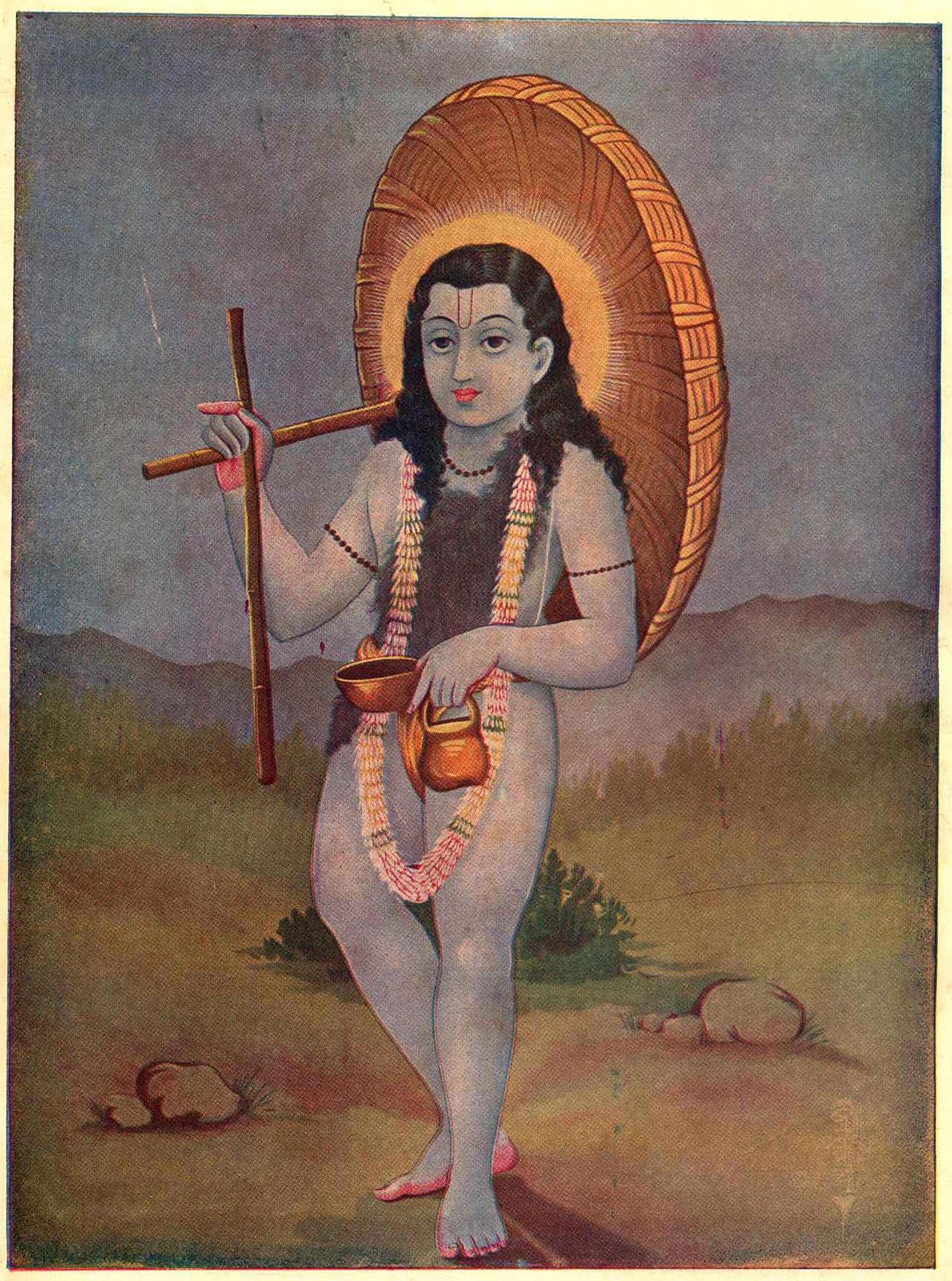
Vamana is one of the principal avatars of Vishnu, traditionally counted as the fifth incarnation in lists of divine descents. In this narrative the deity adopts the appearance of a young Brahmin—small in stature and unassuming in manner—to address a crisis of cosmic order. Vamana is closely associated with the epithet Trivikrama ("he who measured the three worlds"), a title that refers to the miraculous expansion that follows the initial disguise. The episode is best known for the compact but powerful exchange between Vamana and the Asura king Bali, and it is widely recounted in Puranic literature and later folk traditions.
Image gallery
10 Images



Key elements of the story
- The context: a powerful king named Bali (often described as an Asura ruler) had gained supremacy over the heavens and challenged the authority of the gods. His conquests alarmed the celestial beings and their mother figure, Aditi, who appealed to Vishnu for relief.
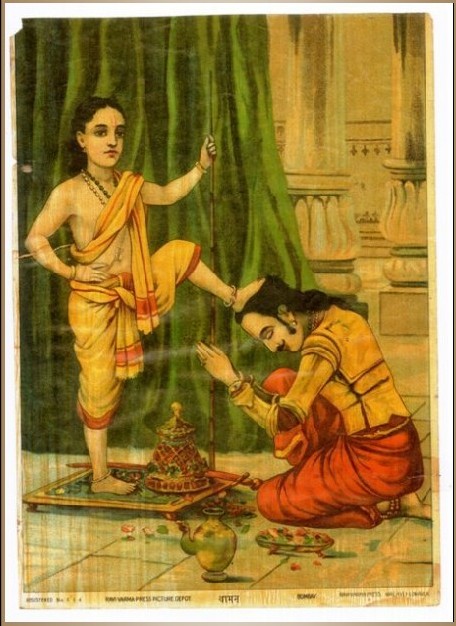
- The request: Vishnu appears as a Brahmin youth and approaches Bali during a sacrificial ceremony. He asks for a simple gift—land measuring three paces—offered as dakshina to a mendicant or holy man, a customary act of honor.
- The transformation: when Bali grants the request, Vamana grows to enormous proportions. With the first stride he covers the earth, with the second he spans the heavens, and, lacking any place for the third, Bali offers his own head as the final step.
- The outcome: impressed by Bali’s generosity and steadfastness, Vishnu grants him rulership of the subterranean realm (Patal) and a promise of protection. Bali is remembered and honored rather than destroyed.
Sources and names
The tale appears in several classical Hindu texts, most prominently in Puranic accounts and devotional works. It is often told under the names Vamana (the dwarf or Brahmin form) and Trivikrama (the cosmic stride). This dual naming reflects the story’s tension between apparent smallness and overwhelming power. Readers interested in broader lists of divine manifestations can consult materials on avatars and related traditions; the form taken by Vamana—incarnate as a human-like mendicant—is discussed in contexts that describe the deity appearing as a human being for the sake of restoring balance.
Symbolism and interpretation
- Cosmic order: Vamana’s three steps symbolize the reassertion of proper hierarchy and limits—earth, heaven, and the final surrender represented by Bali’s head.
- Dharma and generosity: the episode emphasizes sacred obligations such as hospitality and the moral weight of gifts; Bali’s readiness to give everything marks him as righteous despite his earlier ambition.
- Humility and power: the story contrasts outward humility (a small Brahmin) with hidden omnipotence, suggesting that true authority may operate through unexpected forms.
Cultural practices and legacy
The Vamana–Bali narrative has influenced ritual life, regional festivals, and temple iconography. In parts of South India, the annual festival of Onam commemorates the return and benevolent rule of King Bali and celebrates agricultural abundance and social harmony. Artistic depictions vary: some images show Vamana as a diminutive ascetic, while others portray Trivikrama with one foot on earth and the other raised in the act of measuring the cosmos. Temples and devotional literature preserve the tale as an enduring illustration of theological themes—divine intervention, the sanctity of vows, and the reconciliation of conquest with compassion.
Notable distinctions
Unlike avatars that emphasize martial victory, the Vamana story resolves conflict through a combination of cunning, ritual formality, and moral exemplarity rather than simple annihilation. Bali’s elevation to a protected and honored position illustrates a recurring pattern in Hindu narrative: enemies are often transformed into loyal retainers or redeemed figures when they demonstrate virtue in key moments. As a result, Vamana remains a distinctive avatar whose lessons on power, piety, and promise continue to be retold across religious and cultural contexts.
Related articles
Author
AlegsaOnline.com Vamana — Vishnu’s Brahmin Avatar and the Trivikrama Legend Leandro Alegsa
URL: https://en.alegsaonline.com/art/104123