
Tuas Link MRT Station (EW33) — Western Terminus of the East West Line
Tuas Link (EW33) is the western terminus of Singapore's East West MRT Line, serving the Tuas industrial area and offering connections toward the Malaysia–Singapore Second Link and local bus services.
Overview
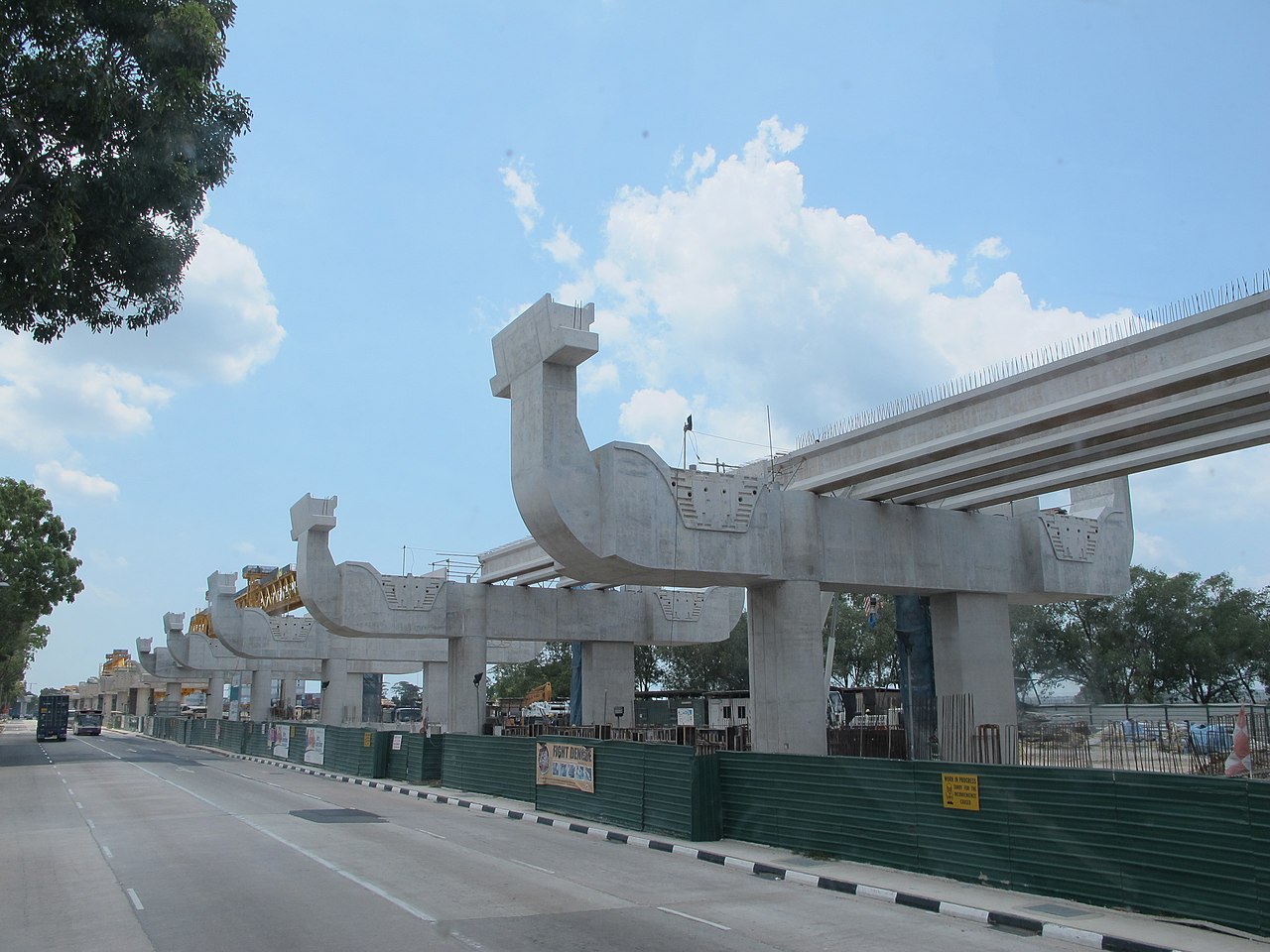
Tuas Link MRT station (EW33) is an elevated Mass Rapid Transit facility on the East West Line that serves the Tuas industrial precinct in western Singapore. As the western terminus of the East West Line, it is the network's westernmost station and acts as a transit node for thousands of workers and visitors traveling to this predominantly industrial and maritime zone. The station was opened to the public as part of a western extension to the line, improving rail access to an area previously dependent on bus and private transport.
Image gallery
7 Images



Design and layout
The station departs from the conventional single-level elevated design in that the passenger platforms sit at a lower elevation than the station control room, fare gates and ticketing concourse above. This split-level arrangement concentrates passenger facilities on the upper concourse while train boarding takes place on a lower platform level, which helps to reduce the station footprint and to manage passenger flows more efficiently. The station accommodates two tracks and terminal operational arrangements that permit trains to reverse direction for return runs toward the city.
Facilities and accessibility
Tuas Link provides standard commuter amenities found across the network, including sheltered walkways from entrances, barrier-controlled ticketing gates, tactile guidance for visually impaired passengers, lifts and ramps for step-free access, and real-time service information displays. The station connects to nearby bus stops and industrial shuttle services that distribute passengers across the surrounding factories, logistics hubs and shipyards. Its facilities are designed to handle heavy shifts of commuters during typical peak periods in the industrial workday.
History and development
The station was constructed as part of an initiative to extend rail services further into the western industrial corridor. The extension aimed to provide a more reliable and higher-capacity alternative to road travel for workers and freight-related personnel. The opening of the station shortened daily commutes for many who previously relied on multiple bus transfers or private vehicles. Its construction followed urban planning priorities to integrate public transport with industrial growth and port-related activities in the Tuas area.
Access, nearby landmarks and restrictions
Tuas Link is within walking distance of several coastal and transport landmarks, including recreational marinas and the road route leading to the Malaysia–Singapore Second Link. Notable nearby points include Raffles Marina and the vehicular Tuas Checkpoint associated with cross-border traffic. Travelers should note that Tuas Checkpoint is a vehicular border facility: pedestrians are not permitted to enter the checkpoint on foot from the station, and those making cross-border journeys must use appropriate vehicular or designated pedestrian crossings where available and permitted.
- Connectivity: rail services to the city and transfer options to local bus routes.
- Proximity: industrial estates, marinas and highway access toward the Second Link.
- Restriction: no pedestrian access into the Tuas vehicular checkpoint from the station.
Importance and notable facts
As the terminus of a major MRT line, Tuas Link plays an important role in Singapore's transport network by supporting the large workforce in the western industrial corridor and by providing an alternative to congested roads. It holds the distinction of being the westernmost station on the MRT network and one of the first above-ground stations to place passenger platforms below the concourse level. For more details on the Mass Rapid Transit system and the East West Line, see general system information about the Mass Rapid Transit (MRT) and the East West Line. For location context, consult resources on Tuas and the broader regional planning material for Singapore.
The station continues to evolve as surrounding developments change; planners monitor ridership and local land use so that walkways, bus links and cycling connections can be improved to meet commuter needs. While primarily serving industrial commuters, the station also supports occasional leisure travel to coastal facilities and acts as a gateway to the western edge of Singapore's rail network.
Questions and answers
Q: Where is Tuas Link MRT station located?
A: Tuas Link MRT station is located in Tuas, Singapore.
Q: Which MRT line does Tuas Link MRT station belong to?
A: Tuas Link MRT station belongs to the East West Line.
Q: Is Tuas Link MRT station an above-ground or underground station?
A: Tuas Link MRT station is an above-ground station.
Q: What is special about the platform level at Tuas Link MRT station?
A: The platforms at Tuas Link MRT station are on a lower level than the station control room, fare gates and ticketing machines.
Q: What are some nearby landmarks to Tuas Link MRT station?
A: Some nearby landmarks to Tuas Link MRT station include Raffles Marina, Tuas Checkpoint, and the Malaysia-Singapore Second Link.
Q: Is it possible to enter Tuas Checkpoint on foot via Tuas Link station?
A: No, it is not possible to enter Tuas Checkpoint on foot via Tuas Link station as the checkpoint is designated as a vehicular checkpoint.
Q: What is the role of Tuas Link station in the MRT network?
A: Tuas Link station is the western terminus of the East West Line, and the westernmost MRT station in the network.
Related articles
Author
AlegsaOnline.com Tuas Link MRT Station (EW33) — Western Terminus of the East West Line Leandro Alegsa
URL: https://en.alegsaonline.com/art/101918
Sources
- lta.gov.sg : "Tuas West Extension Opens on 18 June 2017"
- channelnewsasia.com : "Tuas West Extension MRT stations to open Jun 18"
- straitstimes.com : "Stroll through 'grand' Tuas Link MRT station"
- channelnewsasia.com : "24 more trains for Circle Line by 2015"
- app.lta.gov.sg : "Land Transport Authority – What's New :: Construction Starts for Tuas West Extension"
- app.mot.gov.sg : app.mot.gov.sg
- app.lta.gov.sg : "Construction Starts for Tuas West Extension"
- tnp.sg : "Tuas West Extension on East-West Line to be isolated"
- lta.gov.sg : "Update on Train Services on Tuas West Extension - Press Room - Land Transport Authority"
- todayonline.com : "Tuas West Extension suspended until Sun; no service for Joo Koon-Gul Circle for 1 month"
- straitstimes.com : "Tuas West stations to reopen only on Monday"
- todayonline.com : "Joo Koon MRT collision: Faulty train was transiting between old and new signalling systems"
- straitstimes.com : "Joo Koon-Gul Circle link to remain closed till mid-2018"