
Being and Nothingness: Jean‑Paul Sartre’s Phenomenological Ontology
A clear, concise overview of Jean‑Paul Sartre’s 1943 work Being and Nothingness: its aims, main concepts (being‑in‑itself, being‑for‑itself, bad faith), method, historical context and influence.
Overview
Being and Nothingness is Jean‑Paul Sartre's major philosophical study first published in 1943. Written by the French philosopher Jean‑Paul Sartre, it sets out an account of human freedom and subjectivity from a phenomenological perspective. The book aims to describe the structures of consciousness and the conditions that make personal freedom intelligible, while rejecting deterministic or purely psychological explanations of action.
Image gallery
1 Image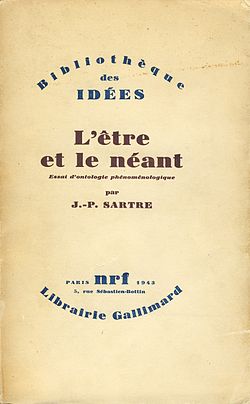
Main concepts
Sartre develops several interconnected notions that recur throughout the work. He distinguishes two fundamental modes of being: "being‑in‑itself" and "being‑for‑itself." The former names the inert, opaque existence of objects; the latter names conscious beings capable of reflecting on themselves. From this distinction follow ideas such as:
- Nothingness: a gap or lack that arises in consciousness and allows for negation and choice.
- Bad faith (mauvaise foi): self‑deception in which people deny their freedom by pretending to be fixed things.
- Facticity and transcendence: the tension between the concrete facts that shape a life and the subject's capacity to project itself into possibilities.
- The Look and the Other: how encounters with other people can objectify the self and create conflict.
Method and influences
Sartre works in the phenomenological tradition, drawing on the methods of description associated with Edmund Husserl and engaging with Martin Heidegger's ontology. Rather than offering an abstract system, he attempts close analyses of concrete lived situations — emotion, reflection, everyday interaction — to reveal the structures that make freedom and responsibility possible. He also outlines an "existential psychoanalysis" as a way to explain individual choices in terms of projects and values.
Historical context and publication
Published during World War II, the book entered a European intellectual climate preoccupied with freedom, responsibility and political engagement. Its appearance helped to consolidate a movement labeled existentialism, though Sartre resisted simplistic labels. The work addresses questions about human existence, being, and ethical responsibility, and has been widely discussed in philosophy, literature and political thought.
Importance and reception
The book is seen as a cornerstone of 20th‑century continental philosophy. It influenced discussions on subjectivity, freedom (freedom) and authenticity and inspired writers and activists beyond strictly academic circles. Critics have praised its ambition and psychological insight while challenging aspects of its metaphysics and claims about interpersonal relations. Scholars continue to debate its arguments about freedom and the limits of self‑deception.
Further reading and distinctions
For introductions and critical studies consult works that situate Sartre’s project within broader philosophy and phenomenology. Because the book combines descriptive analysis with normative implications, readers often contrast it with analytic treatments of freedom or with Heidegger’s earlier existential ontology to clarify points of agreement and divergence.
Being and Nothingness, Sartre and the debates it generated remain central to understanding modern thought about self, other and freedom.
Related articles
Author
AlegsaOnline.com Being and Nothingness: Jean‑Paul Sartre’s Phenomenological Ontology Leandro Alegsa
URL: https://en.alegsaonline.com/art/10160