
Transvaal: historical province and region of northern South Africa
Transvaal, once a Boer republic and later a South African province (1910–1994), denotes a region north of the Vaal River with distinct historical, political and economic importance in South Africa.
Overview
The Transvaal — literally ‘‘beyond the Vaal’’ — refers to a broad region of northern South Africa. The name is most commonly associated with the territory that formed the core of the Boer-led Afrikaner polity known as the South African Republic (ZAR). During the late 19th and 20th centuries Transvaal was an important centre of agriculture, mining and colonial administration, and the term continues to be used informally to describe the area's geography and historical identity.
Image gallery
3 Images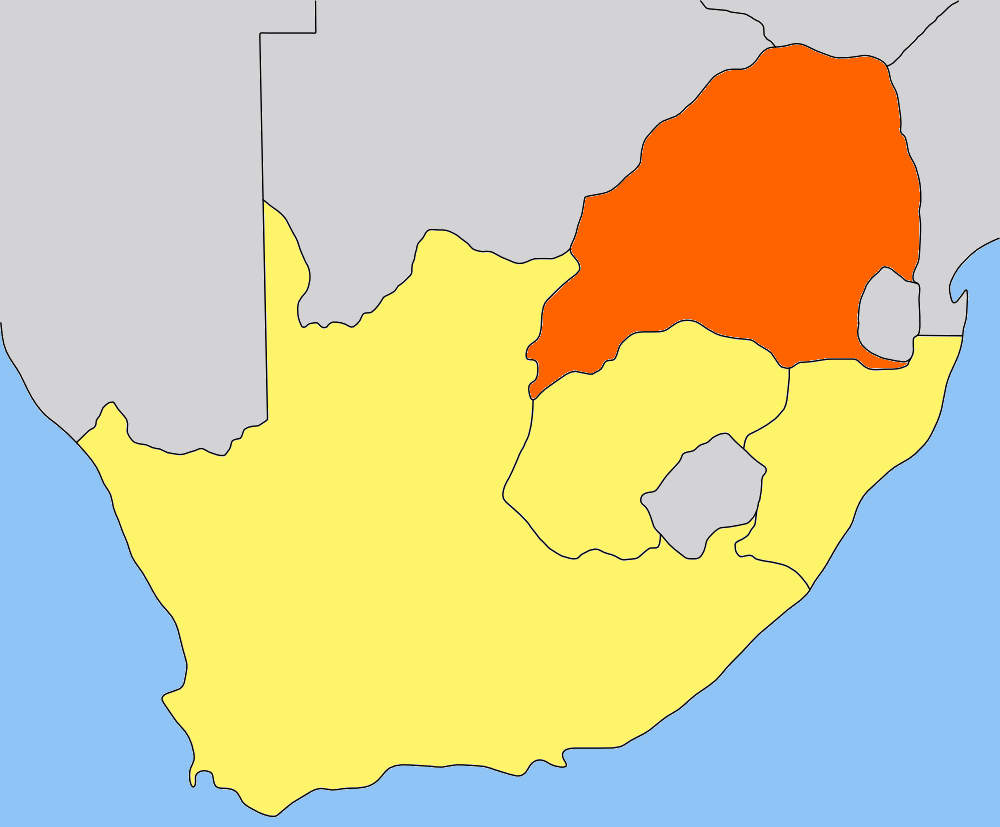


Geography and administrative evolution
Geographically, Transvaal denotes the lands north of the Vaal River and includes highveld plateaus, river valleys and mineral-rich districts. After the Second Boer War the area was administered by the British as the Transvaal Colony. With the formation of the Union of South Africa in 1910, Transvaal became one of the original provinces with its capital at Pretoria. The province was dissolved in 1994 and its territory was divided among several modern provinces, notably Gauteng, Limpopo and Mpumalanga, with parts allocated to the North West province.
History and key events
The political history of Transvaal spans independent Boer governance, armed conflict with the British, and incorporation into South Africa. Major phases include:
- Early Boer settlement and the establishment of the South African Republic, concentrating Afrikaner political institutions and frontier farms.
- Discovery of gold and other minerals in the late 19th century, which transformed the region’s economy and intensified international interest and immigration.
- Conflict and the Anglo-Boer War, after which the British annexed the territory and created the Transvaal Colony.
- Union-era provincial status from 1910 until the end of apartheid-era provincial borders in 1994.
Economic and cultural significance
Transvaal’s mineral wealth—especially the Witwatersrand goldfields—helped make the region an economic engine for southern Africa and a magnet for migrants, investors and industry. Towns and cities that grew from mining and administration, including Pretoria and Johannesburg, remain central to South Africa’s economy and government. The region also played a major role in Afrikaner politics and identity, and its history is closely linked to debates over land, labour and urbanisation.
Legacy and modern usage
Although Transvaal no longer exists as a formal province, the term persists in cultural memory, historical writing and place names. It appears in literature, local institutions and comparative discussions of provincial boundaries. Contemporary references often distinguish the historic Transvaal from the post-1994 provinces that now occupy its former territory, and scholars and residents alike use the name to evoke the region’s particular historical trajectory.
Further reading and resources
For more on the Transvaal’s political history, demographic change and economic development consult regional histories, archival collections and museum materials. Introductory summaries and archival guides are available through national and local institutions; for general context see resources on South Africa, Afrikaner history via Boer studies, and administrative records of the South African Republic. Additional reference points include accounts of the Anglo-Boer War, the formation of the Union of South Africa, and documentation from key years such as 1910 and 1994. Urban histories of Pretoria and the contemporary province of Gauteng illuminate the region’s continuing relevance.
Related articles
Author
AlegsaOnline.com Transvaal: historical province and region of northern South Africa Leandro Alegsa
URL: https://en.alegsaonline.com/art/101209