
Traffic congestion
Traffic congestion (traffic jams) occurs when road demand exceeds capacity, slowing travel and increasing delays; causes, impacts, measurement, and mitigation strategies are discussed.
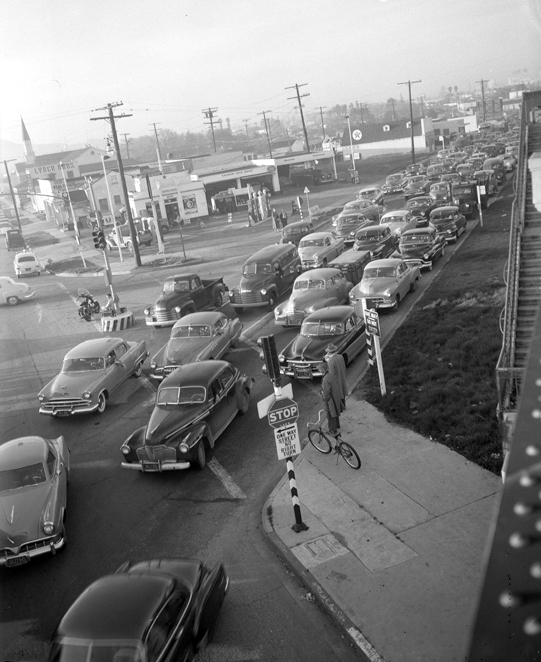
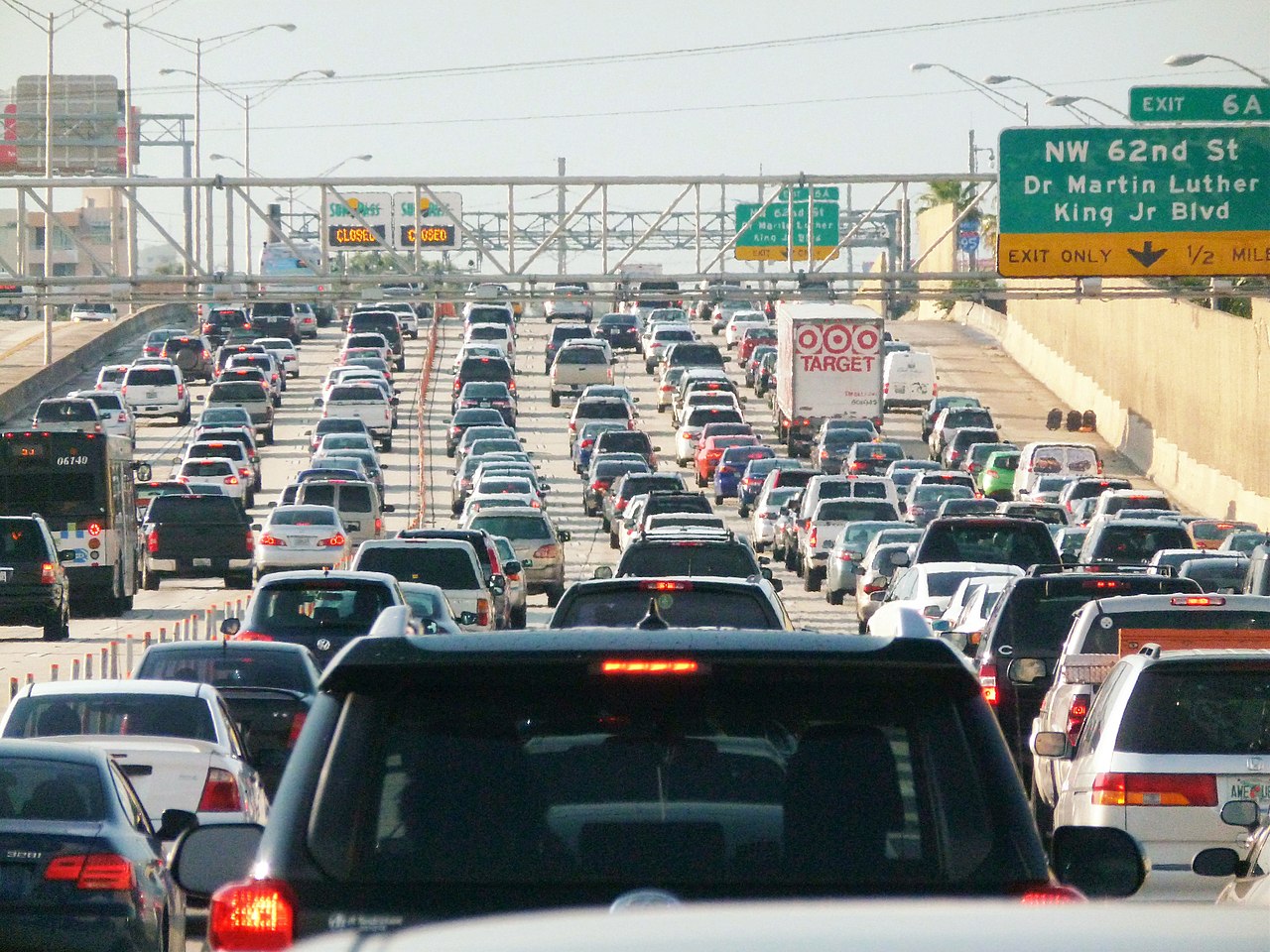
Traffic congestion, often called a traffic jam, arises when the number of vehicles or other road users exceeds the capacity of a roadway, causing speeds to fall and travel times to rise. Congestion increases queueing at intersections and on links, reduces reliability of journeys and can spread spatially and temporally as delays propagate through a network. Traffic congestion may be recurrent — occurring predictably at peak hours — or non‑recurrent, caused by incidents such as collisions, road works or extreme weather.
Image gallery
10 Images





Causes and types
Causes of congestion include both demand factors and capacity constraints. Demand factors are an increase in vehicles from population growth, commuting patterns (for example, morning and evening commuting flows), or temporary surges after events. Capacity constraints arise from physical limitations (narrow roads, insufficient lanes), traffic incidents, poorly timed traffic signals, or lane closures. Two useful distinctions are:
- Recurrent congestion: predictable, related to daily travel peaks.
- Non‑recurrent congestion: unpredictable, due to accidents, breakdowns or short‑term closures.
Impacts
Congestion has multiple economic, environmental and social consequences. It increases fuel consumption and emissions, raises operating costs for freight and transit, reduces productivity through longer commute times, and can aggravate stress and road safety risks. Reliable travel time is often as important to users as speed; congestion reduces predictability, affecting businesses and emergency services.
Management and mitigation
Strategies to reduce congestion range from physical changes to policy and behavioural approaches. Some common tools are:
- Traffic engineering: signal optimization, ramp metering and incident management to restore flow.
- Capacity and demand measures: managed lanes, high‑occupancy vehicle lanes, parking controls and car‑pool incentives.
- Pricing and regulation: congestion charging or fees to discourage single‑occupant trips and curb peak demand; see congestion pricing schemes.
- Travel alternatives: investments in public transport, walking and cycling, and services that operate independently of congestion such as rapid transit.
- Behavioral and technological approaches: telecommuting, staggered work hours, and traffic information systems that help drivers choose less congested routes.
Measurement, modelling and notable facts
Planners measure congestion with indicators such as volume‑to‑capacity ratio, travel time index and delays per vehicle. Models simulate traffic to test interventions. Important concepts include "induced demand," where added road capacity can lead to more driving and a return of congestion, and peak spreading, where some travel shifts to shoulder periods rather than being eliminated. Effective policy usually combines supply, demand and mode choice measures rather than relying on a single fix.
Understanding congestion requires both technical analysis and attention to human behavior: small changes in driver decisions or a single incident may have outsized network effects. Coordinated land use, transport planning and real‑time traffic management are key to reducing the frequency and severity of traffic congestion in urban regions.
Related articles
Author
AlegsaOnline.com Traffic congestion Leandro Alegsa
URL: https://en.alegsaonline.com/art/101037